Use this Weed Eater line hack to load up your fish
It seems here in Louisiana everybody has a hack for something when it comes to fishing. Whether it’s putting super glue on the shank of a jighead or using toothpicks for pegging weights, Louisiana fishermen have turned improvisation into an art form. Over my 50 years of fishing in the Deep South, I’ve heard plenty of Cajun hacks that have helped me catch more fish, but it wasn’t until a fishing trip in the fall of 2022 that I learned that a simple Weed Eater line may be the best fish stringer I’ve ever used.

I discovered the hack on a fishing trip with Capt. Danny Hunter of New Orleans Best Charters. Now, normally I don’t use a stringer for speckled trout, but being an outdoor writer I know the power of a great photo with a stringer full of trout, so I rummaged through my tackle bag in search of my stainless steel clip-style stringer. It wasn’t there. I searched all over the garage but still couldn’t find the stringer. So I grabbed the next best thing — a roll of Weed Eater line. I pulled out about 5 feet of it and used the built-in razor cutter on the package to cut the line. I tucked it in my camera bag and brought it along just in case we caught enough trout to string.
Quick and easy
As the day started, Hunter made his way to the northern shoreline of Lake Borgne where we found a wide trenasse with water pouring out. It didn’t take long to realize that snatching that line was going to turn out to be a good move on my part. Hunter and I were using Marker 54 Shrimp, and after a few stops along the shoreline, we hit our limit of 30 specks just before reaching Bayou Bienvenue.
Now it was time to load the trout onto the line. I fed the first fish on by running the line through the gill and out of the mouth. I tied a loop on the end of the line and brought the other end through it so that the bottom fish served as the stop. As I loaded the other trout onto the line, the process went quicker than I’ve ever experienced. The thin line was just stiff enough to slide through the gills without snagging, unlike what I’ve experienced using nylon stringers. It took me all of 5 minutes to load all 30 fish on the line, and after positioning the boat with the bay and marsh in the background, I went to work. Hunter lifted the loaded stringer into the air and I was able to get the shot I was looking for.
After that trip, I’ve used that same orange Weed Eater line for all of my fishing trips and have captured some of the state’s greatest fishermen holding stringers of fish. Not once has the stringer given me problems. However, I have made one slight adjustment. Instead of using the tied loop on the end of the line, I now use a crimp to clamp a small loop to lock in that first fish.
How to make it
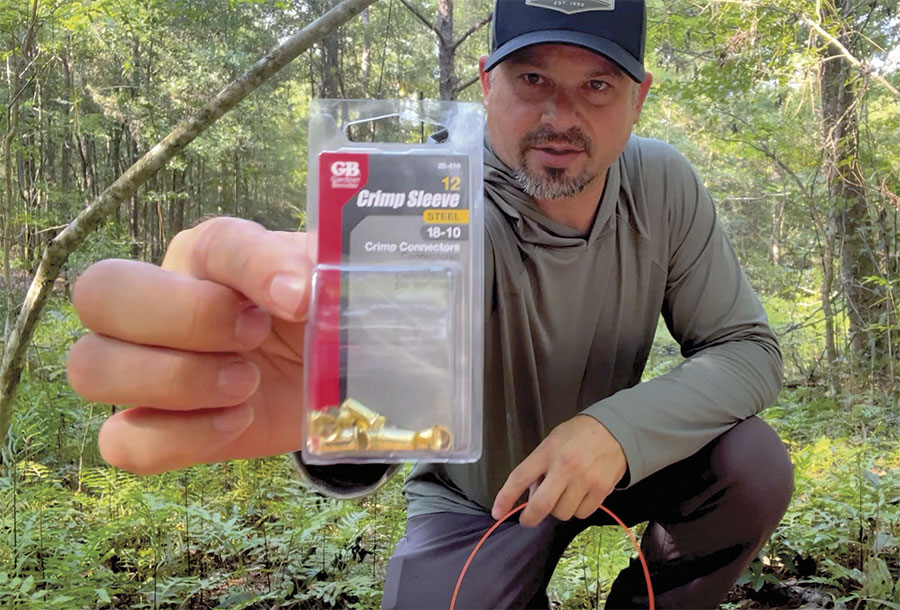
Making your own Weed Eater line stringer is simple and cheap. You’ll probably have all the tools to make it sitting in your garage.
What you’ll need:
- Weed Eater line
- A small crimp or any small piece of metal that can be formed into a small loop
- A pair of pliers
- Wire cutters (or use the built-in cutter on the Weed Eater line package)
Step-by-step assembly
Step 1: Cut about 5 feet of Weed Eater line. This length gives you plenty of room for a good mess of fish while still being manageable.
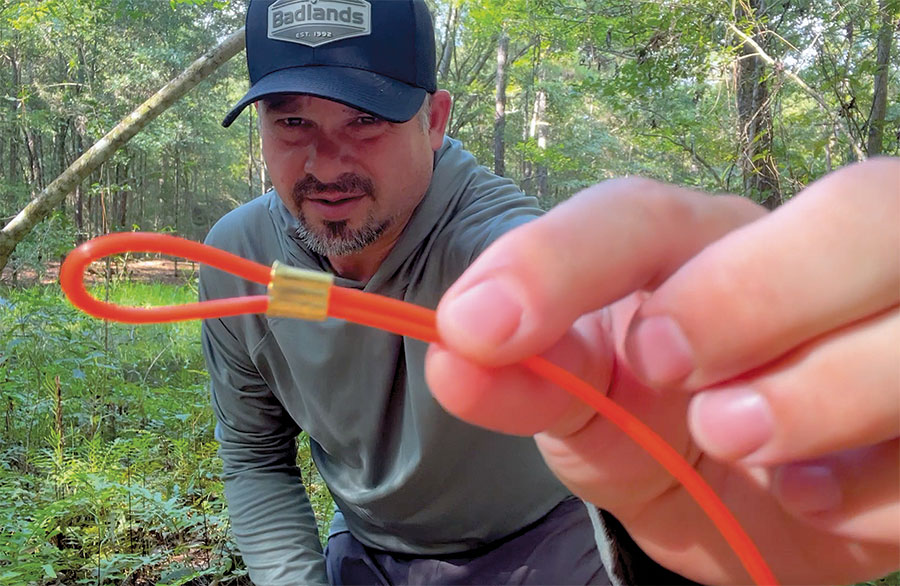
Step 2: At one end of the line, form a small loop about the size of a quarter. This will serve as your stopper to keep the first fish from sliding off.
Step 3: Thread the crimp over both ends of the loop, positioning it right at the base where the loop meets the main line.
Step 4: Using your pliers, squeeze the crimp down tight. Make sure it’s secure as this is what holds everything together.
Step 5: Test your loop by pulling on it. If the crimp holds firm, you’re ready to fish.
Choose round over sharp
On that trip with Hunter, I learned quickly that the type and shape of the line makes a big difference. After we finished taking photos, I noticed Hunter’s hands were bleeding from gripping the loaded stringer. That’s when it hit me: I had grabbed triangle-shaped Weed Eater line instead of the round kind.
Not only does the serrated line cut into your skin, it’s also hard on the fish. The sharp line has the potential to cut the fish’s gills if they’re swimming. Round Weed Eater line, on the other hand, has smooth edges that won’t cut your hands even when you’re gripping a fully loaded stringer. It’s still plenty strong and kinder on both hands and fish. It’s a lesson I learned the hard way, watching Hunter’s hands after our trip was over.
Go big or go home

Weed Eater line comes in a wide range of sizes, from as thin as 0.065 inches all the way up to 0.170 inches in diameter. While any size will work, I recommend staying away from anything in the light category, which is 0.065 to 0.080 inches. While the medium size will work, I’d recommend going as thick as possible. When you’re dealing with saltwater fish like speckled trout, you want a line that can handle the weight without cutting into your hands or the fish.
I always go with the largest diameter available, which is usually 0.105 inches or bigger if I can find it. The thicker line is not only stronger and more durable, but it’s also easier on your hands when you’re carrying a heavy stringer. The thicker diameter also threads through fish gills more smoothly because it has the rigidity to push through without bending or kinking. Trust me, when you’re trying to load 30 specks onto a stringer quickly, that extra stiffness makes all the difference in the world.
After years of using this same piece of orange Weed Eater line, I can honestly say you’ll never have to buy another stringer again. The line is virtually indestructible, and I’ve got the fishing stories to prove it.
That same piece of line has been with me on some of my most memorable trips. It held over 50 bream during a spring trip to White Kitchen, 40 mule trout out of Happy Jack, and 42 Tchefuncte River sac-a-lait, never once showing signs of stress. No fraying, no weak spots, no signs of wear. It just keeps coiling back up into that perfect little bundle, ready for the next load of fish.