Unseen organisms pose great danger to fishermen
In the classic movie “Jaws,” a giant shark ate people along the coast, but a much more dangerous and insidious threat kills one in every five people it encounters.
This threat lurks in Gulf Coast waters and attacks without feeling or warning. No human can see this devastating killer — without a powerful microscope!
Many people call this menace a “flesh-eating virus,” but it’s not a virus. It’s a bacteria, a living single-celled organism called Vibrio Vulnificus. It thrives in Louisiana and Mississippi coastal waters.
“Vibrio Vulnificus is one of the most severe types of infections from this genus of bacteria,” explained Dr. Benjamin Brock, an infectious disease specialist with the University of Mississippi Medical Center in Jackson. “Even with proper treatment, the outcomes are still 20 percent mortality.”
Warm waters
These microscopic creatures live inside algae growing in salty or brackish waters and love warm temperatures. As water warms throughout the summer, algae blooms more profusely. The more algae blooms, the more Vibrio Vulnificus bacteria grows and the more dangerous it becomes to anyone swimming, fishing or boating in Louisiana or Mississippi coastal waters.
People contact these bacteria through open sores or wounds exposed to salt water, making it a serious threat to both commercial and recreational fishermen. People cleaning or handling fish without gloves or who cut a finger, nick themselves with a hook or suffer any other injury could encounter the bacteria even from a perfectly normal fish that appears healthy.
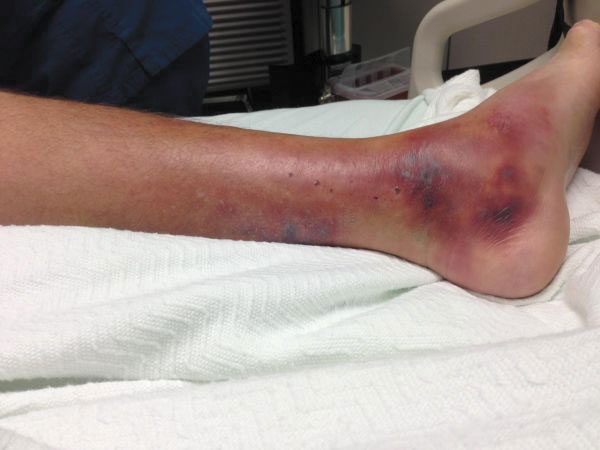 “More than half of the cases are due to water exposure,” the doctor said. “People with open wounds should not let that wound come in contact with salt water, particularly during the summer and especially if the person has a weakened immune system. A person doesn’t necessarily have to go in the water with an obvious open wound to get it. Some cases are due to exposure to the water itself.”
Act quickly
When an individual contracts the disease through an open wound, that person would soon see swelling and redness in the affected area as well as suffer pain and fever. Blood pressure could drop or people could become delirious. If these symptoms occur, get to a hospital immediately. Alert medical personnel about the suspected cause so they know what to treat. Without rapid proper treatment, a person could lose a limb or die.
“If a person just has a scratch on the leg, I don’t think that person necessarily needs to get checked out,” Doctor Brock said. “However, a person who starts developing signs of infection definitely needs to get checked out properly. It’s very important for anybody who gets a skin infection to seek care quickly. The sooner someone gets on antibiotics, the better. It’s rapidly progressive. The skin condition will get worse. Within 12 to 24 hours, it might affect the whole limb. Within 24 to 36 hours, people often have sepsis and organ failure.”
People might also come in contact with this pestilence by eating raw seafood, primarily oysters. Eating undercooked crabs, shrimp and many bony fish can also transmit harmful bacteria to humans.
“The other types of this bacteria are way more common with seafood poisoning,” Doctor Brock said. “With Vibrio Vulnificus, the onset is fairly quick. It primarily affects people with weakened immune systems. People with cirrhosis of the liver, transplants, cancer or on immune-suppressant medicines should avoid eating raw or undercooked fish or shellfish. People who come down with it by consuming food might experience diarrheal illnesses.”
The Centers for Disease Control and Prevention estimates that vibriosis causes 80,000 illnesses each year in the United States. For more information, see www.cdc.gov/vibrio.