Fish are on the move this month, and you should be as well.
Spring has sprung, and that means speckled trout are either on the move to the bigger fringe bays, or they’re already there. The lazy style of winter fishing is over. The close, inside deep holes are practically empty of fish by now, and the longer days of spring have triggered their instinct to head to bigger waters.
“The days of parking at a deep hole five minutes from the dock and fishing slow on the bottom are over for another year,” said Capt. Gene Dugas (985-640-0569), who has been a guide for more than a decade. “Now you’ll have to hustle farther out to the bigger bays and lakes and do some drifting and trolling to fill a box with fish.”
Spring couldn’t have arrived soon enough. I don’t remember any winter as long, as cold and as miserable as the one that just ended. I pity the poor, wretched souls up North who were buried under mountains of snow and ice for months. How can they endure such misery?
I honestly believe I’d curl up into a fetal position and slip into a deep depression if I had to live in such conditions. I’m ready to vote that winter be declared illegal and banned altogether. Like one old salt recently commented, “Gimme some of dat global warming!”
Dugas and I made a recent trip out of his Hopedale dock to see if we could get an early jump on some spring trout. His boat dock is located on Highway 624 just a few miles from the Yscloskey Bridge and straight across from the Dudenhefer Canal.
The long winter took a toll on my stockpile and left me with an empty freezer; I had high hopes to re-stock it. After weeks of persistent winds and low water, a good shift from the east finally put some water back into the marsh, and the weatherman predicted the temperature would touch the 70-degree mark. Even the water temperatures cooperated, climbing out of the 40s and 50s for the first time in forever, and hit 60 degrees. I just knew the trout would be starving, and we’d rake them in like pine needles in the fall.
Dugas pointed the bow of his 25-foot Team Avenger down the Dudenhefer Canal, and the big Optimax outboard hustled us on our way.
“In April, the weather finally starts to warm up, and spring patterns settle in,” Dugas said. “This winter we were pounded by continual cold fronts, without a break in between. Usually after a front blows through, we’ll get a few days of milder temperatures, winds settle down and we get a window of opportunity to fish for a couple days before the next front blows through.
“But not this year. It was one blustery front after another, with no windows in between, and the weather was colder than usual, which interrupted our normal winter trout bite. We just didn’t have a winter trout season this year at all. So, there’s a lot of pent-up desire to get out on the water, and April is the month that generally offers us the first real opportunities to do so.”
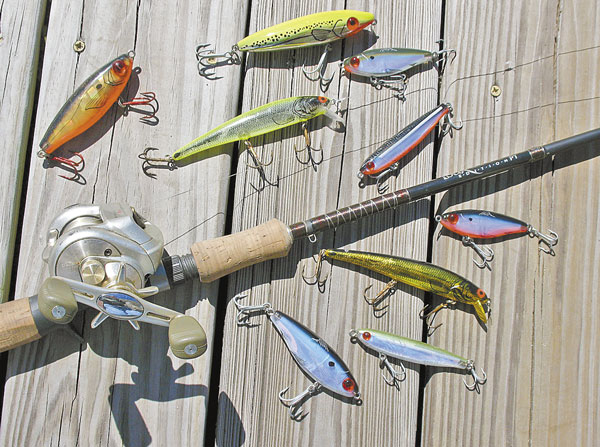
Our first stop was at a big, no-name pond where the marsh drained through to a deeper bayou. I started out tossing a DOA shrimp under a popping cork, while Dugas tossed a MirrOlure Catch 5.
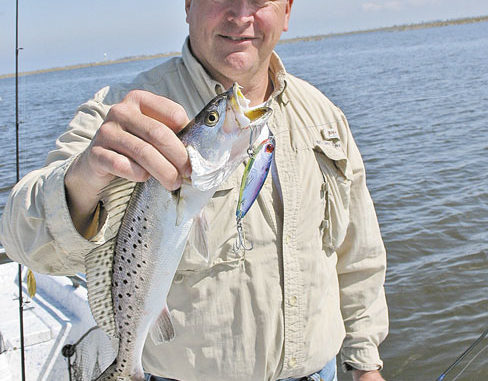
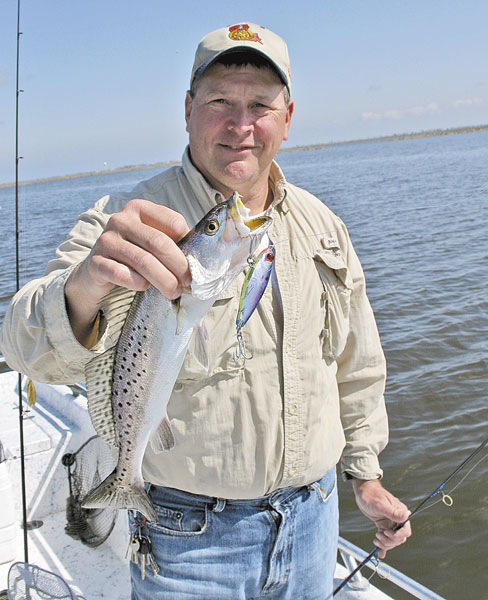
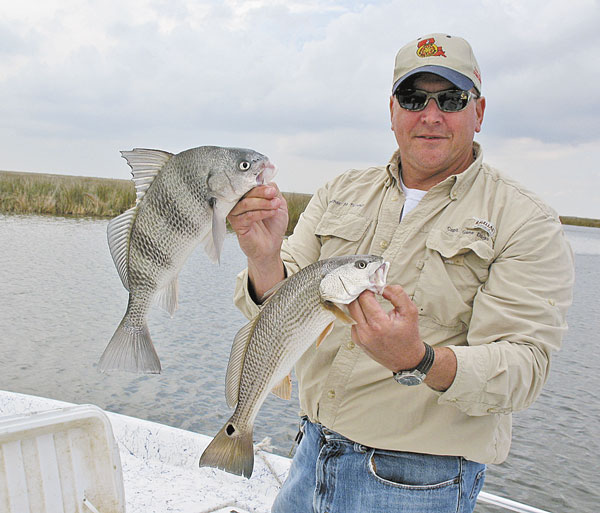
Within four or five minutes, he had the first fish on the line, a nice keeper speck. I was relieved to see the trout show up after the long, cold winter, and hoped this would be the first of many on this beautiful day.
Dugas says the best course of action is to fish over shells this month.
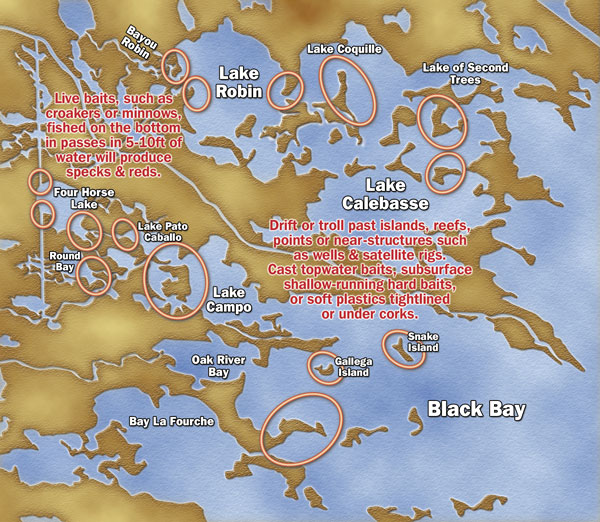
“Head out and fish over oyster reefs or places with a good shell bottom like around the near platforms and satellite rigs in Black Bay, and around islands that have a good shell bank,” he suggested. “Those are the places I’ll focus on this month, and just as soon as you can get live croakers, buy them, because the trout will eat them up over the shells right now.”
Dugas says the major passes that lead from the interior marshes to the outer bays are excellent places to fish this month.
“Four Horse, Oak River, False River, Sister Bayou, Whiskey Bayou, Bay Lafourche — all are good choices,” he said. “On windy days when you can’t get outside, fish the passes and bayous. Drop a live croaker on a sliding-sinker rig to the bottom, and see if you can connect with some hungry trout. If you can’t find live croakers, bring some live minnows along, or fish soft plastics along the bottom, and try under a cork as well.
“But my advice is to head outside any time you get a chance this month. This is a great time to fish all the various islands in the outer bays and the rigs and wells on the north end of Black Bay. Last year we did great in April over around Bay Crabbe, Bay Gardene, Iron Banks and at the islands in Lake Calabasse. Look for shell banks or reefs, look for current lines, look for signs of mullet or baitfish and look for birds. The gulls will start showing up over the shrimp this month, and early in the season like this those birds are often over good-sized trout. Do not pass up birds diving over bait in April.
“I’ll even stop and fish sitting birds if they’re sitting in the passes or at the mouths of bayous this month. If I see gulls sitting on the surface in places like Oak River at Oak River Bay or Bayou Robin at Lake Robin, you’d better believe I’ll stop and cast some baits right there. They’re there for a reason, and if you toss some baits under those birds, you’ll likely find some trout.”
We didn’t get another bite at the big pond, and after spending more time than we probably should have searching for the school, we moved on. And we kept moving on, finding clean water and good current but few fish. We did catch quite a few throwbacks, both reds and specks, but keeper-sized trout were as hard to find as evidence of global warming.
So we kept trolling or drifting, just knowing that the next cast would produce results.
Dugas’ favorite thing to do this month is to drift and troll around the islands and the close-in rigs and wells.
“At the islands, I like to toss topwater baits early, especially if I see mullet,” he said. “Right now, the trout and reds will be hanging near those schools of mullet because they are the primary food source in the water. A topwater bait walked across the surface resembles an injured mullet that’s floundering on the surface, and that is just too enticing for a predator to pass up. They’ll smack those topwater baits with some real authority this month.
“I’ll stay with the topwater bait for as long as possible, and when that plays out, I’ll switch to a shallow-running subsurface hard bait, like the MirrOlure Catch 5 or the new MirrOdines. Any hard bait that looks like a mullet should work.
“Try different colors. Let everybody experiment with different colors and different retrieve speeds until you find out what they’ll hit. They can be finicky this month, so don’t just throw one color and give up if you don’t get a hit. Change colors and speeds, and try soft plastics too, both under a cork and tightlined. You have to try everything.
“If you are in a good place with good water and good current and baitfish, work it over thoroughly before you move on. Otherwise, you’re probably passing up fish.
“But at the same time, April is a hustle month, so you can’t afford to camp out at a non-productive spot. If you’ve worked an area over, and you’ve trolled around it and given each side a chance to produce, move on if you’re not catching fish. And keep moving on until you bump into them. The fish are out there, but it’s up to you to find them.”
Dugas says this time of year it’s usually better and more productive to drift or troll rather than to anchor.
“The exception to this general rule is fishing the passes with live bait,” he said. “If I’ve got some live croakers, I’ll stick my Power Pole or Cajun anchor down so I can cast and fish under a sliding sinker over a shell bottom. Or if I’m fishing a rig or well and want to give a known spot a chance to produce, I might stick the pole down, especially if using live bait.
“But those are the exceptions. Generally, you want to drift or troll this month, which will nine times out of 10, be more effective. The old expression, ‘putting the anchor down is like putting poison down,’ usually holds true this month.
“I believe the key is to get outside as often as you can this month. Get to the outside fringe bays, and to Black Bay, and fish all the near wells and rigs, and the points, reefs and islands. I recommend you kill the motor upcurrent, just drift past the area and fish it with your topwaters or hard baits, or plastics under a cork. Usually, even if I start catching fish, I’ll keep drifting, and only when I’m well away from that strike zone will I start up the motor and go back and drift that area again.
“I’ll try not to anchor at all, unless there are other boats around. Then you’ll have to anchor because if they see you catching fish in a spot and you drift out of it, they’ll move there and park on it. Trolling around an area with your trolling motor is very effective also, because it allows you to fish all sides of the structure.
“Another key is, you don’t want to run way out into Black Bay or Breton Sound this month. Usually the better bite is the north side at any of the dozens of small structures. Any of them could hold some good fish. You might catch three or four fish in a drift, or you might catch less, or more. You might only catch a couple fish at a stop, and you’ll have to move on. But if you keep following that same technique, you’ll end the day with a good box of fish.
“Then, later on as the summer arrives, you’ll want to head farther out into Black Bay or Breton Sound to get on the big trout. But right now, you’ll do better along the fringes.
“If you’ll hustle, you’ll come home with a smile.”
Capt. Gene Dugas can be reached at (985) 640-0569.