Louisiana’s newest wildlife management area is Coochie Brake.
Louisiana Wildlife and Fisheries Commission (LWFC) members unanimously passed a resolution dedicating the 1,894-acre property in Winn Parish to the state’s WMA system.
LDWF officials described the area as “fascinating” with a rich history.
Trevor Fry, from the Grant Parish Proud Facebook page, wrote that the site has “intrigued generations with its legends of curses and bandits.”
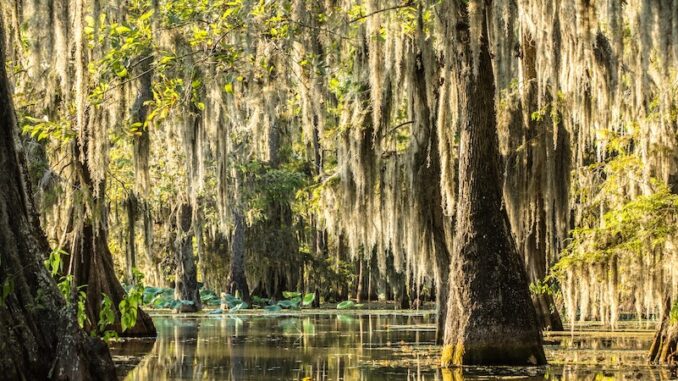
Located at the headwaters of Nantachie Creek, the swamp is steeped in stories of Spanish gold, Nightrider’s lost treasure, and the world’s largest tupelo gum tree. Local lore even claims that compass needles fail to work properly here, spinning in circles.
Some speculate that this low-lying swamp—surrounded by high ground and a series of sandstone ridges—was created by an earthquake or a meteorite crash. According to local legend, the meteorite was a fragment of the massive asteroid that wiped out the dinosaurs at the end of the Cretaceous Period. Some even claim its radioactive properties cause the region’s strange anomalies.
However, LSU Professor Paul Heinrich of the Louisiana Geological Survey provided a scientific account of the wetland’s origins:
“Coochie Brake directly overlies the Coochie Brake salt dome. Geologic studies conducted in this area by oil companies generally show that the strata surrounding and overlying this salt dome were initially pushed up by the salt dome, forming the outcrops around Coochie Brake. Later, the dissolution of the salt caused the center of the salt dome and overlying strata to collapse, forming a very large depression occupied directly by Coochie Brake.”
Hunting at Coochie Brake
Public hunting will be permitted at Coochie Brake WMA this year, and officials are considering installing a kayak launch.
Hunting seasons at the new WMA will include archery-only deer hunting, rabbit hunting with beagles, squirrel hunting with dogs (Feb. 1–28), and nighttime raccoon hunting (Feb. 1–28). Turkey hunting will not be allowed.
According to Rhett Desselle, an LDWF land specialist, Coochie Brake WMA was established through a cooperative endeavor agreement with Louisiana State Parks. The agreement aims to protect wildlife, conserve and manage wetland habitats, and provide public recreation. The WMA is not adjacent to any other state-owned land.
LDWF will use federal grant funds to operate the WMA, matching those funds with money from the Wildlife Natural Heritage Fund and the Conservation Fund.
Projects completed at White Lake WCA
In other news, Lance Ardoin, LDWF biologist manager, provided commissioners with an update on the White Lake Wetlands Conservation Area.
Between 2022 and 2024, several infrastructure projects were completed: a new water control structure was added for $650,000, a pump engine was upgraded for $200,000, a levee breach was repaired for $533,000, and hurricane-damaged roofs were repaired using FEMA funds.
According to Ardoin, a guillotine gate was replaced in 2024 for $400,000, and the LDWF foreman’s house was fully renovated for $189,000 in 2025. This year, the bulkhead at the Florence skeet range was replaced for $35,000.
Additional improvements are planned for the area, including further levee repairs and control structure upgrades.
Changes to menhaden reporting requirements
Meanwhile, commissioners passed a Notice of Intent (NOI) to remove length measurement requirements from commercial menhaden reporting.
The NOI proposes removing the requirement to collect menhaden length measurements from each set. If passed, the modification will adjust the confidentiality provisions of LDWF annual reporting based on the statute.
The NOI will be published in the Sept. 20 State Register, with public comments accepted until 3 p.m. on Oct. 26. If no amendments or oversight hearings arise, it could be finalized by Dec. 20.