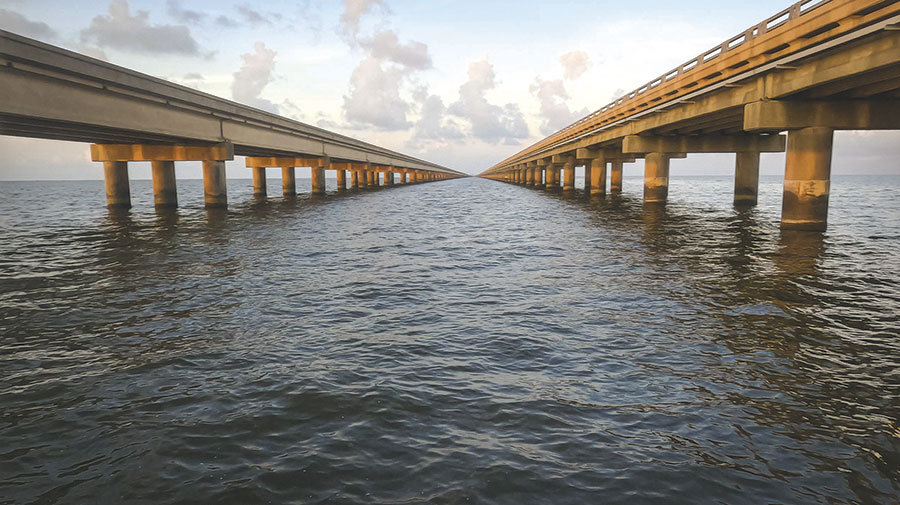
What happens when 24 miles of barnacle-crusted concrete meet 630 square miles of brackish water? Pure magic! After years of waiting, the Lake Pontchartrain Causeway is serving up that perfect combination once again, and anglers are returning to the bridge to experience the resurgence back to what the bridge used to be.
Joey Gauthier of Mandeville has been fishing the Causeway his entire life and has seen the ebb and flow of speckled trout production at the 24-mile reef.
“I remember back when they were dredging a lot, and there was nothing there,” he said. “Then, they stopped the dredging, and it got really good.”
So good that the Causeway was known as a trophy trout destination in Southeast Louisiana. But as most estuaries go, things change, and the speckled trout production
at the bridge all but dried up during the record four spillway openings from 2016 to 2020.
September setup
In September, Gauthier likes to jig the bottom using plastics, a strategy that serves multiple purposes.
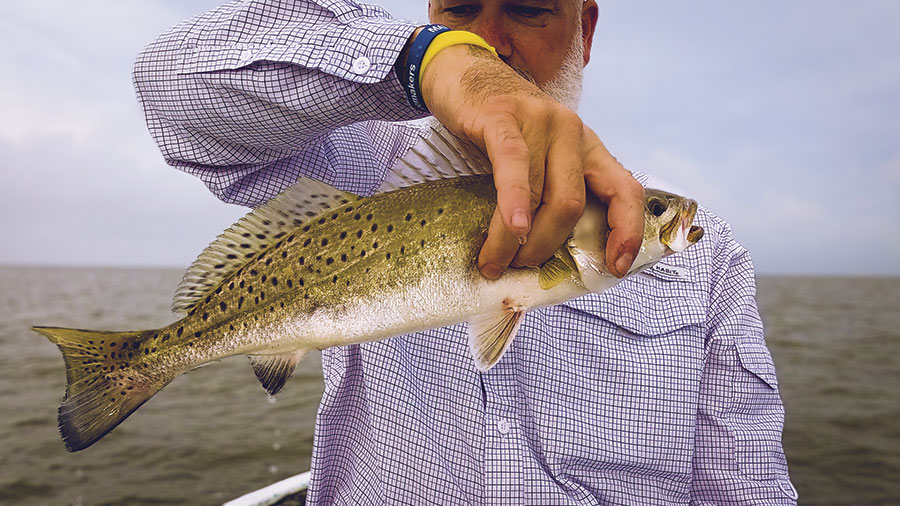
“Artificial is going to filter out a lot of the trash fish under the bridge,” he said. “Anything will bite live bait, but not everything will eat plastic.”
While live shrimp can produce sheepshead around the pilings, Gauthier said most anglers make the trek for one reason: “Big trout.”
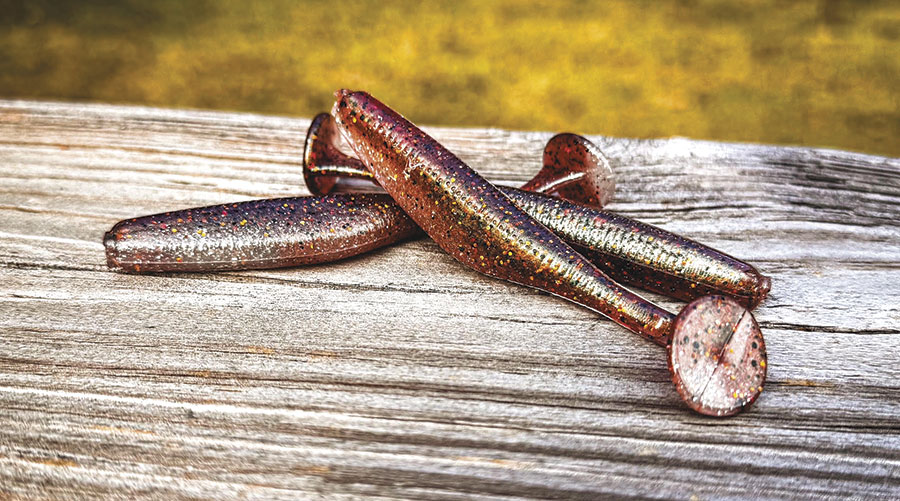
Gauthier’s plastic of choice is a 3.8-inch Storm Minnow made by Lost Coast Baits.
“I like the mullet or cocahoe color, anything that’s got a darker contrast to it,” he said. “I try to stay away from anything flashy or really translucent.”
Gauthier threads the Storm Minnow onto a 3/8 or ½-ounce unpainted jighead, with weight selection depending on tidal flow.
“The weight all depends on how hard the tide is pushing under the bridge,” he said.
Rod selection is equally important for Causeway success. Gauthier uses a 7-foot medium-heavy/fast action baitcast rod, explaining the need for specific characteristics: “I like a stiff, sensitive rod with enough backbone to move the fish away from the pilings.”
Line choice rounds out his setup. Gauthier prefers 12-pound fluorocarbon for a simple reason. It gets down to where the fish are.
“When I’m fishing the bridge, I typically load up with 12-pound fluorocarbon just to make sure the bait gets down there,” he said. “If you ball up a handful of mono and a handful of fluoro, you’ll see that the fluoro sinks.”
The art of the drop
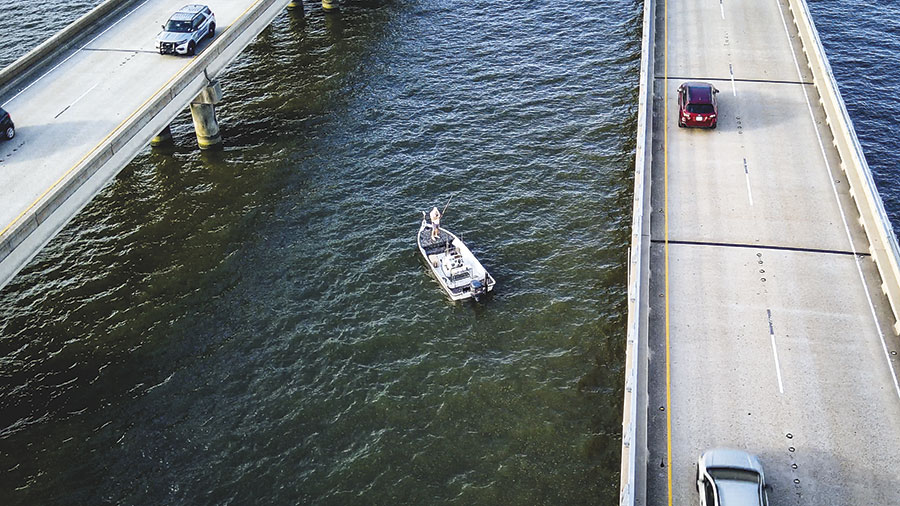
While the bridge can produce big trout, it has been known to frustrate anglers who tangle with it. Gauthier describes his relationship with the Causeway as “consistently inconstant.”
“You can be out there for several hours during the morning, and for some reason, the fish just turn on,” he said. “Nine times out of 10, the fish are there, you just have to be disciplined enough to try different things and use the process of elimination to find what’s working.”
While the Pontchartrain Pop is a popular method of jigging the bridges of Lake Pontchartrain, Gauthier said trying different retrieves is very important at the Causeway.
“A lot of guys will just rely on that up and down twitch, and sometimes the fish don’t want it twitched straight up and down aggressively,” he said. “Sometimes they like it when it’s drug on the bottom, when it makes a little mud come up.”
Gauthier stresses that it’s important to get that bait down to the bottom.
“Some guys will make the mistake of letting the bait fall with the rod tip up, and the bait is falling towards you like it’s on a pendulum,” he said. “If you watch the guys who are the best at jigging the bridge, they’ll jig and drop their rod tip towards the water so that the jig falls on a slack line. So it’s falling more vertically than it is swinging into you horizontally.”
Key in on the pattern
Another no-no is fishing with corks. Gauthier said he’s seen guys waste a lot of time fishing the top of the water column.
“Unless you’re using a sliding cork, you’re wasting your time out there,” he said. “You’ve got to get down to the bottom at the bridge.”
Gauthier’s approach to the Causeway requires patience and adaptability above all else.
“You can’t give up on these fish until you’ve changed lure color, changed boat position, and tried dragging the lure,” he said.
It’s for this reason that Gauthier believes anglers who can catch trout consistently at the Causeway are some of the best fishermen in Louisiana.
“I think bass fishermen key in on the patterns way better than saltwater fishermen do,” he said. “You see these guys that are really good bass fishermen — they know exactly where that bait was when that fish hit — it was on the down-current, right-hand side of the piling, on the row of three pilings. If you try to figure out the pattern, one will show itself.”
When to go
Gauthier fishes out of a 21-foot Kenner and launches out of Mandeville Harbor.
“If it’s decently calm with a slight chop, it will take me about 12 minutes to get to the bridge,” he said.
As far as wind is concerned, Lake Pontchartrain can churn up and make fishing awfully difficult.
“I’m 57 and my body can’t take the beating that it used to take, so if I see anything over 12 knots, that’s where I draw the line,” he said. “Keep in mind that the weatherman is always wrong, so if the winds are forecasted to be blowing 8-10, well, you can best believe it’s going to be blowing 15-18.”
As far as direction is concerned, Gauthier prefers a north or south wind because it helps him operate his boat up and down the bridge. He warns against fishing the bridge on days with a west wind.
“Like most places, a west wind is going to muddy up everything,” he said. “The perfect wind is 5 mph out of the north with a good falling tide. If I can get a wind that moves my boat up and down the bridge without me having to get on the trolling motor all morning.”
As September progresses, cool fronts are a possibility. Gauthier said a falling barometer is always helpful so fishing before a front will help.
Another key to catching trout at the Causeway is keeping an eye on the moon phases.
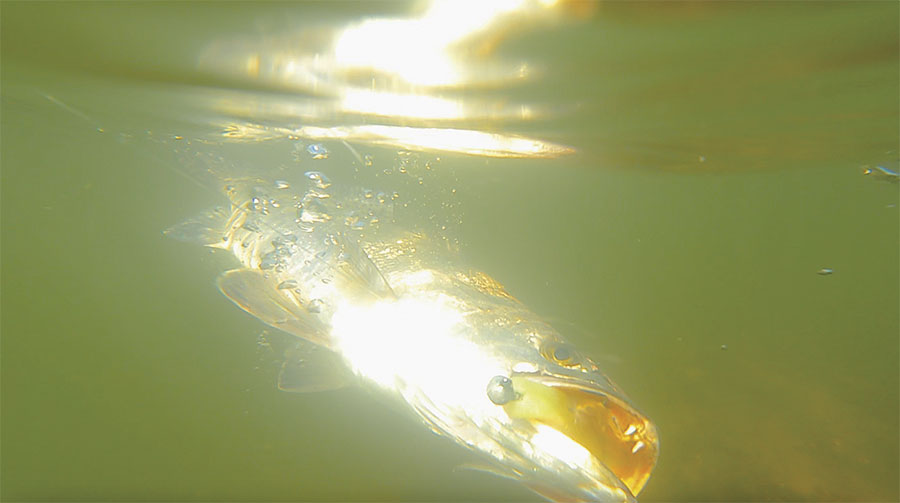
“A lot of people don’t pay attention to the solunar table, but I’m telling you, there’s something to it,” he said. “If you can fish before the full moon, that’s going to help.”
Where to start?
With 24 miles of concrete to fish, it can be tough choosing a spot. Gauthier likes to start close to the Northshore.
“I’ll usually start on the south side of the bridge at the 4-mile hump,” he said.
For those familiar with the Causeway, you’ve seen what looks like sheds on legs that appear every few miles. These are utility sheds, and Gauthier never passes up the opportunity to fish them.
“We call them deer stands, so I’ll start at the first deer stand at the 4-mile hump,” he said.
While most anglers fish the outside of the north and south bridges, Gauthier recommends changing things up a bit.
“Everybody knows the pattern — you fish down current from the bridge legs — but what a lot of people don’t do is fish the middle,” he said. “I see a lot of guys fishing the outside of the bridges, but a lot of people forget about the middle of the bridges.”
As the cold fronts start to pass through and the water temperatures cool, the speckled trout bite at the bridge will improve. Come hunting season, you’ll have two options: kill a whitetail from a deer stand in the woods, or haul in a mule under a ‘deer stand’ at the Causeway.