There is no more exciting way for a kayaker to catch a trout than on a topwater lure
The April full moon generally kicks off the speckled trout spawn and some great topwater action. This year’s moon came early on April 1. With a couple cool fronts still hitting the state, the action was a bit slower. However, May will see two full moons on the 1st and on the 31st. Both are poised to provide fantastic big trout fishing. From the couple days before the full moon, through and until a few days after, the big girls are hungry, active, and there is no better way to catch them than with a topwater lure.
One of the big advantages of kayak fishing is the stealth factor. When making a quiet approach with less water disturbance, you can literally get right in the middle of fish without spooking them. Locating schools of baitfish is a key to fantastic topwater catches. Mullets travel in huge schools and are easily identified as their noses protrude from the water as the pods move along — typically following a shoreline or rock jetty. Menhaden (pogies) also travel in schools and are identified by seeing them flipping their tails at the surface, as well as a clicking sound that is audible when you get close. In addition to baitfish schools, keep an eye out for jumping shrimp. They are often being pursued, and casting close to the action can spur a strike.
These baitfish schools are often shadowed by big trout hanging on the edges of or underneath the bait. It is somewhat amazing that a trout picks out your lure rather than one of the thousands of live bait. Slowly and silently approach the schools until you are close enough for a long cast. If they are moving in a defined direction, get ahead of the school and let them swim to you. I like to cast as far as I can to keep from spooking the bait. Cast anywhere in or near the bait and get ready for an explosion.
Walk the dog
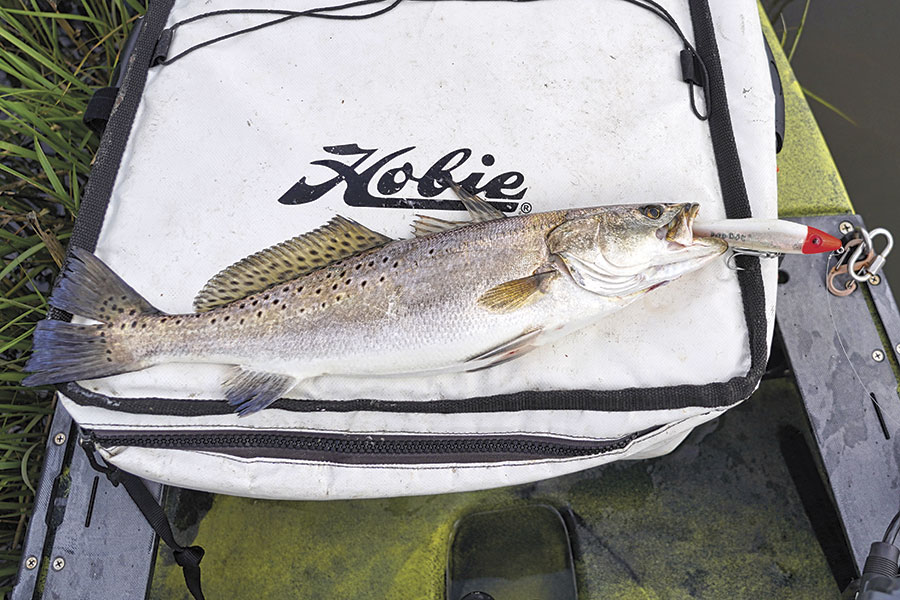
Topwater lures come in a wide variety of styles, sizes and colors. While colors are a personal preference, note that the bottom color is most important, as that is mainly what the fish sees from underneath. While lures that wake on the surface or have cupped faces for chugging and splashing certainly produce fish, “walk the dog” style lures that zig-zag across the surface are hard to beat. Learning the walking technique takes a little practice, but once learned, it becomes second nature. It is quite easy to produce various cadences with simple twitches of the rod tip in conjunction with simultaneously reeling in the slack.
This technique can be done sitting in the kayak or standing if your yak is super stable and you have good balance. However, I personally prefer sitting, as it is most stable and you are at deck level when you need to grab your net without having to transition from standing to sitting. One tip is to use rods without long handles, as it is easier to cast and work without the rod butt hitting your legs or stomach.
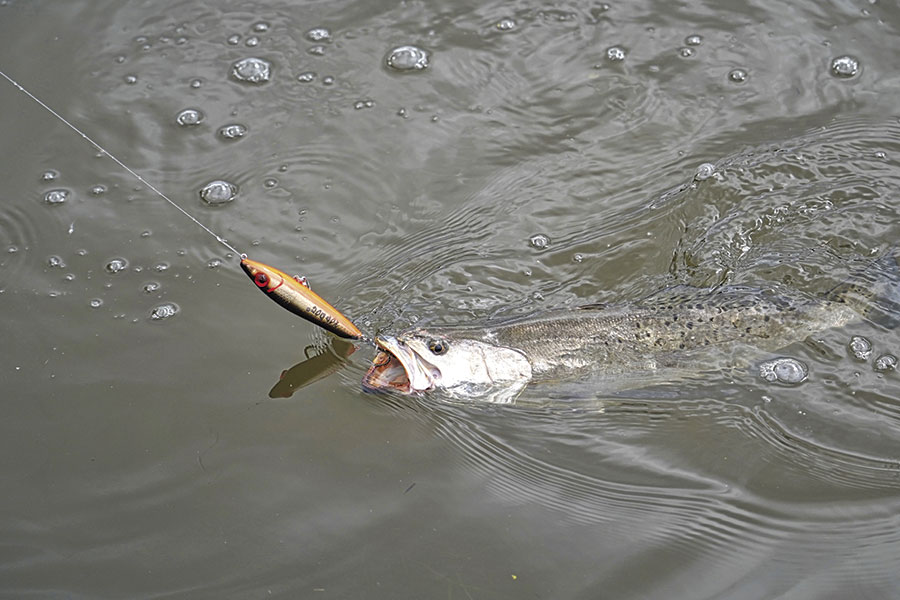
There is nothing quite as exciting as a topwater strike. The water boils and oftentimes you’ll see part of the fish come out of the water. Of course, the thrill of the hit often causes an instant hookset reaction that may result in missing a fish. This is usually due to reaction setting the hook too early. Patience is the key. Waiting an extra second or two until you feel the weight of the fish on your line helps ensure solid hook-ups.
A well-known guide advises anglers new to topwater to close their eyes while working the lure. Without the visual stimulus of seeing the strike, you get better at training for the slight hookset delay until you feel the fish.
If you miss a fish
While most topwater lures sport three treble hooks, somehow, fish often fail to get hooked on the initial strike. When this occurs, there are two techniques that help induce a follow-up strike or even another nearby trout to hit. Either can be successful, and you’ll just have to figure out which one works best on any given day. If you miss a fish, do nothing. Resist the urge to move the lure, and if you do anything, just twitch the lure in place. The fish may think it is injured from the strike and come back for a second bite. The other technique is to quickly start the dog walking again to portray a fish that had a close call and is now trying to flee. Either way, you often get lucky and get a second (or even third) chance to connect.
Topwater lures in the close confines of a kayak can be dangerous. When attached to a thrashing fish, those multi-treble hooks can find their way into your finger, arm, or leg. The safest procedure is to land the fish in a net and then get control with a lip-grip. The grip helps steady the fish while safely removing the hook(s).
Braid or mono lines work well with topwater lures, but if braid is used, a length of mono or flouro leader should be added. This provides a bit of stretch to act as a shock absorber to keep from ripping the hooks out of the fish’s mouth — especially trout. A simple uni-to-uni knot works well for line to leader connection.
Kayak anglers that do not use topwater lures are missing out on some of the most exciting ‘yak fishing there is. This time of year is prime, and while you can get a bite any time of the day, early mornings and late evenings prove best. Put together a small box with a few different sizes and colors of topwater lures and you are ready to get in on some great trout action. You will be hooked.