Marshes dominate much of the eastern and southern shorelines of Calcasieu Lake, known locally as Big Lake. Several bayous flow into the lake from these marshes, but weirs block most streams flowing through this area, separating the marshes from the lake.
The East Cove Unit of Cameron Prairie National Wildlife Refuge preserves nearly 15,000 acres of brackish to intermediate marsh in this area. Only accessible by boat at times, these and adjacent marshes provide rich nursery grounds for shrimp, crabs, small fish and many other creatures. Juvenile redfish grow up in these marshes before heading offshore.
The weirs exist to control salinity levels and prevent saltwater intrusion into these wetlands. Anglers can fish the lake side of the weirs all year long, but the weirs prevent boat access during waterfowl season and close periodically when salinity levels rise too high.
“On the East Cove Unit of Cameron Prairie NWR, boat access is open all year long, except during the Louisiana West Zone waterfowl season,” said Allie Mulligan, the manager for the combined Sabine and Cameron Prairie NWRs. “Fishing and crabbing from a boat are permitted year-round except during the waterfowl season or when Grand Bayou boat bay is closed.”
To get to these fertile fishing grounds, when accessible, small boats can only pass through the water control structure at Grand Bayou when the 10-foot-wide boat bay opens. Larger or tall boats cannot fit through it.
“At times, passing through the boat bay is treacherous, even for a licensed professional guide like me who has been fishing the area forever,” said Kevin Broussard with Cajun Paradise Charters (337-274-0788, cajunparadisecharters.com) in Hackberry. “Sometimes, we see a two-foot difference in water levels between the lake and the marshes. I’ve seen many trolling motors and windshields get damaged. Often, people forget to take their rods out of holders and they snap.”
Less fishing pressure
Big Lake and the rest of the Calcasieu Estuary endure enormous pressure all year long. However, with limited access, these marshes beyond the weirs receive considerably less fishing pressure. On this day, we passed through behind a weir while people in nearby boats threw nets for shrimp.
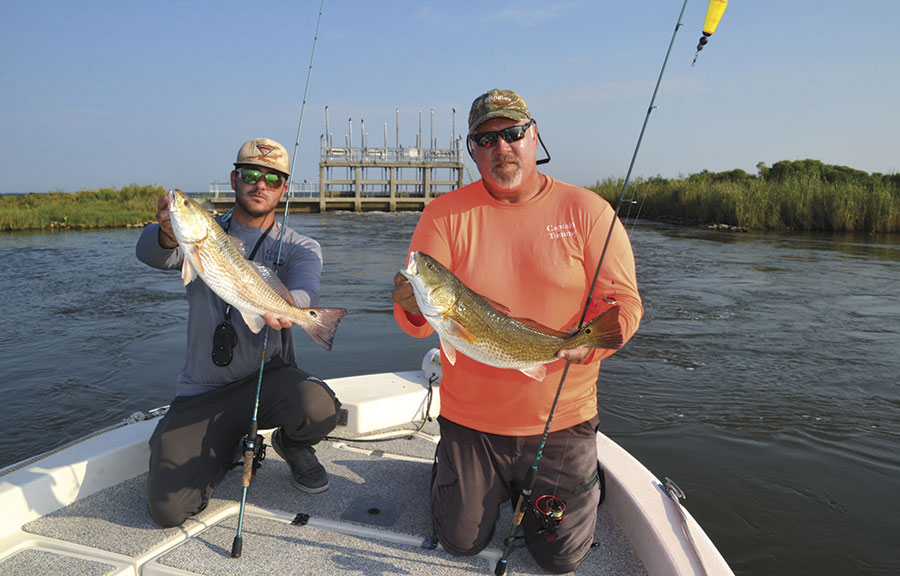
“I like to fish near people casting nets for shrimp,” said Tommy Adams of Fishing Tom Guide Service (318-675-9114, FishingTom.net) in Sulphur. “Where shrimp are is where fish want to be.”
During a powerful incoming tide this day, churning water rushed through the gates, carrying shrimp, crabs, small fish and other morsels. Big redfish commonly congregate on the downstream side of the weirs waiting to snatch anything flowing to them. In the roiling white and green maelstrom coming through the gates, silvery baitfish flickered.
Black double-crested cormorants dove to catch shad. Just above the tumult, various seagulls and terns hovered, waiting to snatch anything they considered delicious. Preferring bigger prey like mullets, pelicans periodically dove into the fray to gulp a meal. Adams maneuvered his boat in the powerful current while Hayden Hoffpauir threw a cast net for fresh squirming finger mullets for the livewell.
“That’s what I wanted,” Hoffpauir said, “finger mullets about 3 to 8 inches long!”
Hoffpauir fashioned his “weir rig.” He tied a sinker onto a drop-line, using a weight only as big as necessary to hold the bait near the bottom. He rigged another drop-line for the mullet so it stayed slightly above the sinker. When hooked through the nose and out its nostril, a finger mullet could swim somewhat naturally, making an irresistible temptation for big redfish holding at the edge of the raging current.
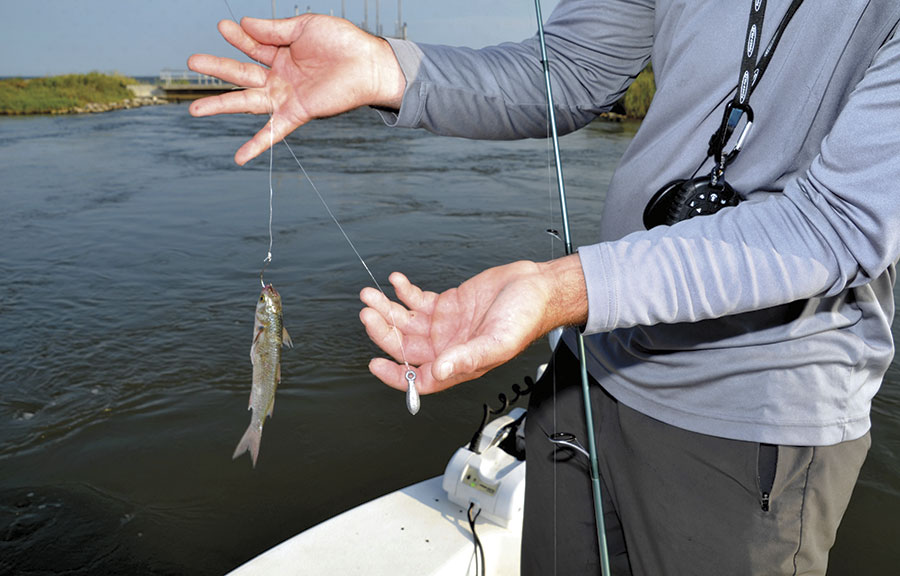
“Toss the bait as close to the weir as possible,” Hoffpauir instructed. “Try to put it right where the current creates a small seam so the water flows slightly calmer. That’s where big redfish hold.”
Adams drove his boat just off to one side out of the major flow and put his trolling motor on spot-lock. We each cast toward the weir. Almost as soon as the bait touched water, our rods bent over with massive spot-tails that inhaled our mullets.
“When three people each get hooked up with bull redfish at the same time, with fish going in all different directions, we must dance and weave out of each other’s way,” Adams said. “That gets exciting!”
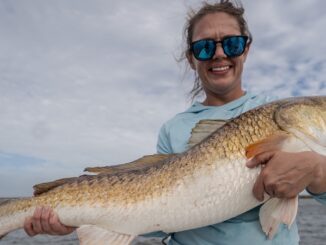
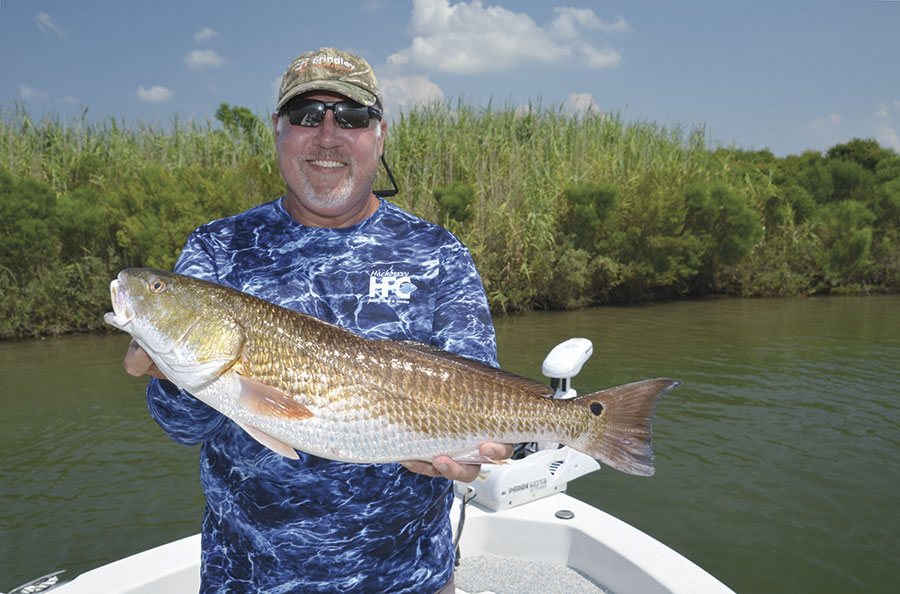
It took longer to fight and land our fish than it did for redfish to take the bait. Quickly, we filled our limits of slot reds. Our biggest problem, culling through all the redfish that exceeded 27 inches!
Outstanding habitat
Broussard grew up fishing these marshes and the lake with his father, the late Cajun Phil. He used to run an aluminum boat with a 25-horsepower outboard from Hackberry across the lake to fish the marshes before the weirs existed. He’s been guiding on the lake since 1985.
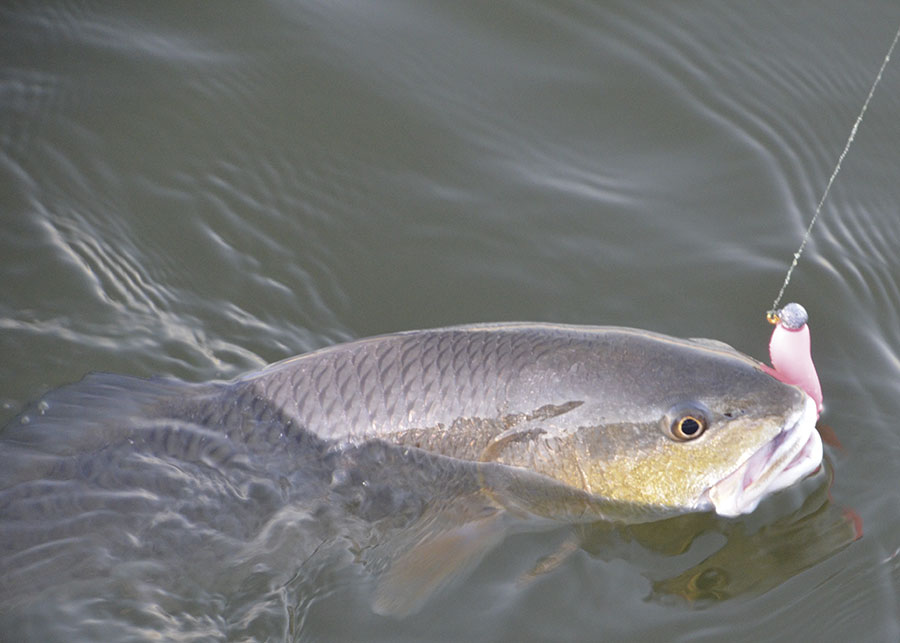
“For many years, the area behind the weirs has been a very special place to me with great memories,” Broussard said. “Back then, it was all natural bayous that came off the lake. The redfish action was phenomenal. We could anchor at any point or pocket, throw a dead shrimp under a cork and catch all the redfish we wanted. Back then, we could catch bass, blue catfish, redfish, trout and flounder in the same area. I have not caught a black bass back in that marsh since the hurricanes hit in 2020.”
Those marshes still provide outstanding habitat, reminiscent of the vast marshes stretching across the southeastern part of the state. Several bayous still flow through the system and connect to numerous small lakes and ponds, most about 1 to 3 feet deep. These marshes and shallow lakes hold abundant redfish and flounder, but anglers can also catch black drum, sheepshead, speckled trout and other fish in those wetlands.
“In March 2026, I went to my favorite spot and caught more than 40 trout, redfish and flounder,” Broussard said. “These marshes are a fishing paradise! That’s where all the shrimp, crabs and baitfish go to grow.”
Most bayous average about 6 to 8 feet deep, but some holes plunge to 18 to 20 feet deep. Bigger trout and black drum usually lurk in those deeper holes in the bayous. Redfish drop in those holes during temperature extremes. With limited access, these marshes receive far less pressure than Big Lake.
“We’re lucky and very blessed to have an estuary and fishery where people can catch various fish species,” Broussard said. “All those weirs have fish around them when the water moves. With the water constricted, tons of bait move through when the gates open.”
Top baits for redfish
Anglers can catch redfish and other species by all the typical methods. In May, many people throw topwater baits for redfish. For an adrenaline rush, few experiences in inland waters come close to the savagery of big redfish smashing topwater baits in shallow water. When a redfish explodes on a floating lure, it resembles someone throwing dynamite into the water.
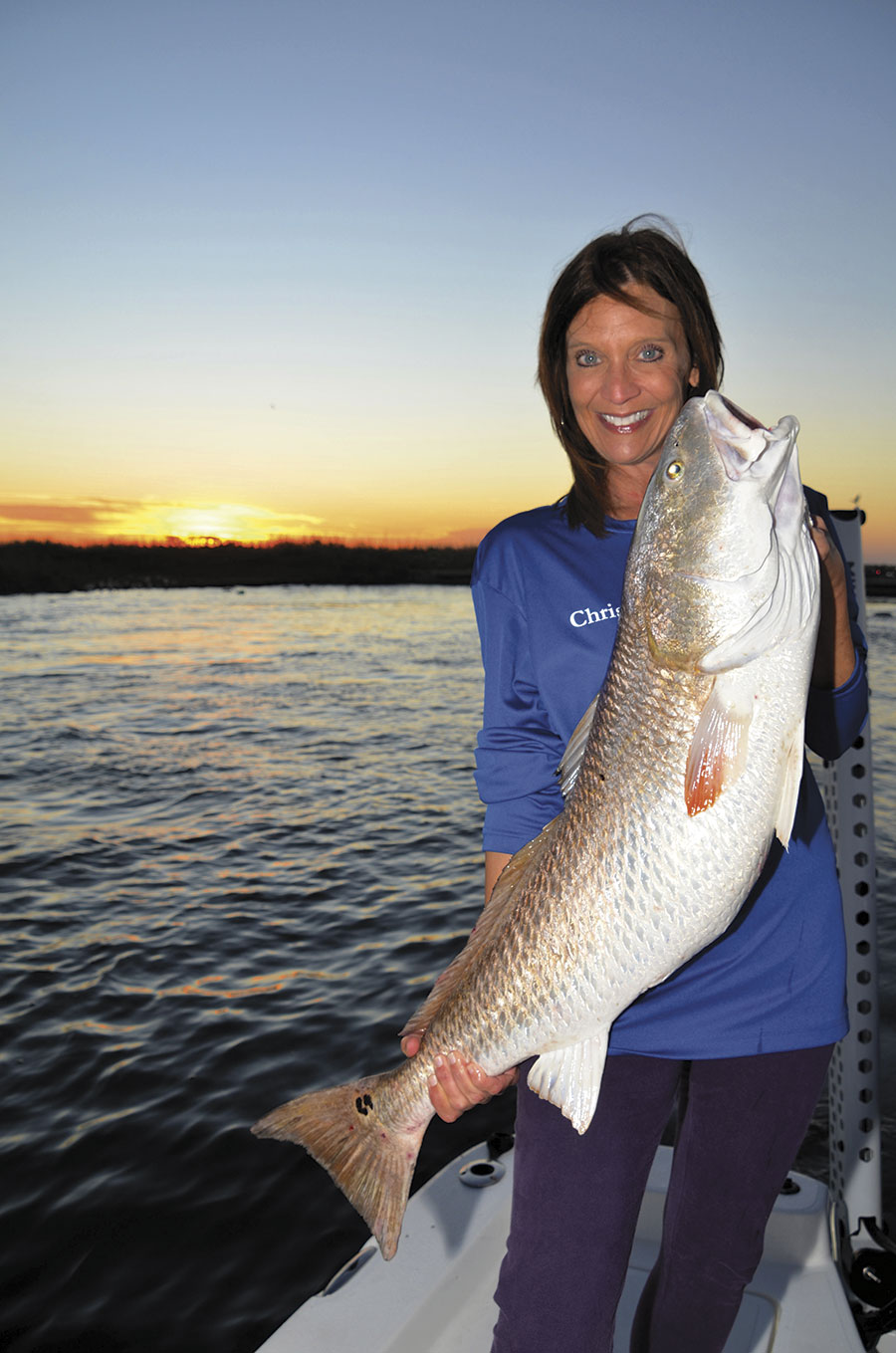
“May is a very good time to fish those wetlands,” Broussard said. “At that time, redfish start showing up back in the shallow marshes. For people who like to throw topwater baits for redfish, May is a great time to fish the marshes. We’ll see redfish all over the place in May. The spring flounder run mostly ended by May, but people might catch a few flounder in the marshes. In May, people also catch lots of black drum and sheepshead on shrimp.”
Big spot-tailed marsh marauders cruise weedy shorelines and prowl the shallows looking for shrimp, crabs or other morsels to devour. Redfish love mullets, which frequently thrust their heads above water to feed on plankton. Hefty walking baits sail long distances and enticingly zigzag across the surface imitating mullets. Hot colors for spring redfish include bone, clear, red and white, green and silver or black and silver.
“For redfish, we usually fish a live shrimp or a Gulp! Shrimp under a popping cork,” Broussard said. “In the summer, we see redfish schools working in 1 to 3 feet of water. Watch for birds working. May is also a good time to catch trout in those marshes. If the gates are open so the water can flow naturally, trout action can be very good in May. For the bigger trout, we fish light jigheads with soft-plastic trailers or live bait. My personal biggest trout from back there in 2025 weighed 8.75 pounds. We put 20 trout weighing more than five pounds into my boat from those marshes just in 2025.”
Levees and dredge spoil filled in many small ponds and lakes, all part of a massive marsh restoration project. However, people can still find numerous redfish honey holes in these wetlands.
“The East Cove Unit is part of a 64,000-acre marsh restoration program known as the Cameron Creole Watershed Project,” Mulligan said. “Most state fishing regulations apply, but some areas are designated ‘No Fishing’ or ‘Area Closed’ for safety or management purposes.”
For more information on the refuge, call 337-636-8979. For fishing and boating regulations on the refuges, see www.fws.gov/media/southwest-louisiana-nwr-complex-fishing-and-boating-regulations-2024.