Redfish terrorize everything in their path during spawning season
A colossal swirling grayish monster obliterated the northern horizon. Water, marsh and sky merged into one ominous dark entity, strengthened by the oppressive late summer afternoon swelter.
Safely some distance from the storm, we focused on a different colored “monster.” About 100 yards away, a coppery-gold splotch churned the surface of the shallow bay. Ahead of the discolored mass, terrified mullets leaped in desperate, futile attempts to escape their spot-tailed pursuers.
“In mid-August, big schools of bull redfish come into the shallow bays,” said Mike Frenette with the Redfish Lodge of Louisiana (504-782-0924, Laredfish.com) that runs out of Venice Marina (venicemarina.com). “I’ve seen some mega schools containing thousands of fish. That giant glowing orange ball will annihilate whatever gets in its path. Rig up the biggest topwater bait you have. We’re going to have some fun.”

Motoring to get ahead of the marine maelstrom, we stopped where we could intercept the school. Frenette lowered the Power Poles and we waited quietly for the spot-tailed predators to come into casting range.
“Cast to the school edges to avoid spooking them,” Frenette instructed. “I really like to throw a Strike King Mega Dog at those big schools. Work it with a walk-the-dog motion or just let it sit there and twitch it. They are going to see it and explode on it.”
Schooled up
As the tumultuous host approached, we tossed our topwater temptations just in front of the bronze cauldron and twitched them. Instantly, both large baits vanished as if someone tossed dynamite into the water. Our reels began screeching for relief with line sizzling from them. As we fought the coppery leviathans, we danced the “Venice Waltz” around the boat trying to keep our lines untangled. Many spot-tailed marauders swarmed the two hooked fish and tried to steal the baits from their mouths.

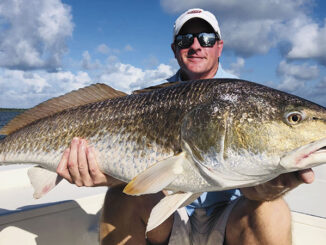
“Nothing like a double hook-up with 30-pound class redfish on topwater baits,” Frenette said. “A topwater strike from any fish creates excitement, but nothing compares to catching big bull redfish on top for pure fun and excitement. Those bulls really blow up on topwater baits.”
Such scenes occur frequently along the Louisiana coast from late summer through early fall. Redfish spend their juvenile years in the marshes and estuaries. When they reach sexual maturity, about the time they measure 27 inches long, most redfish head offshore where they spend the rest of their lives. They might live another 40 years. In late summer and fall, bulls gather in colossal schools closer inshore to spawn.
“When the bulls school up to breed, we ride around looking for them,” said Kip Plaisance (985-637-7251, fishtidewater.com), who guides with his son Max for Plaisance’s Tidewater Charters in the Fourchon area. “We find them schooled up on the beach at times. They also get around numerous wellheads near Fourchon. After we find them, we can catch bulls on anything we want to throw.”
The spawn
The term “bull” defines size more than sex and describes any massive redfish. In the drum family and also called red drum, male redfish gather in enormous schools called “drumming aggregates.” They start drumming around sunset to attract females. Males pick places around passes where the tide can carry eggs and larvae into the marshes where the tiny larvae can hide from predators, feed and grow.
Redfish don’t build nests like largemouth bass or bluegills. Batch spawners, females drop their eggs and males fertilize them. Males might stay in the same general area for weeks, but females come and go as they become ready to spawn.
“Louisiana redfish generally spawn from mid-August through mid-November with the peak in September and October,” said Jason Adriance, a Louisiana Department of Wildlife and Fisheries biologist. “Many females spawn every seven days, perhaps as often as every two to four days. On average, a female lays about 1.5 million eggs per spawn. One female redfish could potentially produce 20 to 40 million offspring per season, but the eggs and larvae have high mortality.”
In one to two days, the eggs hatch. Small larvae feed upon plankton as they work their way toward the marshes and estuaries. Young redfish spend three to six years in the marshes and estuaries before moving offshore. Some roam in and out of nearshore or inshore areas. Reds reach about 8 inches in their first spring. They grow to about 18 inches in less than two years. Fishing pressure largely falls upon the juvenile reds in the marshes.
“The Louisiana redfish population is in decline, but we’re looking to build it back up,” Adriance said. “The key metric is the ‘escapement rate.’ That’s the amount of juveniles that leave inshore waters to join the spawning population offshore. We need a minimum of 30 percent escapement to keep the population healthy. We reduced limits because we have some issues with the stock population and need to bring it back up to target.”
Big red bullies

Single spawning schools might spread across acres of water. Several schools could roam the same bays terrorizing everything small enough to swallow. When bull reds come inshore, they create outstanding opportunities for anglers to catch giant, extremely powerful fish without venturing miles offshore.
“As the weather starts to cool in the fall, redfish move into shallower water,” said Troy Nash with South Louisiana Redfishing (337-412-5950, www.southlouisianaredfishing.com) who fishes the Vermilion Bay area. “We see huge redfish schools coming down the banks on the south end of Marsh Island in water 18 inches deep. Some go on the north side of the island wherever they can find salty water and bait.”
Rampaging bulls might smash anything that touches the water. They aggressively attack menhaden, also called pogies, and other baitfish. They savor and have a particular fondness for succulent mullets. Mullets habitually stay near the surface and commonly swim with their noses sticking out of the water. Big topwater baits mimic wounded mullets struggling on the surface.
“Redfish are the gangsters of salt water,” Frenette said. “They herd baitfish and eat anything that gets in their way. During the spawning season, we catch many reds in the 25- to 40-pound range. A big redfish can easily swallow a 2-pound mullet. When bulls congregate in big schools, nothing beats tossing a topwater at them.”
Lure placement
Most saltwater anglers throw heavy walking baits for enticing reds on top. These hefty lures sail long distances. Worked with short, brisk wrist flicks, walking baits slide across the surface in a scintillating zigzag motion like a crippled mullet. When bull reds get in a feeding frenzy, bait type and color matters much less than lure placement. Toss a large topwater just in front of the school or past it. Twitch or jerk it to create motion and get their attention. Then, hold on!
In early fall, anglers can catch monster spot-tails many other ways. Big crankbaits, suspending or slow-sinking hard baits, spinnerbaits and buzzbaits all work. The old standby, a gold spoon generates enticing wobbling action. Practically anything could provoke a vicious strike.
“In recent years, I’ve had more clients come down to catch bull reds on flyrods,” Frenette said. “That’s such a fun, alternative way to catch them. A good saltwater flyrod bends more than conventional rods, so they wear the fish out easier. It’s still a tremendous fight. Redfish are beasts.”

A jighead tipped with a plastic trailer also works. Many anglers throw popping corks dangling jigs or soft-plastic shrimp beneath them. Live bait also works. Practically anything will tempt rampaging reds.
“People can throw jigheads under popping corks or just about anything,” Nash said. “When we see a school, we don’t want to hit them on the nose. That could spook the entire school. Throw slightly past them and lead them a little. Pull the bait toward them. They’ll find it.”
Natural baits
Redfish devour many natural baits. Bulls like fish and crabs more than shrimp. Croakers, pogies and live mullets about 4 to 8 inches long make excellent enticements.
“Redfish will eat up a white trout, alive or dead,” Plaisance said. “When we put a white trout in front of a big redfish, that’s a guarantee. We catch many reds in the 30- to 40-inch range. The biggest redfish we caught weighed 42 pounds.”
Jetties mark many channels, such as Calcasieu Pass near Cameron. These rocks and concrete blocks attract crabs, shrimp and baitfish. Bull reds cruise the jetties looking for anything they can consume.
“In August and September, we see schools numbering 300 to 400 bull redfish running along the beach,” said Brian Hanchey with Louisiana Backwater Charters (337-660-6594, louisianabackwatercharters.com), who runs a lodge on the Calcasieu Ship Channel in Hackberry. “We catch many bull reds by the Cameron jetties. We cut up ladyfish for bait. Redfish love them!”
Many people come from all over to catch Louisiana redfish. They contribute a significant economic impact for the state. Reds can endure a little rough treatment, but handle them gently. Those big spot-tailed breeders spawn future generations.
Take a few photos, revive them as necessary and release them quickly so they can continue breeding for decades to come.