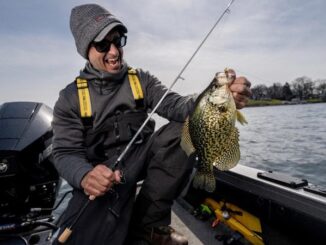
As crappie begin transitioning toward spring patterns on Cross Lake, success often comes down to patience and time on the water. While many anglers choose to travel to nearby lakes in search of an easier bite, Derrick Uzzle prefers to stay close to home and figure out what the fish are doing right in front of him.
“I’ve noticed the fish have been on or near structure,” Uzzle said. “That can be in the creeks, bayous, really anywhere. If the bait or cover is there or nearby, the crappie are there somewhere. You just have to locate them.”
Rather than locking into a specific depth, Uzzle focuses on areas that naturally hold bait as fish begin to shift out of their cold-water patterns. Structure remains the common denominator, whether he is fishing open water or working into creeks and bayous. Finding those areas takes time, but once located, they can hold fish consistently as conditions gradually change.
Uzzle’s gear
Uzzle relies on a spinning setup that allows him to cover water efficiently while maintaining sensitivity.
“My main combo has been a Shimano Miravel 3000 on an 11-foot Phoenix Trifecta Lite spinning rod,” he said. “I use it mainly for casting and pitching.”
His rig includes a 1/16- or 1/32-ounce pegged worm weight with a bead above it to reduce tangles and keep the hook from catching on the weight. He spools his reel with high-visibility Sakuma Nite Crystal copolymer line in 14-pound test or less, which allows him to see subtle bites while still fishing confidently around structure.
Artificial baits have been a key during this transition period, as Uzzle has not relied on live bait.
“I’ve used nothing but hair jigs or soft jigs,” he said.
Send It Jigs hair jigs and custom Flikr baits made by Andrew Pate have been his top producers. Natural and smoke-colored soft plastics, with or without chartreuse tails, have worked well, along with hair jigs in red, black, and white combinations with flash, as well as chartreuse and silver flash patterns.
Electronics play a major role in Uzzle’s approach as fish begin to reposition. Before ever making a cast, he studies the area using side scan, down scan and traditional sonar on his Garmin 8610.
“I generally check for bait and structure on my graph before I decide to drop the trolling motor and start using LiveScope,” Uzzle said.
Once he commits to an area, LiveScope allows him to see how fish are positioned and decide which side of the boat to fish first. Wind direction is always considered.
“If the wind is coming out of the north, I’m most likely fishing the south side and vice versa,” he said, unless the area is well protected.
Figuring things out
Water clarity and conditions have also influenced how Uzzle approaches Cross Lake during this seasonal shift. He noted the water has been clearer than expected, and many of the crappie he targets are holding close to the bottom or tight to structure as they gradually begin to move. Calm days can make fishing tougher.
“On calm days, the fish seem to have a more negative reaction to vibrations or disturbances,” he said, making stealth and boat control especially important.
Crappie on Cross Lake tend to group up in specific areas, and Uzzle has noticed the size of fish is often consistent within each location. While fish may be spread across a large area, smaller zones can produce the same numbers and quality depending on daily conditions.
What keeps Uzzle coming back to Cross Lake during this transition period is the challenge of figuring the fish out.
“It’s a lake you have to dedicate the time to and just go fishing,” he said.
Flexibility is critical, as anglers must adapt to what the fish want rather than fishing their preferred techniques.
“You can’t just fish what you want to fish,” Uzzle said. “The fish don’t care what you like to do. You have to do what works best if you want to catch them consistently.”
For anglers new to Cross Lake, Uzzle’s advice is simple: commit to it. He believes every trip adds valuable knowledge, even when the bite is slow.
“It’s not always an amazing trip,” he said, “but it’s never for nothing. The lessons learned come with the territory.”