Rare duck was taken next-to-last day of early teal season
Something looked strange, admitted Jeremy Fruge of Kinder, the first time a flock of ducks swung over his 1-acre teal and crawfish pond on Sept. 26.
“About 8 a.m., two of them came zooming by on my left, but something about one of them didn’t look right,” said Fruge, 47. “They looked like teal, but one of them looked like it had some white, and I thought it might be a spoonbill (shoveler) drake.
“Then, they came swinging around a little too far away, and they all landed,” he said. “I could see the white one, and I knew it was a teal. Then, they got up and flew off to the right and came in range. They were kind of spread out, and the white one was easy to pick out, so I shot one time and killed it. It couldn’t have been any easier.
“As far as I knew, they were all teal, because I could see the blue, and they had a chance to get away, but they came back. I thought it was all over when they got up.”
When Fruge splashed over to pick up a duck he figured was something special, he wasn’t disappointed.
“When I walked up to it, I knew what I had,” he said. “It was kind of like walking up on a big buck when you’ve shot one.”
A stand-out bird
What Fruge found was a blue-winged teal alright, but one almost entirely white, except for the head and the blue wing patches, plus a few darker feathers.
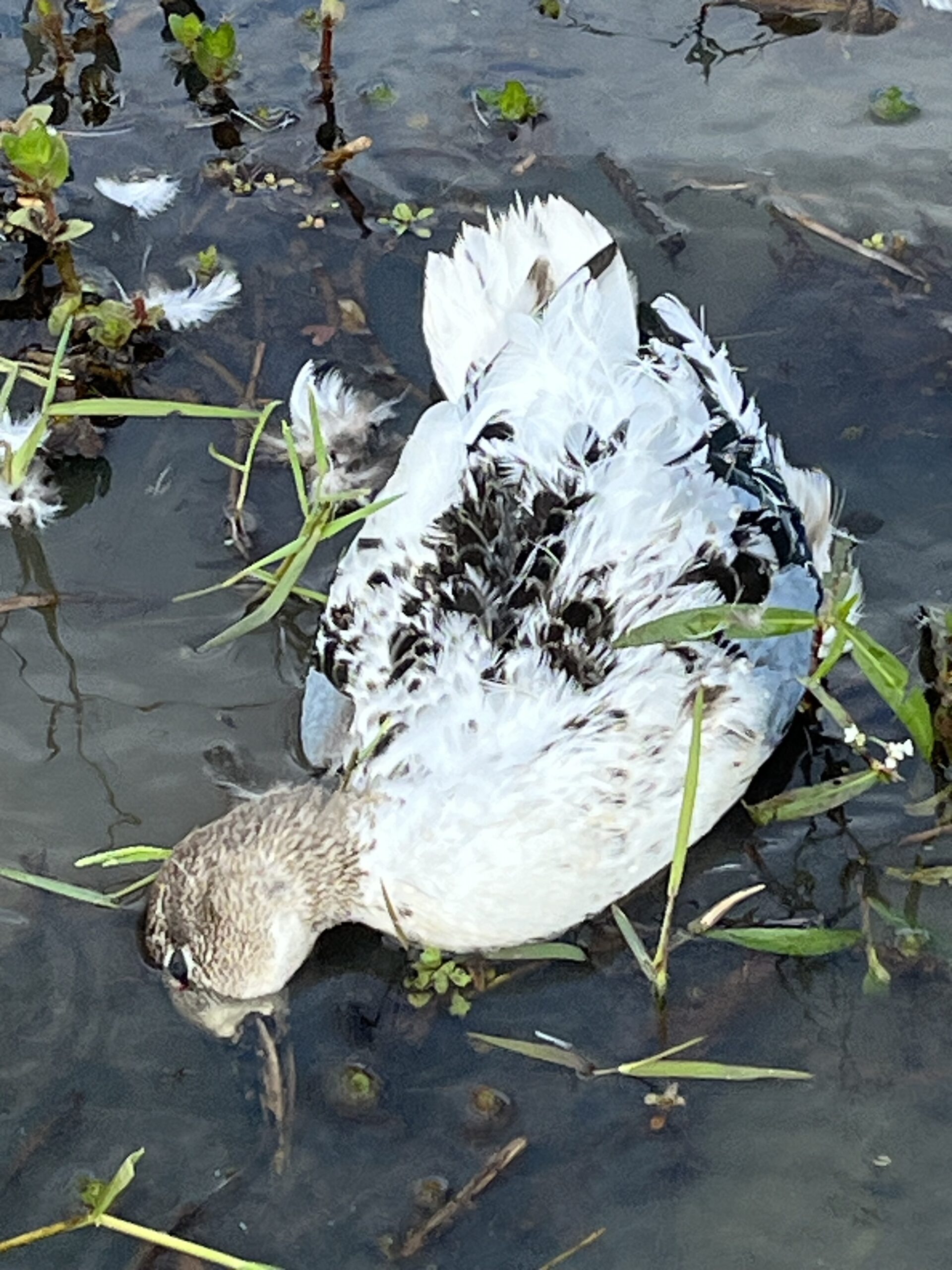
The bird, according to Jason Olszak, waterfowl program manager for the Louisiana Department of Wildlife and Fisheries, was leucistic, a unique coloration pattern that can affect any number of bird, mammal and fish species. It’s not as unusual as a true albino, but it’s definitely not an everyday thing.
“It is genetic to some extent,” Olszak said. “It has to do with the issue of pigment to the feathers at the cellular level. It’s not as rare as a true albino, but it is certainly rare, especially in adult birds. Because of their color, they stand out so much that you don’t see many that live past their first migration. Hens are even more rare, because there is no way for them to really hide and nest.”
Productive little teal pond
Fruge said his even being on his little teal pond was a bit of an unusual deal.
“I have this little teal/crawfish pond on one side of my house, maybe 150 yards away,” he said. “It was meant to be 8 acres but right now, it’s just an acre. I need to get levees built all the way around before it can get bigger. There’s nothing but crawfish grass in it.
“I usually keep the pond for the kids to hunt, but I used to guide for Southern Delta Outfitters, and I told Parker Cole, who runs it, that he could use it as a backup if he had a trip and didn’t have enough teal.
“I went that day just to be hunting,” he said. “I was going to Lake Arthur on the last day, and I just figured I’d go out there the day before. I got out at daylight and didn’t see anything, didn’t hear any shooting. I figured the ducks were gone.”
Fortunately, the big flock finally showed up and left Fruge with one duck and plenty of memories.
Normally, Fruge likes to carry home at least a handful of ducks.
“I’m usually about killing numbers, because my family really likes to eat wild ducks, but after I killed this one, I just picked him up and that was it,” he said.