We interrupt the discussion of alligators, sharks, hogs, cats, deer, amberjack and ducks promised in last month’s Down on the Dock column, to bring you breaking news.
Governor Jeff Landry has sold another piece of Louisiana!
Much to the dismay of duck hunters, coastal restoration folks and engineers and some of the residents of Vermilion Parish when he announced he’d brokered a deal to hand 130,000 acres at Pecan Island to SpaceX.
Well now, in addition to building booster rockets near New Orleans for six decades, Louisiana is taking another step in taking the United States into outer space.
Hurrah! Whoopee! All together now, countdown from 10 … Blast off!
Well, there goes one of the only remaining pieces of stable marshes in our state.
Well, there goes waterfowl hunting.
Not so, you say.
Yes so.
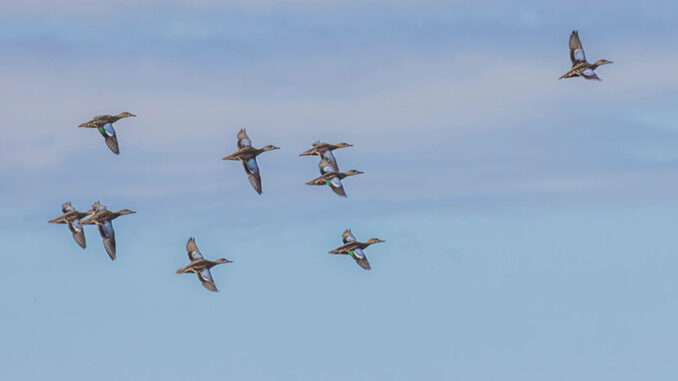
Sure there are some who’ll tell you Pecan Island duck hunting has waned recently. Yes, it has, but the wild waterfowlers who’ve spent years in duck blinds in the marshes and flooded fields know flights of ducks into Pecan Island is cyclical.
Their experience, and their records, during the decades of 60-day duck seasons proves that weather, mostly frigid weather in the Mississippi Valley states to our north, sends hundreds of thousands of ducks into Pecan Island marshes.
They know the early season is the time to hunt, then there’s a lull, then, if the temperatures dip, the last couple of weeks during the season will keep them in ducks for their tables.
True, there are some seasons they’d rather forget, but they pick up their decoys, stow their pirogues, clean their shotguns, take their retrievers to the vet for a post-season check-up and know, and pray, the next duck season will be better.
Yet, there’s more to this 130,000-acre development than duck hunting.
South Louisiana subsoil
Look, there’s no engineering degree to show you here, so the next move is to talk to engineers, and some with degrees and knowledge of South Louisiana soils look askance at this SpaceX launching site. (Of course, none of these men will be identified for fear of reprisals from those on high in Louisiana’s executive branch.)
These men point to launch sites in Florida (Cape Kennedy), California and Texas and talk about the bedrock in those places and mention things like limestone and granite to compare with the river-deposited sediment that makes up the subsoil across South Louisiana.
One engineer went so far as to quote from the Bible, the passage about a house built on rock and the one build on sand, the obvious reference to the durability of the built-on-rock house and the perils of the built-on-sand structure.
Another pointed to the fact that high-rise structures in Louisiana came in the last half of the 20th century only because soil and construction engineers figured out how to support tall buildings with unique and highly engineered foundations.
He said the pressures of a high-rise and the foundations needed to support these buildings don’t compare to the pressures millions of pounds of thrust coming from rockets capable of launching whatever it is SpaceX wants to put into space orbit — “Lots of concrete, lots, and that might not be enough,” he said.
Loss of coastal marshes
Another group of skeptical detractors to this project is the conservationists who view it as the destruction of vital marshlands and the areas surrounding the marshes.
These men and women said they know the marshes and the upland areas around the marshes are linked to each other. Note here that “upland” is more a term for areas that stay dry most of the time but feed water into the marshes.
They point to this development as having the potential to funnel more water into the marshes — that land covered in concrete doesn’t absorb the volume of water and creates more run-off — which likely will result in a bit-by-bit erosion of the marshes.
To a person, they said this will result in another tragic loss of marshy areas in a place that is one of a very few places in coastal Louisiana where the marshes are relatively stable.
And, what happens after the first major hurricane sweeps into Southwest Louisiana? There’s enough evidence, beginning with Hurricane Audrey in 1957, to know violent and highly destructive storms devastate this area.
All in all, this appears to be another blow to maintaining — certainly not enhancing — our state’s reputation for being the Sportsman’s Paradise.
The menhaden issue, the governor’s data-processing moves and the related problems in North Louisiana and his project-destroying moves through the Coastal Restoration and Protection Authority add to a growing list of unanswered “why” questions.
This one-thing-after-another progression begs for answers about who benefits from these moves.
It also makes one wonder if our elected officials understand that it is us who makes them and not them who make us.
It certainly appears some of them have forgotten that.