Chronic wasting disease could severely impact Louisiana’s deer numbers
There’s a line in the third season of “The Chosen,” a biblical quote to be sure, that goes like this: “It’s easy to upset powerful people, but it’s worth it.”
I’m not a biblical scholar, so don’t chastise for mixing words from a widely viewed serial with the Bible. Sure, I read our world’s most read and quoted book, but never read that line.
I like it.
Somehow it fits more now than in those BC years. (And, why is it now that age is B-C-E? BC wasn’t good enough?)
So, today, where is it we start with “powerful people?”
Can we start in the Louisiana Legislature?
Can we start with the senator and the state representative who launched a campaign to curb Louisiana Department of Wildlife and Fisheries attempts to slow the advance of chronic wasting disease — CWD — in our state?
So these two guys started their push with concurrent resolutions railing against things like anti-baiting regulations and transporting deer and deer parts from areas where CWD has been found in infected deer.
It’s clear CWD is spreading from the first finding along the Mississippi River.
This is an always fatal disease to deer, and from its first finding, Wildlife and Fisheries has taken steps to attempt to control this virulent disease.
The bait-feed ban
From the start, and continuing after finding diseased deer in other east-central and northeastern parishes, state veterinarian Dr. Jim LaCour and state wildlife biologists and their teams set out regulations calling for an “Enhanced Area” and a “Buffer Area” within boundaries called a “CWD Control Area.”
Guess it’s the regulations in the Enhanced Area that has ruffled these two legislators and their constituents — the ban on baiting and feeding, though those practices are allowed in the Buffer Zone that circles the Enhanced Area — in the places where a diseased deer was taken. Food plots are allowed.
The bait-feed ban was, and is, an attempt to keep deer from congregating in one place, thereby increasing the chance to spread CWD from a diseased animal.
Believing veterinarians and wildlife biologists is easy when it comes to CWD. Their long-standing testimony is that CWD is spread in several ways. Simply stated, this disease comes from excrement and remains in the ground indefinitely and ready to infect other animals.
Yes, this is boiling down volumes of information on this subject, and one thing is clear — CWD isn’t going away and it’s going to take a concerted effort to keep it from spreading to every deer herd in our state.
That didn’t seem to bother these two legislators, one of which brought in avid hunter Ted Nugent (yep, the rock musician) to protest against the strict hunter regulations in CWD-affected areas — as if Nugent is the source authority on CWD, but appeared to be more on the side of anti-regulations than preservation of Louisiana’s whitetail deer.
Protecting our deer numbers
Look, our state’s first-ever confirmed CWD-positive deer came in 2022 after being found in Colorado near two decades ago.
That it has spread through all or parts of nearly a third of Louisiana’s 64 parishes in just four years tells all we need to know about how virulent CWD is and can be. From recent maps, CWD Control Areas stretch from Ouachita Parish south all the way into the northern reaches of Pointe Coupee Parish.
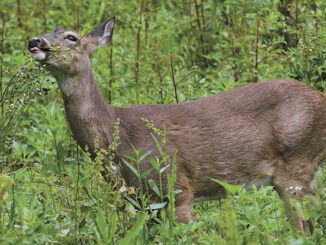
The book on CWD is its always fatal, has no treatment and brings on “irreversible damage to brain tissue in deer, which leads to excessive salivation, neurological symptoms, emaciation, and death of the animal.”
It’s worth noting this Wildlife and Fisheries advisory: “Although CWD has not been shown to be contagious to humans, the Centers for Disease Control and the World Health Organization recommend against the human consumption of deer known to be infected with CWD.
“Also, it is recommended that people hunting in areas known to harbor CWD-infected deer have their deer tested for the disease prior to consuming the animals. LDWF will provide testing for hunter-harvested deer free of charge.”
Yes, measures to control the spread are restrictive. Transporting deer from control areas demands effort on the parts of hunters. Banning deer skulls with any remaining brain tissue from being taken from places where CWD has been found is a deliberate attempt to slow the spread of a disease which, in the future, could severely impact deer numbers.
We can’t ignore the speed at which CWD has taken hold in Louisiana, and can’t pass off increased hunting regulations as just another attack on our freedoms.
Chronic Wasting Disease is serious business, and we’d best understand that it’s going to take all deer hunters and landowners to adapt to necessary actions to impede its spread.