This hollow-body soft plastic frog excels in heavy cover
Of all the artificial lures Oklahoma bass fishing pro Jason Christie has designed or helped design over the past two decades, an avid bass angler who happens to be an industry insider said one line he appreciates most is Booyah’s Pad Crashers and Poppin’ Pad Crashers.
Dustin Elder of Hot Springs, Ark., got hooked on the ½-ounce, 2 ½-inch long Pad Crashers after they were introduced in 2012 by Booyah Bait Co., an artificial lure manufacturing company first known for its “wire baits,” spinnerbaits and buzz baits, then later for its jigs, crankbaits and topwater plugs.
Between 2008-2010, BOOYAH officials decided to do more than wire baits and put their efforts into making a thin-skinned, collapsible soft plastic frog, which is where Christie got on board to lead the design phase. After Pad Crashers and Poppin’ Pad Crashers were released a few years later, Booyah’s plastic frog line got so popular it is one of the company’s best sellers, second today only to its spinnerbaits.
Easy to use
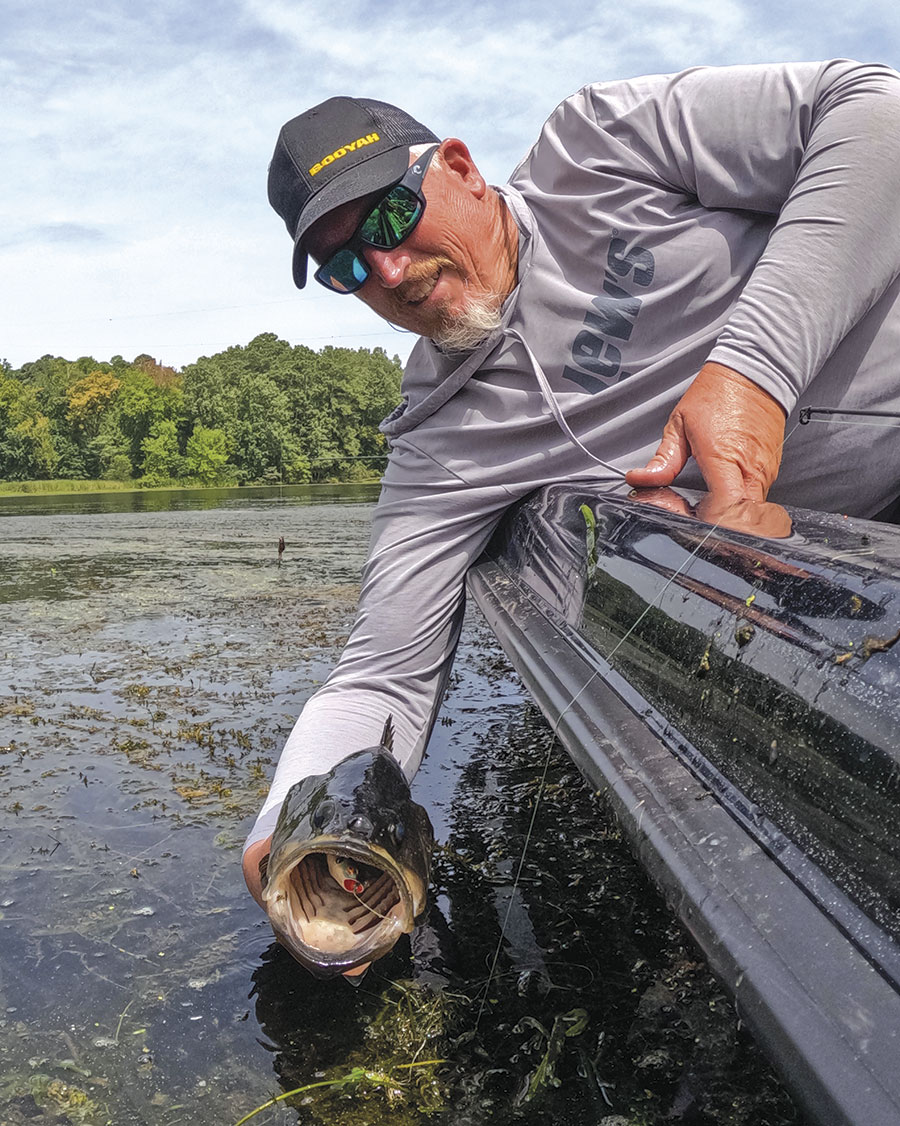
Elder, 30, got his hands on the Pad Crashers over the next few years and one gave him his “plastic frog personal best” at nearly 7 pounds in 2019 while he was practicing for a tournament at Millwood Lake in Southwest Arkansas.
The brand manager for Heddon Lures and War Eagle Custom Lures, who also assists PRADCO Outdoor Brands product director Chad Warner, tips his cap to the plastic frogs’ designer, Christie, an 18-year veteran who’s fishing the Bassmaster Elite Series. Christie and PRADCO’s other pro staffers, Stetson Blaylock, Luke Palmer and Blake Capps, all fish with the plastic frog he designed when conditions call for the bogus hopper.
“Every one of our pros use it,” Elder said. “To me, it all lies in the actual body of the frog. It has a very soft, thin plastic. It’s not hard to hook a fish with a Pad Crasher. You don’t have to be really picky with your hookset because it collapses so well.”
He added that regardless of the thin wall of plastic, it’s plenty durable and withstands the rigors of plastic frog fishing.
Pad Crashers, which are walking baits, and Poppin’ Pad Crashers, which create significant surface disturbance with a cupped mouth, also are touted for being snag- and weed-free on surface vegetation in heavy cover.
“And it uses a really good double hook that stays sharp for a long time,” Elder said about the premium quality 3/0 double hook specially crafted for Booyah.
Sixteen color options
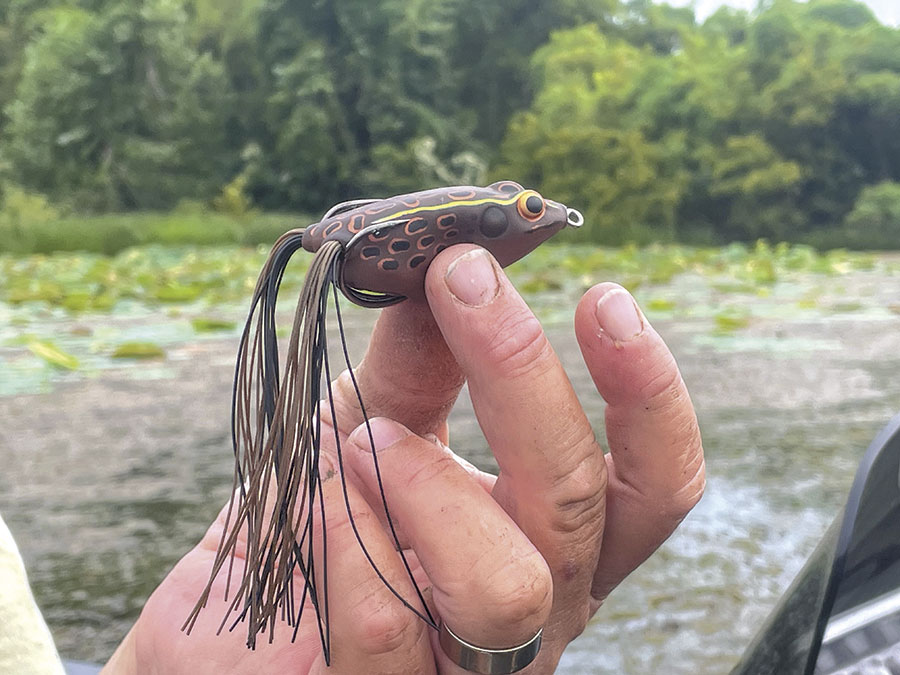
Elder pointed out both the Pad Crasher and Poppin’ Pad Crasher, plus their smaller counterparts, the Pad Crasher Jr. and Poppin’ Pad Crasher Jr., both ¼-ounce and 2 inches long with a 2/0 double hook, are available in 16 colors.
His personal favorite is either an albino frog or the night train (black) Pad Crasher. He’s got a dozen of each color stacked in his boat.
About the junior model, he said, “It’s very castable but it’s best to go to a smaller rod, like a shorter 6-8 spinnerbait rod, and use lighter braid, like 30-pound test. It’s not hard to throw at all. You’ve just got to go down on your gear a little bit.”
The Poppin’ Pad Crasher “moves a lot of water, very similar to a Magnum Pop-R,” Elder said. “It’s got a big cup so it moves a lot of water.”
When he fishes the Pad Crasher, he ties a loop knot at the eye on the plastic frog’s nose and just walks it back and forth in place.
“I stop it a lot, especially if it gets in a hole (in the vegetation or heavy cover),” he said, noting he often targets individual grass patches or other stand-alone cover.
For more information on the Booyah Pad Crasher models and other Booyah Bait Co./PRADCO Outdoor Brands products, go to booyah-baits.com or call (800) 531-1201.