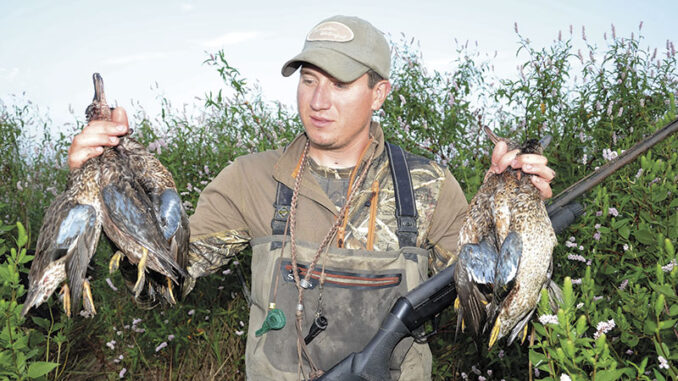
Crouching in tall marsh grass, we were already sweating profusely from the humid September heat.
To the east, a pink ribbon marked the horizon as we heard unseen specters rocketing low over us. Then, something splashed in the pond as we counted down the final minutes before legal shooting hours.
Finally, distant gunfire rumbled over the marshes, marking the beginning of another season afield. Immediately, whatever landed in our pond decided to leave, but more would come back on this magnificent September morn.
“We always look forward to teal season,” said Drew Fruge, with Cypress Cove Outfitters (337-384-2095, Cypresscoveoutfitters.com) in Gueydan. “Teal are fun to hunt. It’s our favorite time of the year.”
A harbinger of fall, blue-winged teal typically migrate much earlier than other ducks. Blue-wings migrate based upon the photoperiod, the amount of daylight in a 24-hour period, not the temperature. Teal normally begin to arrive on the Gulf Coast by late August or early September. This year, the Louisiana teal season runs from Sept. 19-27.
“The peak blue-winged teal migration through Louisiana occurs in late September and early October,” said Jason Olszak, the Louisiana Department of Wildlife & Fisheries Waterfowl Program Manager in Lafayette. “We set the teal season as late into September as possible.”
Poor to average conditions across much of the northern Great Plains duck breeding grounds affected the fall flight. Saskatchewan, where the majority of blue-winged teal that head to Louisiana hatch, rated poor to fair.
“During the September teal season, green-winged teal only make up about 3% or less of the Louisiana harvest,” Olszak reported.
Extensive scouting
During the September season, Louisiana sportsmen can shoot up to six birds per day in any combination of blue-winged, green-winged or cinnamon teal. More common in western states and Mexico, some cinnamon teal come to Louisiana, mostly in the southwestern part of the state. Female blue-winged teal and cinnamon teal look almost identical.
“We kill four or five green-winged teal every September,” Fruge said. “We have some cinnamon teal in this area, but it’s almost impossible to tell a blue-wing from a cinnamon in September.”
Of course, sportsmen must find teal before they can hunt them. That requires frequent and extensive scouting. One day, swarming clouds of teal might buzz around a particular pond like a whistling tornado. The next day, sportsmen only see empty skies.
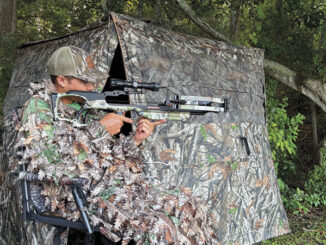
“For teal, we must do a lot of scouting to keep up with the birds,” Fruge said. “In September, we must stay mobile. We go where the birds are. They might be in one field today and gone tomorrow, so we put up temporary panel blinds.”
Blue-winged teal don’t require much water. In fact, the dabblers can only reach down to about 6 inches. A hard rain could turn a dry field into a teal paradise overnight. Freshly flooded agricultural fields with just a few inches of sheet water create ideal teal habitat.
“The majority of teal hunting occurs in the agricultural areas, especially rice fields in the southwestern part of Louisiana,” Olszak said. “People can also hunt rice fields up towards Alexandria and around the Monroe area. A properly prepped rice field makes a great place to hunt teal.”
Concealment
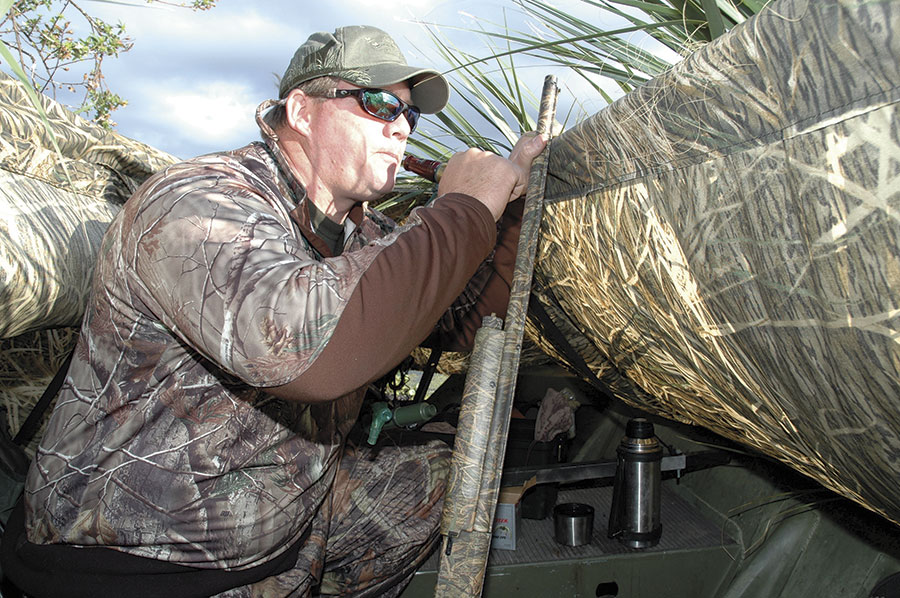
On lakes, marshes or river systems, many people use boats with pop-up blinds for scouting and hunting. Sportsmen can select a spot, toss out a few decoys and begin hunting in minutes. They could even move several times in a morning.
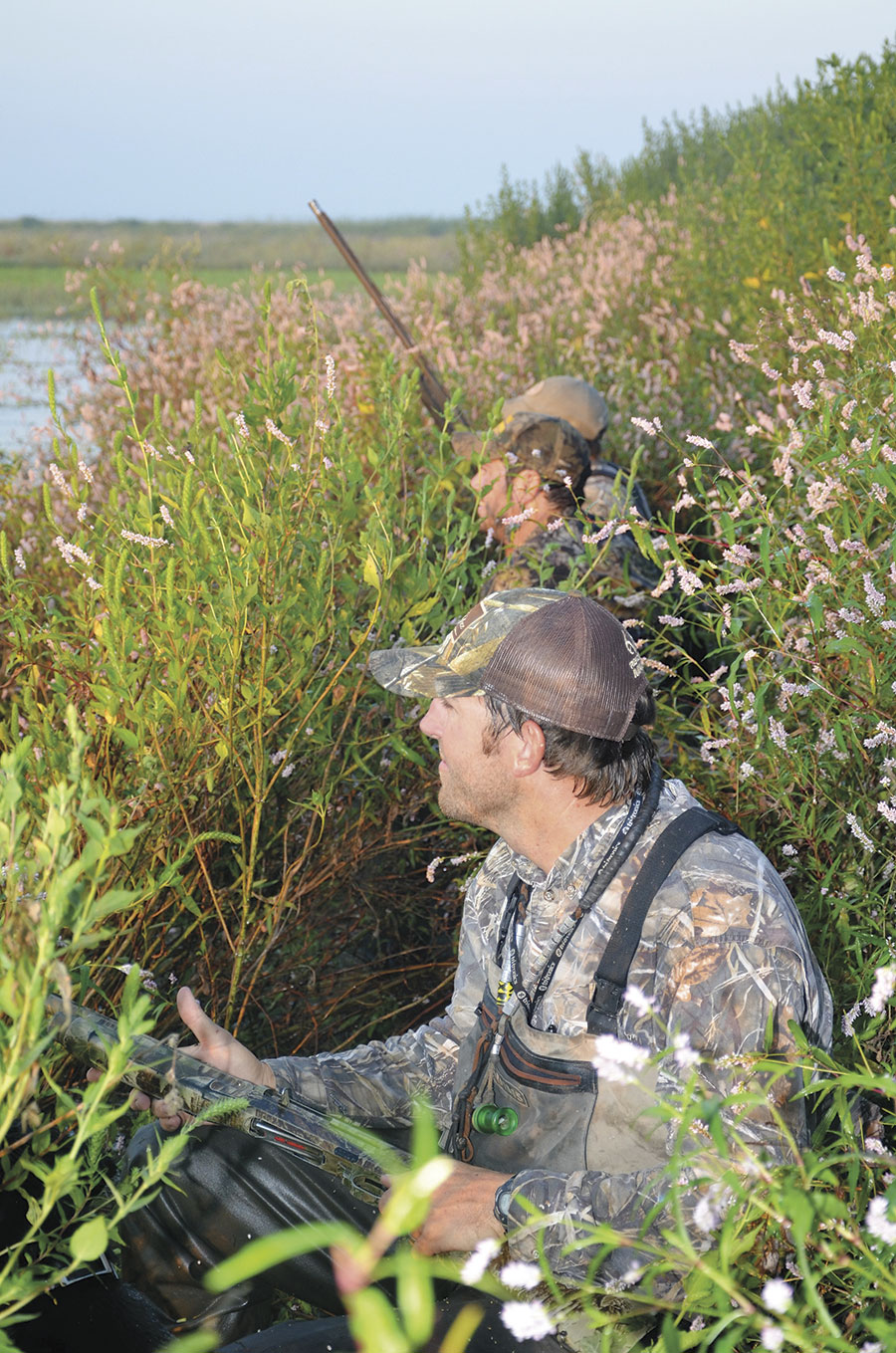
Teal hunters don’t need much cover. Many sportsmen simply hide in high reeds or any other available natural cover. In soggy marshes, bring a small piece of plywood as a base. Put a small folding stool or a waterproof shell bucket on the plywood for more comfort than squatting in the reeds.
Keep watch where the birds want to go. If they keep landing on the far side of the pond or next pond over, quickly grab the gear, a few decoys and hide where teal already want to go.
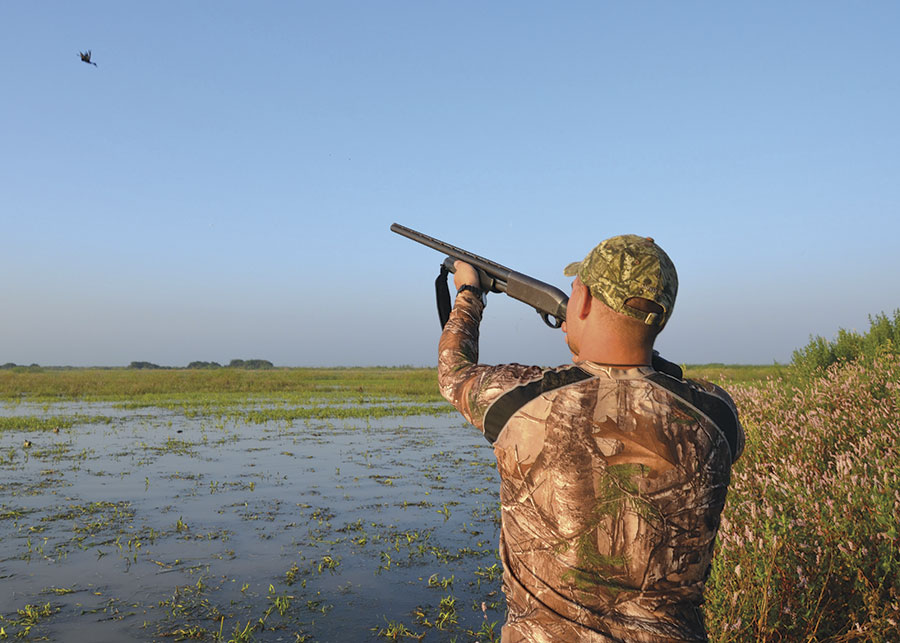
Teal usually fly at first light or earlier. In the right place at the right time, action can come furiously. Fast and incredibly agile, teal routinely fly just over the grass tops. Sportsmen looking out over their decoy spreads as shooting hours begin might see 12 decoys. Moments later, they count 16 decoys with four swimming and nobody saw them arrive.
“Teal move early in the morning,” Fruge said. “Often, we’re out of the field before 8:30 a.m. During big duck season, we might stay in the fields much later in the morning if necessary.”
Decoy spreads
The diminutive waterfowl regularly fly in small, tight flocks, but can also gather in huge groups numbering several hundred birds, all twisting and turning as one unit. Unlike mallards that frustratingly circle a pond before committing to land, low-flying teal frequently just fall from the sky and crash-land wherever they choose. Even the most experienced waterfowlers might not see them coming. They just seemingly materialize.
“Sportsmen often see high-speed black silhouettes zooming past them in the darkness,” said Jeff Dauzat of Fin and Feather Guide Service (504-818-2176, www.finandfeatherguides.com), who hunts the Mississippi River Delta marshes. “Teal don’t really circle. They twitter along over the marsh, see decoys and dive-bomb in.”
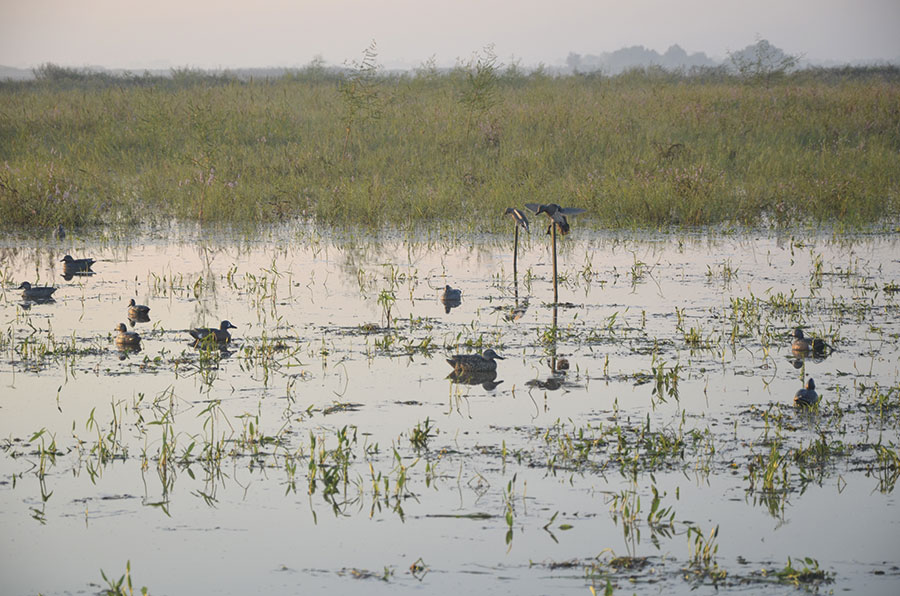
In September, sportsmen don’t need huge decoy spreads. Just a few decoys in a good pothole or opening in a rice field will suffice. Leave the brightly-colored mallard decoys home in September. Use small blue-wing or green-wing teal decoys. Since all ducks look drab in September, use mostly hen decoys.
“In September, we don’t use as many decoys as we would in December, but we run a lot of motion decoys,” Fruge said. “During the regular season, we don’t use motion decoys, except maybe something that splashes.”
Non-migratory mottled ducks stay in their favorite coastal marshes all year long. Both sexes resemble hen mallards. Mottled duck or mallard hen decoys often serve as confidence decoys for September teal hunting. When hunting a marsh, place a pair of mallard hen decoys at extreme range to serve as shooting marks. Add a pair on either side of the blind close to the grass to simulate mottled ducks.
Calling
For calling, leave the mallard quackers at home. Blue-wing drakes make a whistling “tsee tsee” sound. Hens emit a high-pitched squeal. Drake green-wings make a high-pitched “preep-preep.” Hens make a sharp, high “quack,” a warning sound. In a spot where teal already want to go, no calling works better than bad calling.
“A green-wing mainly whistles, which sounds very similar to a pintail whistle,” said Rod Haydel of Haydel’s Game Calls (www.haydels.com) in Bossier City. “Anytime hunters can sound more like the birds they are hunting, the better. I usually wait until I see birds before I call to them.”
In the coastal marshes, sportsmen can hunt several federal refuges and wildlife management areas. On public lands, scout multiple potential good places to hunt in case the birds move or other hunters get to the prime spot first.
“In September, we concentrate on smaller bodies of water,” Dauzat said. “Teal work better in smaller potholes earlier in the season. Blue-wings will come to green-wing decoys. Keep well concealed with the sun at your back. Keep movement to a minimum.”
Temperatures soar in September, keeping cold-blooded reptiles active. Always watch for snakes, especially before crawling into a blind in the darkness. In the marshes, alligators learn to associate gunfire with food. Frequently, they lurk just outside the decoy spread waiting for something to drop from the sky.
Know your ducks
Always positively identify the target before pulling the trigger. In September, teal hunters might spot other waterfowl not legal to shoot. In timbered areas, waterfowlers commonly see non-migratory wood ducks. Some pintails, gadwalls and wigeon migrate early. Shovelers exhibit bright blue shoulder patches. Look for their big spoon-like bills.
Louisiana sportsmen might also spot black-bellied and fulvous whistling ducks. Both breed in the southern United States and winter in Mexico or farther south. In recent years, black belly populations have expanded, becoming increasingly common in some areas.
“Black-bellied whistling ducks first moved into the state 25 to 30 years ago and proliferated,” Olszak said. “Now, we estimate 200,000 to 250,000 black-bellied whistling ducks in Louisiana. We thought they flew south by the time the regular duck season began, but in our January surveys, we estimated nearly 200,000 across the coast.”
Both species remain illegal during the September season, but the state will open an experimental black-bellied whistling duck season in October. The season runs from Oct. 3-11, 2026, with a limit of four per day.
“The October season is just for black-bellied whistling ducks,” Olszak emphasized. “Fulvous whistling ducks are not legal during the October season and neither is any other duck species. Both whistling species are legal to shoot during the regular duck season.”
The September season gives sportsmen a tune-up before the regular duck season starts. In the right spot, this special season can truly create some great memories on magical September morns.