State biologists share what wildlife management areas offer the best chance for duck hunters to score this season
One of Louisiana’s out-of-the-way, far off the beaten path wildlife management areas gave up 4.12 ducks per hunter effort in 2025-26, highest among any of the state’s 53 WMAs.
Duck hunters earned those 1,138 ducks on Pass-a-Loutre WMA, located 10 miles south of Venice via the Mississippi River. It has been said before and it’ll be said again, hunting there is a challenge, but often the efforts are worth it, thus making it one of the top destinations among the state’s WMAs.
Waterfowlers in the know realize scouting is the key to successful hunts on the Pass-a-Loutre WMA. It is a 115,000-plus acre area rich with widgeon grass, delta duck potatoes and pond weed, food that brings ducks to the table in the numerous river channels, shorelines, shallow bays (particularly those along the west side of South Pass), natural bayous and manmade canals laced with intermediate and freshwater marshes in Plaquemines Parish. Find the food in places waterfowl are least likely to be pressured and you’ll find the ducks.
Pass-a-Loutre didn’t give up the most ducks last season, but many hunter efforts were rewarded. Last season, Louisiana’s heavy hitters were Dewey W. Wills WMA, Atchafalaya Delta WMA, Russell Sage WMA, Boeuf WMA and Spring Bayou WMA. Louisiana Sportsman asked state biologists to look into the past numbers and share how the table is being set for those and other WMAs this season.
Coastal Lafayette Region
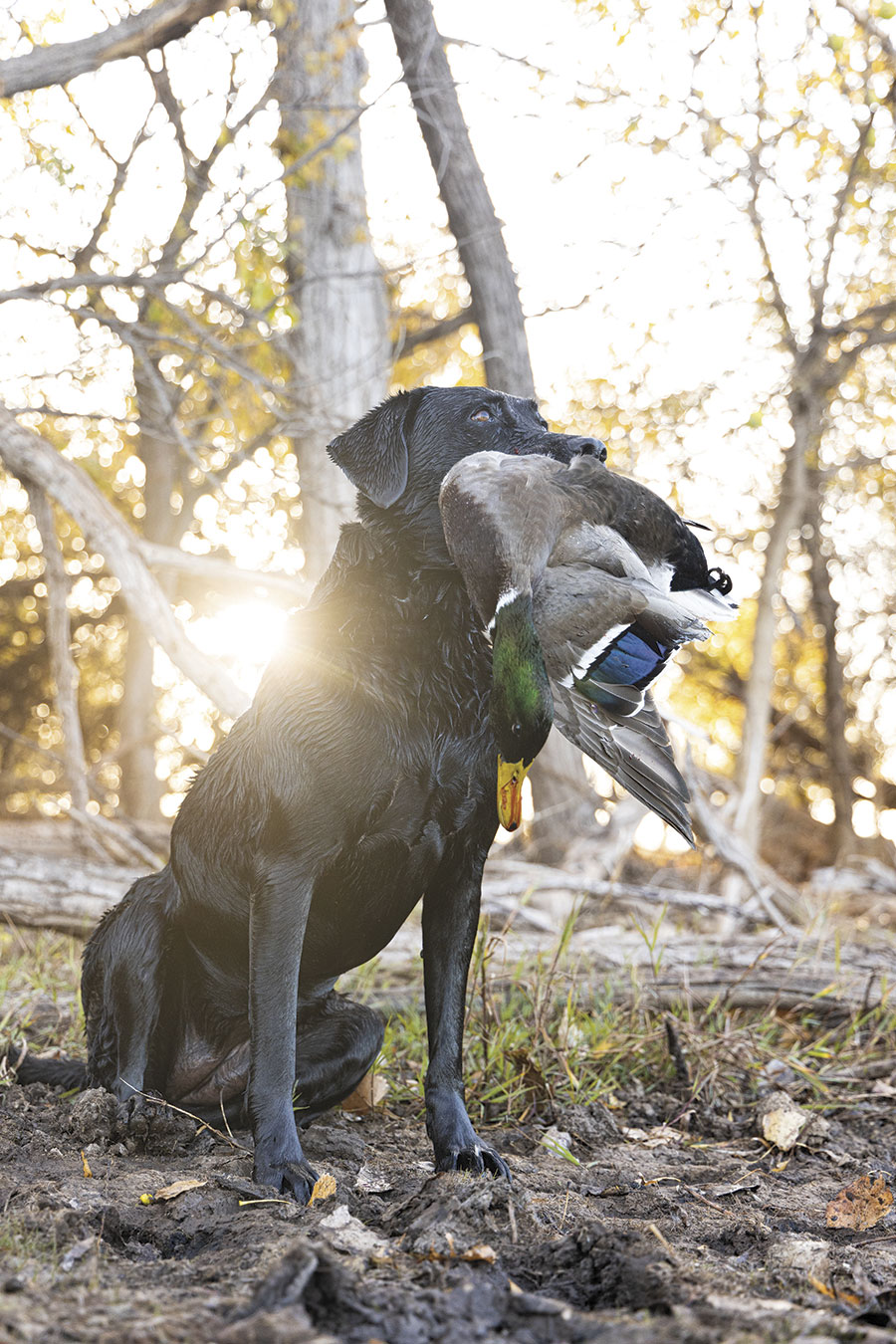 Duck hunting prospects look good on the Atchafalaya Delta WMA, which is very popular for migrating ducks and duck hunters.
Tyson Crouch, LDWF biologist manager for the region, said Atchafalaya Delta WMA waterfowlers harvested 6,011 ducks, the second-highest duck harvest last season among Louisiana’s WMAs. The count trailed only the Pineville Region’s Dewey W. Wills WMA’s 7,524 ducks in 2025-26.
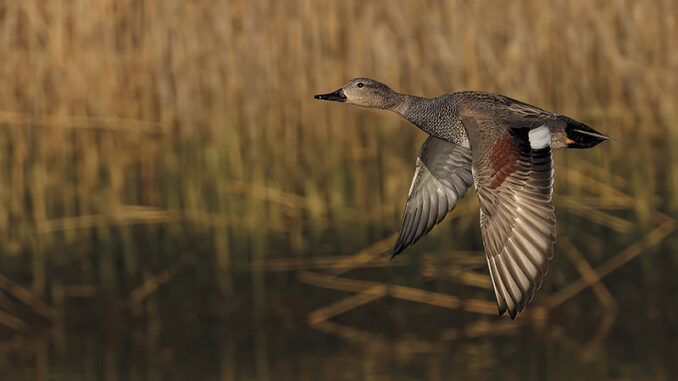
Crouch, a 44-year-old biologist and 15-year LDWF veteran, is pleased with the number of ducks given up last season on the Atchafalaya Delta WMA. Most of the 6,000-plus ducks harvested were blue-winged teal, green-winged teal, gadwall and lesser scaup.
“It’s always good to hear and see. Six thousand is actually down a little from the previous season,” he said in mid-September, noting the WMA’s duck harvest was 8,432 in 2024-25.
He turned his attention to 2026-27 and said, “Hopefully, it’s good. It can always be repeated, you know. It’s always hard to say … every year is different. Just keep your fingers crossed there’s no tropical activity.”
Atchafalaya Delta WMA, a rich ecosystem accessible only by boat, features some of the most scenic duck hunting habitat along the coastline. The Main Delta has 15,000 or so acres of marsh and scrubby habitat but mostly open water, while the highly popular Wax Lake Delta has approximately 12,000 acres of marsh, according to the LDWF.
“I’d say the Wax (Wax Lake Delta) probably gets the majority of the duck hunters,” Crouch said.
Habitat-wise, Atchafalaya Delta WMA “looks good out there” with plenty of submerged aquatic vegetation (SAV). As an added bonus, the veteran biologist said water clarity is good thanks to low Atchafalaya River stages since late July.
“One good thing about having low river stages, the water stays clear a lot,” he said. “That really contributes to SAV production.”
And with the river well within its banks for so long, there’s plenty of fresh water inside the WMA. With consistently high salinity outside the area through summer and, typically, most of the winter, ducks look for fresh water with their migration at an end.
The first split last season definitely was the most productive, he said, adding the region’s other WMAs were consistent throughout the second split in 2025-26.
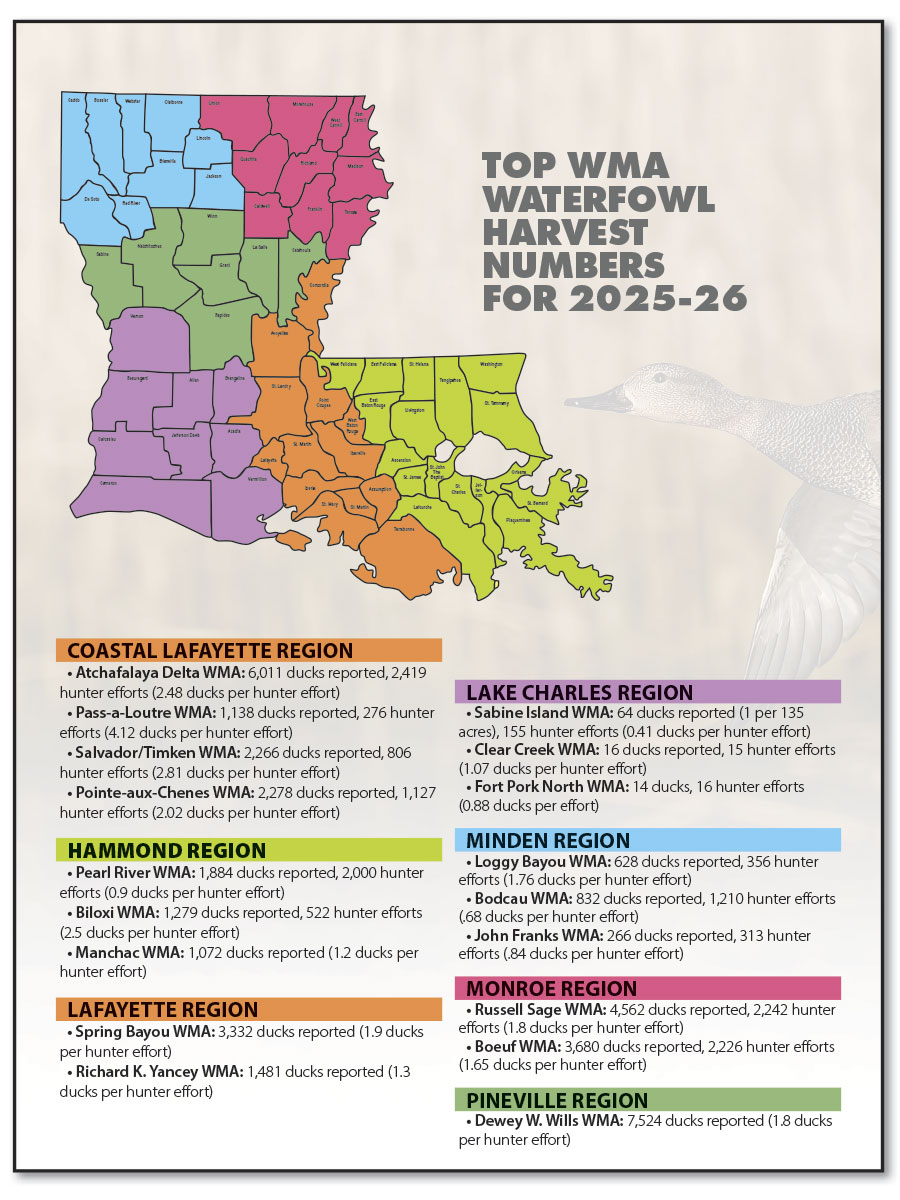 Crouch advised duck hunters that Coastal Lafayette Region WMAs will have noon closures except for Pass-a-Loutre WMA and Atchafalaya Delta WMA. For the Pass-a-Loutre and Atchafalaya Delta WMAs, mornings remain the most consistent, but some afternoons can be red-hot due to tidal movement.
Pointe-aux-Chenes WMA and Salvador/Timken WMA duck hunters reported 2,278 and 2,266 ducks harvested in 2025-26.
Hammond Region
Duck harvest numbers slipped from the 2024-25 season to the 2025-26 season on two of the top three wildlife management areas in the Hammond Region.
Most of the ducks the past two seasons came off the highly popular Pearl River WMA, where 1,884 birds were reported taken, according to LDWF WMA Biologist Supervisor Forest Burks. Burks noted it took 2,000 hunters to reach that number, or 0.9 hunter efforts per duck.
The 2025-26 duck harvest was less than the 3,326 ducks that were taken there in 2024-25, according to Burks.
Pearl River WMA had its typical spring flood. The good news is the marshes haven’t been impacted severely by tropical weather since Hurricane Ida in late August 2021.
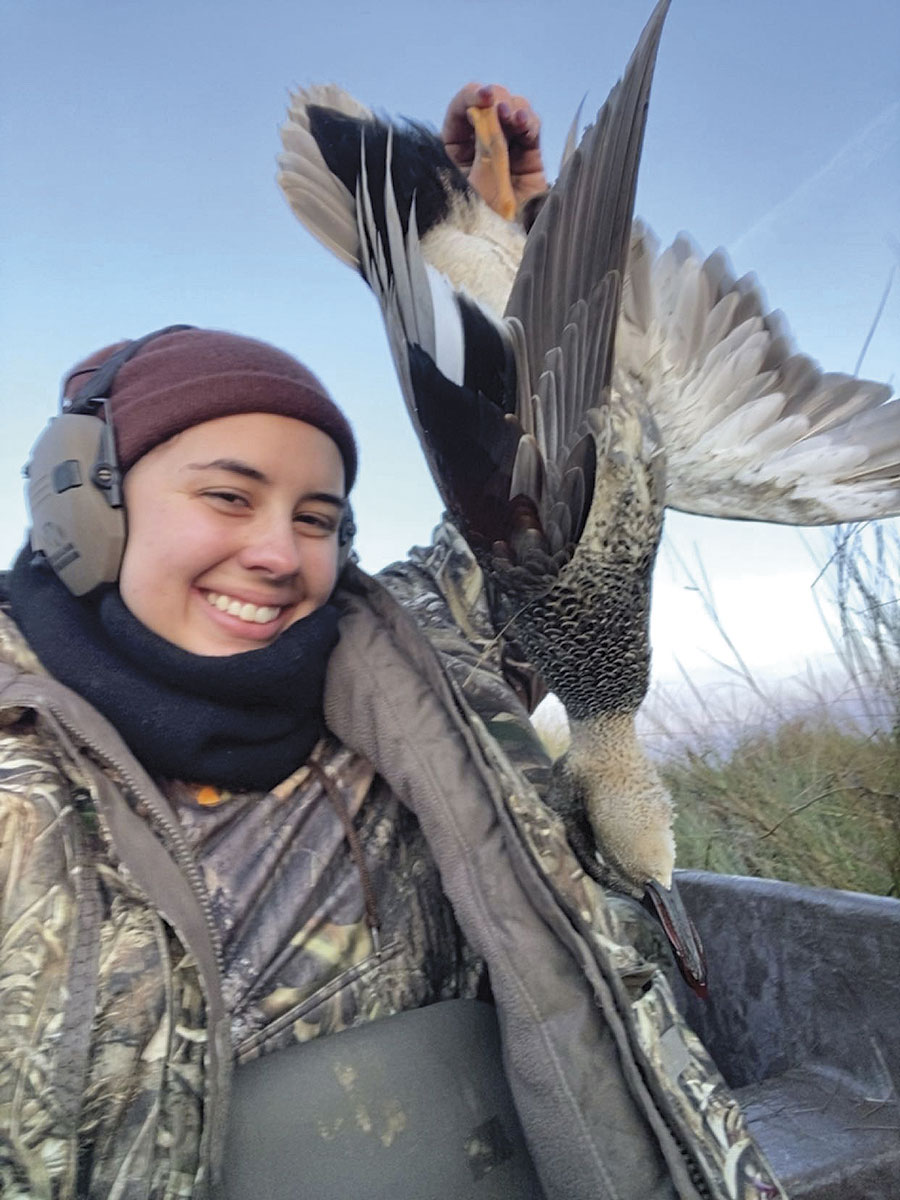
Biloxi WMA’s 2025-26 duck harvest checked in at 1,279 ducks on 522 hunter efforts. That’s 2.5 ducks per hunt, the highest success rate in the Hammond Region, Burks said. The Biloxi WMA’s duck harvest was way above the 585 count in 2024-25.
Manchac WMA yielded fewer ducks, 1,072 at 1.2 ducks per hunter effort, than both Biloxi WMA and Pearl River WMA in 2025-26.
Gadwall, green-winged teal and blue-winged teal show up the most in each of those marshes. Wood ducks can be found in the swamps on Pearl River WMA, Joyce WMA and Maurepas WMA.
Burks pointed out the first hour after legal shooting time can be the most productive in the region’s swamps and marshes.
Lafayette Region
Duck hunters looking for quality waterfowl habitat on public lands have two great options in Spring Bayou WMA and Attakapas Island WMA in the LDWF’s Lafayette Region.
No one knows that better than the region’s biologist manager, Schuyler Dartez, who emphasized herbicide applications on both areas have improved waterfowl habitat that should remain constant through the 2026-27 season. He noted that Spring Bayou WMA holds large concentrations of migrating ducks every winter, thus making it a golden opportunity to knock down ducks.
Spring Bayou WMA lived up to its status as one of the top destinations last season when hunters knocked down 3,332 ducks at 1.9 ducks per hunter effort. Richard K. Yancey WMA, known for its deer hunting productivity, was next in line with 1,481 ducks, or 1.3 ducks per hunter effort.
Offseason flooding introduces nuisance aquatic vegetation into lakes on the region’s WMAs, according to Dartez. Giant salvinia, Cuban bulrush and water hyacinth are the bane of many waterbodies during those times. WMA staffers attack the problem with summer drawdowns and partner with aquatic spray crews during the growing season.
Tropical Storm Arthur’s historic rainfall in June was responsible for major flooding in the region’s Avoyelles Parish WMAs. However, Dartez pointed out that dry conditions before and after allowed most areas to return to normal. On Pomme de Terre WMA, “water was held after the flood and the area remains at full pool stage for the first time in three years,” he said.
What can the region’s waterfowlers expect to see? Green-winged teal, blue-winged teal, wood ducks and shovelers are the species most often finding their way into bags.
When to hunt? Dartez pointed out the first and second split’s first days often are the most successful periods to hunt ducks on the WMAs. After all, he said, it’s a great chance to hunt birds that have experienced the least amount of pressure.
Lake Charles Region
An island surrounded by the Sabine River, Old River and Big Bayou happens to be the only WMA that has significant waterfowl habitat in the Lake Charles Region.
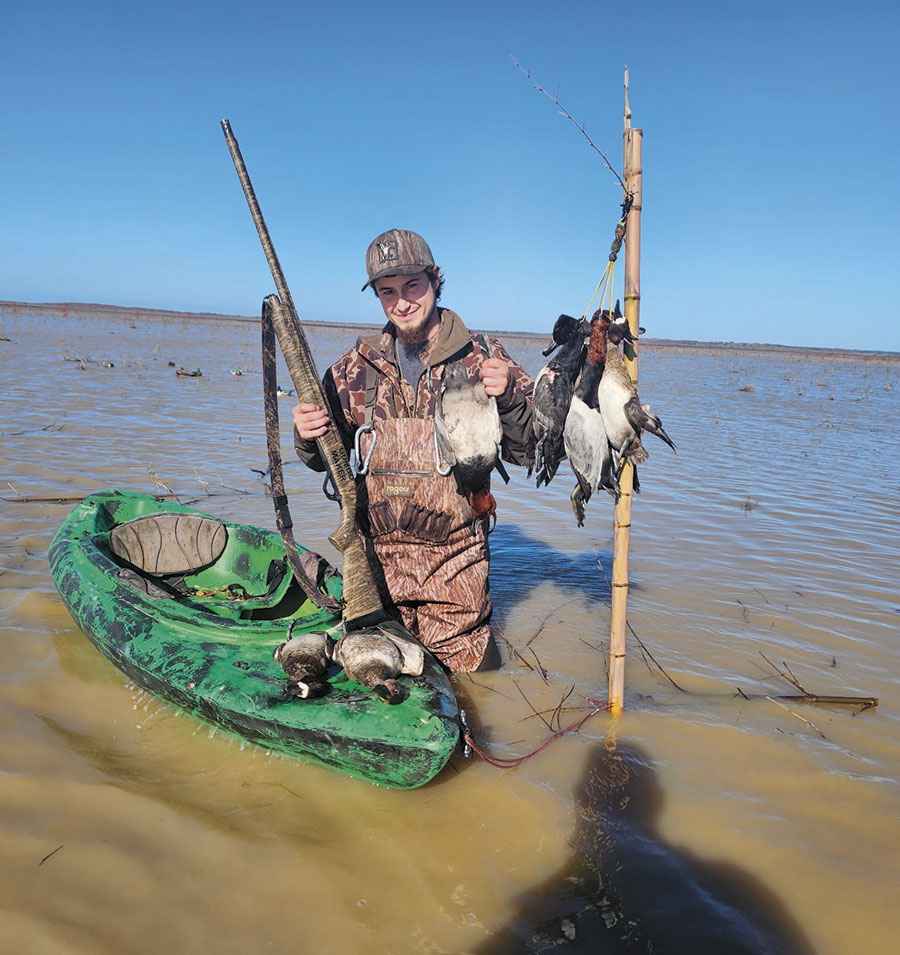
In other words, Sabine Island WMA is the lone legitimate duck hunting hotspot on public land in southwestern Louisiana. Veteran LDWF biologist manager Kori Legleu-Buxton described the WMA in her annual report for Louisiana Sportsman.
The 8,343-acre Sabine Island WMA has extensive stands of mature cypress-tupelo swamp and many bayous, sloughs and ponds, Legleu-Buxton said.
“Habitat conditions can be quite variable from year to year, or even day to day, and are primarily influenced by river stage and precipitation,” she said.
Overall, duck usage is moderate compared to other coastal marshes and agricultural impoundments, Legleu-Buxton said, but wood ducks are plentiful enough to make it worth the trip.
The Sabine River WMA’s duck harvest in 2025-26 was 64 ducks, one per 135 acres, and 0.41 per hunter effort, she said, adding the total was down from 155 ducks in 2024-25.
Duck hunting success there tends to be slightly higher during the second split, according to Legleu-Buxton.
As for the region’s other WMAs, a few wood ducks can be found on various streams and ponds.
“Surprisingly, several of these upland WMAs had higher success rates (duck per hunter effort) than Sabine Island last season, with Clear Creek hunters taking 1.07 ducks per effort (15 hunters harvested 16 ducks), followed by Fort Polk-North, where 16 hunters harvested 14 ducks (0.88 ducks per effort),” Legleu-Buxton said.
Minden Region
Bodcau WMA, a 33,766-acre public area in Bossier and Webster parishes, recorded the top duck harvest among Minden Region WMAs in back-to-back seasons and appears primed for another good season in 2026-27.
Weather and water conditions since last season haven’t impacted that or any other WMA in the Minden Region, according to LDWF Biologist Manager Jarrod Hughes. The duck hunting outlook is fair to good as wood ducks, mallards and gadwalls, the predominant species found in the region, head this way.
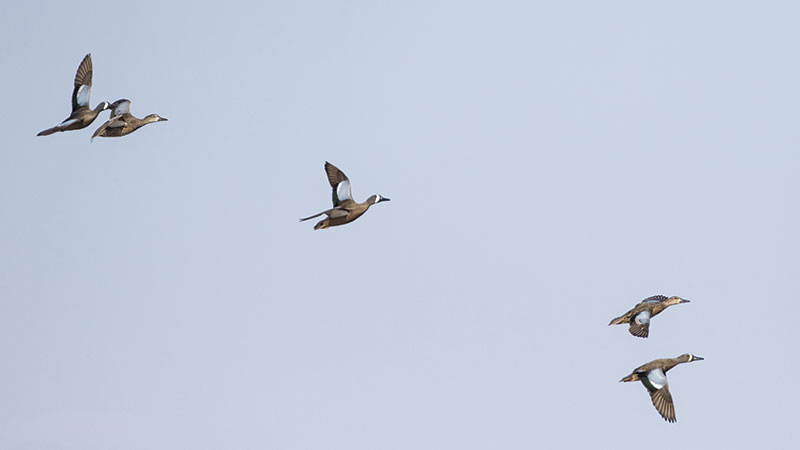
Hughes reported that three WMAs provide the most habitat and opportunity with green-tree reservoirs, ponds and sloughs to hunt.
Bodcau WMA reportedly gave up 832 ducks during the 2025-26 season and 1,132 ducks in 2024-25. Bodcau WMA’s waterfowlers got one duck per .68 hunter efforts last season, Hughes said.
The duck harvest at Loggy Bayou WMA last season was 628, or 1.76 ducks per hunter effort, compared to 509 ducks downed in 2024-25.
John Franks WMA duck hunters killed 266 ducks, .84 ducks per hunter effort, in 2025-26.
Duck hunting on these WMAs ends at noon.
Monroe Region
Two huge WMAs in North Louisiana typically have the highest duck harvests in the Monroe Region.
WMA Biologist Aidan Caruso said as much in her annual duck hunting report. The numbers back her up as Russell Sage WMA and Boeuf WMA reported duck harvest totals last season at 4,562 and 3,680 ducks, respectively.
Russell Sage WMA’s count was lower than the 6,451 ducks shot down the previous season on its 38,000-plus acres, while Boeuf WMA’s total was also lower than the 3,790 ducks harvested in 2024-25 on its 51,000-plus acres.
There’s a good reason duck hunters turn to those WMAs.
“Russell Sage has around 8,000 acres of moist soil units, 1,600 acres of swamps and sloughs and about 2,500 acres of greentree reservoir,” Caruso said. “On the waterfowl refuge, a pump was recently installed which will provide critical sanctuary for waterfowl.
“Boeuf has around 7,500 acres of moist soil units, about 1,800 acres of greentree reservoir and approximately 5,000 acres of lakes, swamps and sloughs. The Topan and greentree reservoir pumps on Boeuf have recently been repaired and are fully functional.”
Caruso believes the best time for duck hunting success in the region is near the end of the season when there usually is more water. However, the beginning of each split often presents more opportunities to bring down ducks because after they have been pressured there is a lull in the harvest.
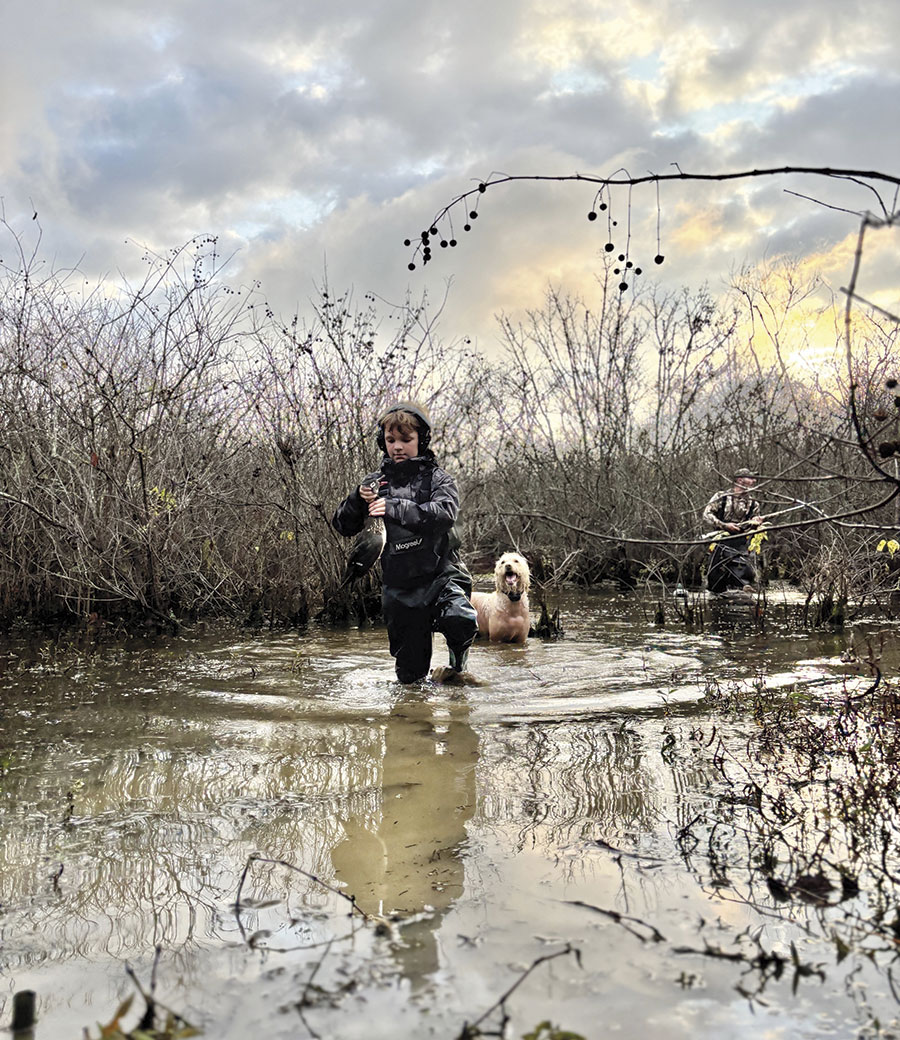
Still, early season duck hunting success on those public areas usually lags because there is less water than in November.
“The past few seasons, we have experienced extreme drought across the state, which has been felt by duck hunters in this region,” Caruso said. “We are dependent on rainfall to fill moist soil units and are unable to pump water in the units if the Lafourche Canal is too low.”
Pineville Region
A duck hunter’s paradise saturated with sloughs, moist-soil flats, borrow pits, flooded oak flats and impoundments awaits waterfowlers who haul their shotguns to a 63,984-acre WMA northeast of Pineville.
Set up by shooting time (30 minutes before sunrise) and hunt till at least 9 a.m. to get the best crack at wood ducks, gadwall, blue-winged teal, pintails and mallards that frequent Dewey W. Wills WMA. And once water depth increases, try the 2,440-acre moist-soil habitat inside the Little River Basin (formerly Catahoula Lake) for canvasbacks, ring-necked ducks, lesser scaup and redheads.
Vaughan McDonald, a veteran biologist manager for the Pineville Region in central Louisiana, pointed out that duck hunters reported 7,524 ducks (1.8 ducks per hunter effort) harvested last season on Dewey W. Wills WMA. The total is the highest on any WMA in the state in 2025-26.
It’s a popular public area where waterfowlers typically shoot a majority of the migrating ducks in late winter during the second split, according to McDonald. Temperatures and an increased availability of water usually are more favorable late in the season, the veteran biologist said.
McDonald advised duck hunters they must be off the WMA before 2 p.m. Also, duck hunting ends at noon (previously 2 p.m.).
Dewey W. Wills WMA’s newest regulations affecting waterfowlers this season include the prohibition on using vessels powered by internal combustion engines between noon-4 p.m. from Nov. 1-Jan. 31.
He said a severe drought in 2022 caused a large die-off of red oaks on the WMA, particularly Nuttall oak. The result is a reduced amount of hard mast available to ducks in flooded units.
Duck hunters harvested 281 ducks (1.02 ducks per hunter effort) last season on Alexander State Forest WMA, primarily within the Indian Creek Reservoir. McDonald recommended waterfowlers to bring a kayak or pirogue to put out decoys and retrieve ducks, or bring a retrieving dog.