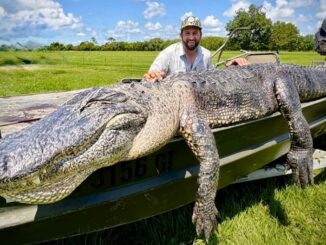
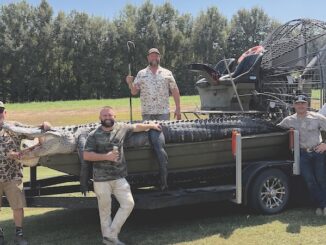
Two step brothers from California came to Louisiana to hunt alligators and made wildlife management history. Hunting with David Hanson of Monroe, the team bagged two impressive reptiles.
On Sept. 11, 2025, they approached the first line and knew they had a big one. Hanson’s son-in-law Trevor Fedoruk, a police officer, took first honors, bagging an alligator measuring 11 feet, 8 inches. Not to be outdone, his older step-brother, Jeffrey Lawrenson, found a 12-foot, 2-inch alligator on the next line.
“Five minutes into his first alligator hunt during his first visit to Louisiana, Jeffery caught a 12-footer,” Hanson said. “We hunted on Fletchers Lake, a private lake near Clayton on the border of Tensas and Concordia parishes. We were filming a local TV show out of Monroe called TP Outdoors Adventures with Bill Petrus.”
Older brother Jeffery took the prize for the biggest reptile, but Trevor scored the most interesting catch. His 400-pound bull wore a tag attached in August 1999. That alligator hatched in 1997. In 1999, the state released it near St. Joseph in Tensas Parish when it measured 38 inches long.

“That alligator travelled 26 miles in 28 years,” Hanson said. “We caught some big alligators over the years, but this one with the tag was a true trophy. The recapture of the oldest recorded tagged alligator in Louisiana since they started tagging alligators in the 1980s by two brothers makes it very special.”
Tag and release
After centuries of “shoot on sight,” the Louisiana alligator population bottomed out by the 1960s. As the population began to recover, the state allowed very tightly managed hunting again.
“In 1986, the Louisiana Department of Wildlife and Fisheries began allowing alligator farmers and ranchers to collect wild alligator eggs to supply their farms,” explained George E. Melancon, Sr., a biologist at Rockefeller Wildlife Refuge in Grand Chenier. “As a conservation measure, alligator farmers were required to release a percentage of the alligators that they hatched once they were grown to a certain size back into the wild from areas where they collected the eggs.”
The percentage released varied over the years, depending upon the status of the wild population. Before releasing each reptile, people would measure its length, record its sex and place a metal tag, originally designed for sea turtles, on each front leg. In addition, they made unique notches in its tail, a different pattern each year. That allowed biologist to know the animal’s age, even if the metal tags disappeared.

“We have a different sequence of tail notches by year going all the way back to the beginning in 1988,” said Jeb Linscombe, the LDWF alligator program manager in Lafayette. “This particular gator was the oldest one that retained a tag.”
Something special
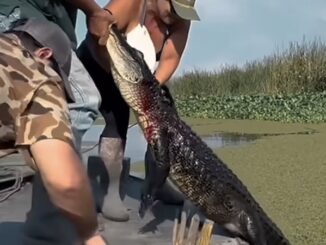
Hanson not only hunts alligators, but traps them for the state. When he saw the notched tail on the first alligator, he immediately knew he had a special animal in his boat. Then, he saw the metal band on its foot and called the LDWF. Later that same day, Hanson caught a gator measuring 8.5 feet.
Alligators usually live at least 30 years, if not caught. The big reptiles might live more than 50 years and exceed 15 feet in length.
“People think of alligators as apex predators with nothing in nature that can kill them,” Linscombe said. “That’s true once they reach a certain size. Juvenile mortality is very high. Only about 17 percent of all hatchlings reach 48 inches long. Even a 2-footer could fall prey to mink, otters and other predators. It takes an alligator about 10 years to reach about 6 feet long and become a breeding adult.”