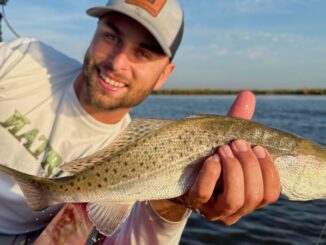
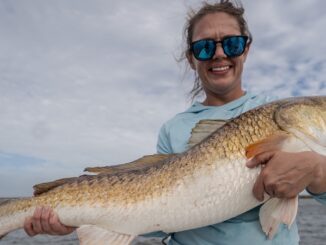
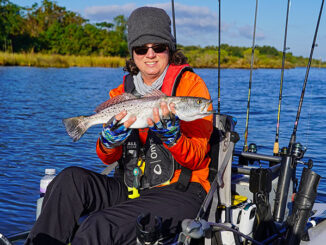
We are firmly into fall, and the trout have fully moved to the interior marshes. There is no better time of the year for kayak anglers to pursue limits of speckled trout across the coast of Louisiana. Typically, mild weather and no need for long paddles make for some great trips.
With a much calmer than expected 2025 hurricane season, there was little tropical weather activity to beat up the marshes. The grass beds in many areas will remain thick until they are knocked back by freezing temperatures later in winter. Although not as prolific in the grass as redfish, trout are still nearby, as these grass beds hold countless numbers of baitfish and other species trout prey upon. Live shrimp remains available in many areas, but the trout become more easily caught on artificial lures as shrimp become less abundant in the marsh with winter approaching.
This time of year is marked by recurring cool/cold fronts, but many mild days still provide for comfortable and productive kayak fishing outings. Techniques don’t change much other than slower presentations as the water temps continue to go down. During the milder stretches, trout can be found virtually anywhere throughout the marsh. Following stronger cold fronts with a drop of a few degrees of water temperature, the trout move to nearby deeper areas and tend to school up in these areas of slightly warmer water.
Search casting
On the cooler days, start off in the outside turns of bayous where the water has scoured deeper holes as opposed to the flats of the inside turns. Rock jetties and dams warm quickly on bright, sunny days and the slight temperature increase in adjacent waters triggers more feeding activity. As the day wears on, they may spread onto nearby flats.
Successful techniques vary widely during this time and virtually any live, natural or artificial baits put trout in the kayak. The biggest key to catching trout is finding them. Cast search lures like a popping cork, spinner bait, Rat-L-Trap or tightlined plastics to cover all directions around the kayak and various water depths. Once located, pay attention to where and how you just caught a fish. More often than not, repeating that same cast and retrieve produces more fish.
If the bite slows, resist the urge to pick up and look for other areas. Odds are that the trout have simply moved from that particular spot but may still be close by. Move to the closest productive looking spots and repeat search casting in all directions. Not only may the fish have moved horizontally, they may have moved vertically also. Having a few rods rigged with different lures makes for quick work throwing lures to try different actions and depths. Again, once you find them, you should be able to repeat the success cast after cast.
When you decide to move to a different area, be sure to cast and/or troll along the way. You’ll have no idea if you’re passing up fish if you move along without having a lure in the water. Many times you’ll stumble on fish in an area you were least expecting and may have simply overlooked.
Pick your days
With no thunderstorms this time of year, the weather patterns are more predictable. Watch the forecasts for fronts and avoid days when they are coming through. There is no need to get beat up on windy days when calmer days are on the way. While fish can certainly be caught right after a front, a couple days afterwards are usually best. The weather has stabilized and the water is likely a bit cleaner, both making for increased feeding activity.

Once you have a general fishing location in mind, check out maps or Google Earth to locate potential hot spots before you even launch the kayak. A little research can save unnecessary paddling time and increase your fishing time. Make a plan to fish a few different areas that provide a variety of features where you expect the trout may be holding.
Note any structures or funnels that may concentrate moving water. Hard falling tides out of a small drain into a larger bayou can be killer spots this time of year. Stake out the kayak where you can cast your lure into the current and work it to mimic a shrimp or baitfish being carried out with the tide.
Techniques to use
Cuts, coves and rock jetties are always high-percentage spots. Slow trolling along a rock jetty covers lots of water, and when a fish is caught it is easy to repeat the action. Although not completely necessary, a depth finder can be a useful tool this time of year. Deep water in the marsh may be a relative term, but a change of just a few feet in depth can make all the difference in the world. Make a mental note to quickly glance at the depth when a fish is caught. Repeating that same technique often proves productive.
If you find a strong cold front has dropped the water temps several degrees, look for deep holes or drop-offs where the trout may have piled up. Again, a depth finder helps locate these areas and can show marks on the screen identifying the presence of fish. A technique borrowed from the bass fishing world called drop-shotting works well on schooled trout. A simple rig with a sinker on the bottom and a hook tied in-line 12-18 inches above allows for vertically dropping your bait or lure directly into the fish. This technique works well with live bait and soft plastics.
Although this is the second year since the new trout regulations went into effect, a reminder is always good. The size limits require a 13-inch minimum length and a maximum length of 20 inches. However, anglers can keep two fish over 20 inches in the daily limit of 15 total speckled trout.