On a warm afternoon in Lake Charles, I sat at a table on the patio of the home of Paul Brown.
For well over an hour, I discussed bait design, production and fishing techniques with Paul Brown, his son Steve Brown, and Capt. Bruce Baugh. Baugh lives next door and Steve Brown had traveled in from his home in Pearland, Tex.
I took this opportunity to learn every ounce of information I could about the creation of the original Corky to the modern-day production still within the Brown family.
The world of saltwater trout fishing has evolved over the last 50 years to include vast improvements in artificial lure design and construction. Louisiana and Gulf Coast anglers in pursuit of large trout are aware of the name Paul Brown and the Corky saltwater baits.
As an expert craftsman, Paul Brown started creating saltwater artificial lures inside his garage in Houston, Tex., in 1974. The Corky has since been responsible for catching many of the largest trout in the South.
Paul Brown was always an avid angler. In conversations with fellow anglers, he would often discuss the best trout baits, colors and designs. Discussions around the old “Tout Tails” of the 1970’s led him to believe he could design one himself in a version that was more suitable for saltwater fishing. He designed his own version of a shrimp tail and would often share his creations with other anglers and guides.
The Corky is born
In the early 1980’s, Paul Brown had a conversation with a friend named Bubba Silver, who asked him if he could design a Zara Spook type bait in soft plastic for saltwater trout fishing. Paul Brown, not wanting to do a knock off of the Zara Spook, tried something else.
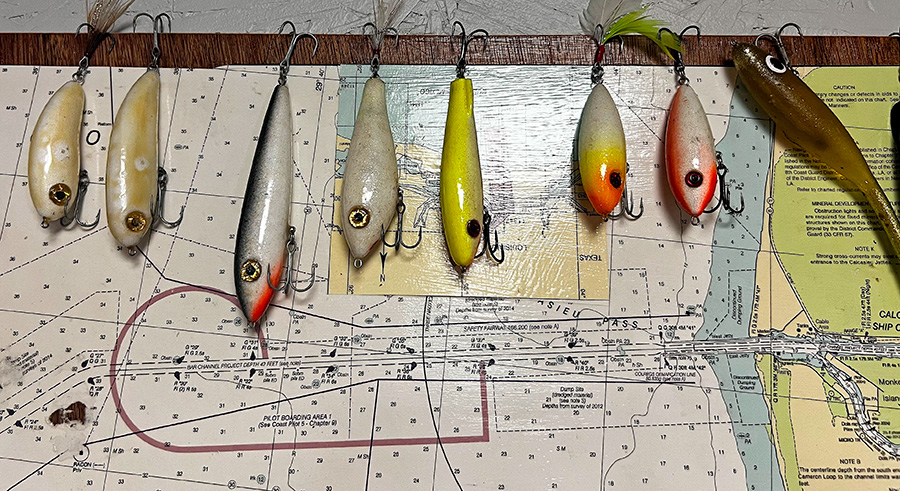
“I began carving wooden baits in the original design creation of what today is the Corky,” he said.
Paul Brown would use wood and hand carve the bait into the shape that he had envisioned. But he said the first design he created had a significant flaw.
“When retrieved through the water it would spin uncontrollably,” he said.
A proud veteran that served in the United States Navy from 1955 to 1959, Paul Brown had seen submarines and their basic design. That inspired an idea to stop the spinning.
“I realized that if we widened the tail end of the bait and created some tail stabilization, then the bait would swim true,” he said.
The modification proved successful and the very first version of the Corky was born. During the early years of this bait design and prototype creation, Paul Brown would meet at a place called Pine Plaza in Dickerson, Tex., with other anglers.

“We would discuss types of baits and color variations that were successful,” he said.
It was a “think tank” for artificial bait design and colors. The owner of Pine Plaza later became the organizer of the first spotted seatrout tournaments in South Texas. This feedback among anglers and guides was helpful in the beginning of Paul Brown’s design of saltwater baits.
Increased demand
By the late 1980’s to early 1990’s Paul Brown had finally created what he felt was a solid version of the Corky. The wooden hand-carved bait served as the model for a mold to make the bait in soft plastic. The soft plastic version went into prototype production at his home.
Paul Brown used the Corky often in field trials and shared the bait with other anglers and guides. It began to gain traction, and by 1996 Jim Wallace of Texas caught the Texas state record spotted seatrout weighing 13 pounds, 11 ounces, and measuring 33 1/3 inches long on a Corky designed and created by Paul Brown.
As one can imagine, even in a world with no internet, the word got out fast. Paul Brown began building and selling baits with an increased demand for the productive lure. He has never had a contract with a mass production facility and all the baits he has sold were made by his own hand and sold from his home. This newfound fame landed the Corky on store shelves for the first time. The most popular designs created by Paul Brown were Fatboy, Devil and the Corky.
Over the next 14 years the baits became increasingly popular. In fact, Paul Brown had difficulty keeping up with demand. His lures caught the attention of MirrOLure and negotiations began to sell the rights for the designs. In 2010, he sold the designs to MirrOLure for the Fatboy, Devil and Corky.
A new era
In the same year, Paul Brown began working on a design for a new bait named the “Broken Back Corky.” The basic design was to create a two-piece bait that would allow for the tail section to move freely and create more action on retrieve. Paul Brown worked closely with Capt. Baugh in field assessing the bait and it is now marketed by his son, Steve Brown.
Baugh has a very specific retrieve he prefers when using the Broken Back.
“You make two short twitches that are followed by a longer, slower draw,” he said.
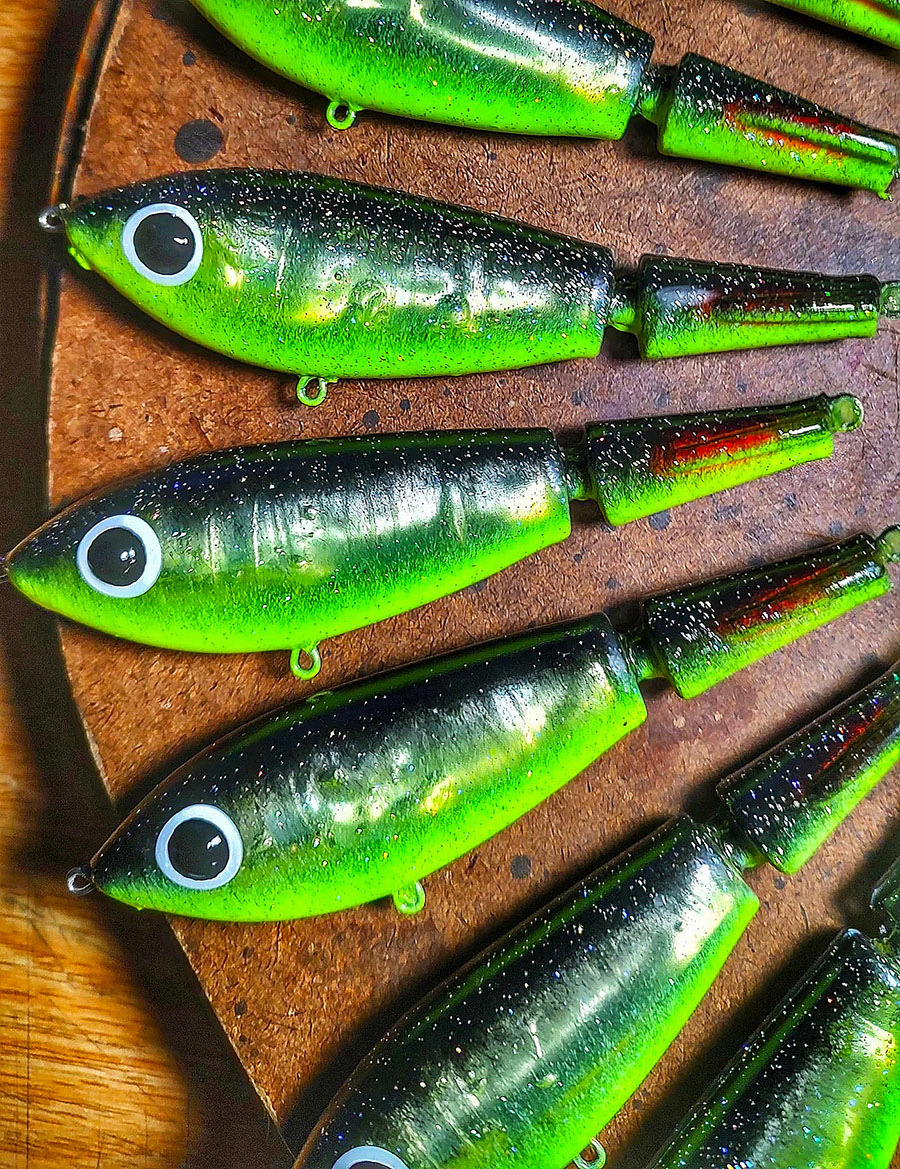
Baugh insists that the angler leave enough room at the top as the bait is drawn back in a slow pull to allow for a proper hook set when a fish strikes. He has used Paul Brown baits for many years and still does today as he guides clients around the Calcasieu Lake estuary.
Steve Brown has been around the bait design business all his life. He has collaborated closely with his father in the design and creation of the Brown brand and has taken over as the company lead of design, production and sales.
Steve Brown, like his father, does not work with mass production companies and creates every single bait by himself in his own shop. He creates baits in batches and posts them to social media when they are ready for sale. He can be found on Instagram and Facebook, and following his posts is the only way to know when baits are available for sale. I will advise you to turn on your notifications and be ready as soon as a batch is posted. In my experience, you have about 15 minutes to make a purchase or the batch will be sold out.
Steve Brown handles production and sales for the Broken Back, Peanut and Bug Eye baits and he is a true expert in the craft, producing an incredible product.
What the future holds
During my visit with the three men, I was given a behind the scenes look at bait prototypes and the creation of these baits. This included a look back in time at old production methods and old prototypes. Steve Brown pulled out a few baits to demonstrate on the banks of the bayou at his father’s home. I watched as these experts dissected the actions of the bait upon retrieve and how design changes can impact the action of the bait in the water.
Steve Brown pulled out a lure to demonstrate a retrieve but prefaced this demonstration by letting me know that I could not take any photographs of the bait, I could not describe the bait design, nor could I describe the action of the bait when retrieved. It was clearly a top secret prototype.
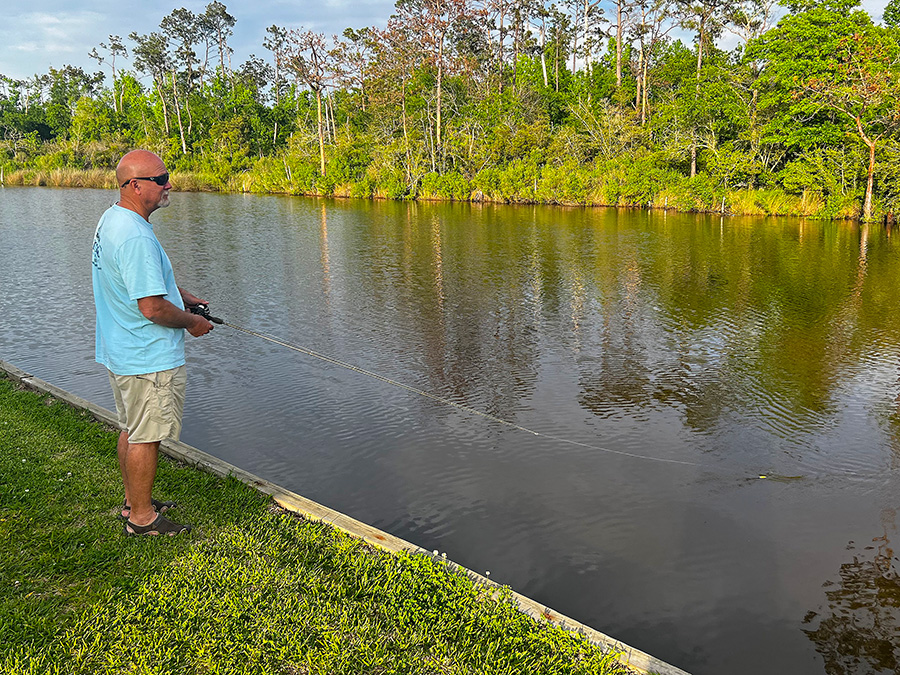
I suddenly reflected on my own time in the military and the world of variations of classified and protected information. It was as if I was suddenly in the middle of a modified Cajun and Texan classified briefing. I felt so incredibly privileged to be allowed to see the prototype bait up close and in action.
In print, I can only say that I strongly suggest following Steve Brown on social media and at steveslures.com. In the not-so-distant future, a new and innovative design is coming and it is a concept I have never seen before. My examination of the bait left me astonished by the action of it in the water. My experience was a clear demonstration that the Brown family tradition of lure design and creativity is as strong as ever and continues to grow today, some 50 years after its origins.