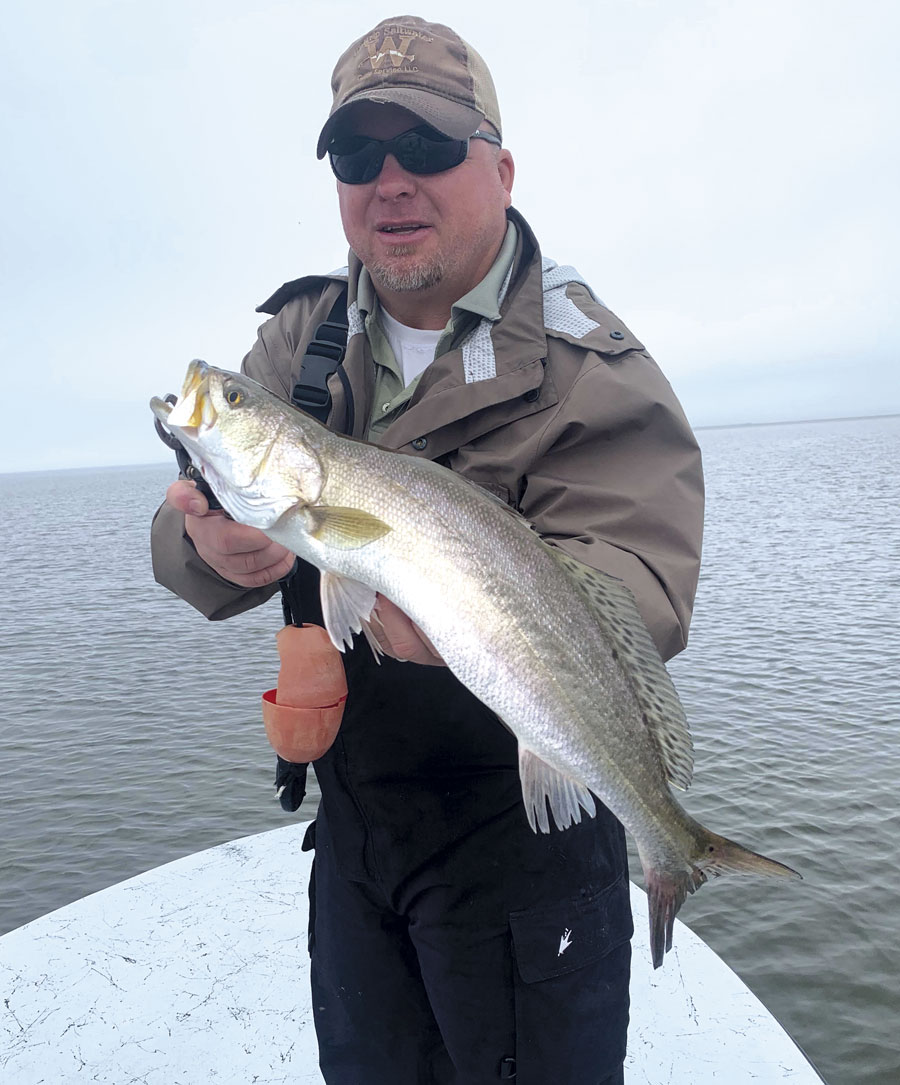
The wintry weather chase for speckled trout in Southwest Louisiana can be an incredible challenge in December. I have spent some time on the waters of Calcasieu Lake, also known as Big Lake, and December often equates to a cold boat ride accompanied by challenging conditions.
Capt. Jeremy Waltrip, owner of Waltrip’s Saltwater Guide Service LLC, has been a Big Lake guide for many years and has fished the Calcasieu Estuary his entire life. Waltrip is a bit of a local legend and is known as a straight shooter when it comes to all things saltwater fishing. I sought out his advice on fishing Big Lake this month.
Waltrip pointed out that December trout fishing can be tricky and that weather conditions are the most crucial factor. He looks for a good warm day in December with low winds to target the most productive spots. The trout congregate in shallow water areas over dark mud bottoms or shells where the water temperature warms more quickly. Finding these shallow, warmer water areas near deep water transitions is a key factor in locating trout.
This slightly warmer water can include flats near drop-offs, marshes and bayous that feed deeper water. Warmer trending days can change the temperature of these shallow flats over dark bottoms and shells as much as 5 to 10 degrees after just two to three days of 70-degree weather. This attracts all variations of saltwater species in pursuit of baitfish and crustaceans. Anglers should watch for a weather spike leading to water temperature increases for the best opportunity.
Waltrip targets the 2- to 4-foot depths, working baits that mimic fish.
“I prefer to fish baits like the Catch 2000, Corky and soft plastics on a 16-ounce jig,” he said.
Find out what the fish are eating
In the colder water, the retrieve is much slower than summer. The use of live baitfish or shrimp can also be productive. Waltrip suggested locating schools of baitfish and using a cast net for a variety of saltwater minnows and mullet to produce a solid bite.
A key point he made that many anglers overlook is the stomach contents of fish they catch.
“I like to see what the fish are eating,” he said.
Examining what the fish are eating at various times of the year can provide great information on where to find the fish and how to catch them. Waltrip pointed out that the summertime 12-to-13-inch trout may have put on another inch or two by December, after the summer spawn. He averages larger fish in the late winter.
Waltrip suggested avoiding the days with stronger winds that can make locating feeding trout exceedingly difficult. These colder days can also make for an incredibly uncomfortable boat ride. My father, a veteran winter angler, once told me that “40 degrees at 40 mph in a bay boat is not a 40-degree trip!” In fact, the wind chill for such a ride is about 25 degrees. This translates into an angler planning for a trip that includes layered clothing, where items can be added for traveling and removed after stopping for longer periods to fish various locations. I like to add hand warmers, light gloves and a face covering, especially for the first run of the morning. Do not underestimate the impact of a winter boat ride.
If you look for the warming trends, focus on a slow retrieve and target the right shallow warmer waters, a successful December trout chasing adventure could be in your future.