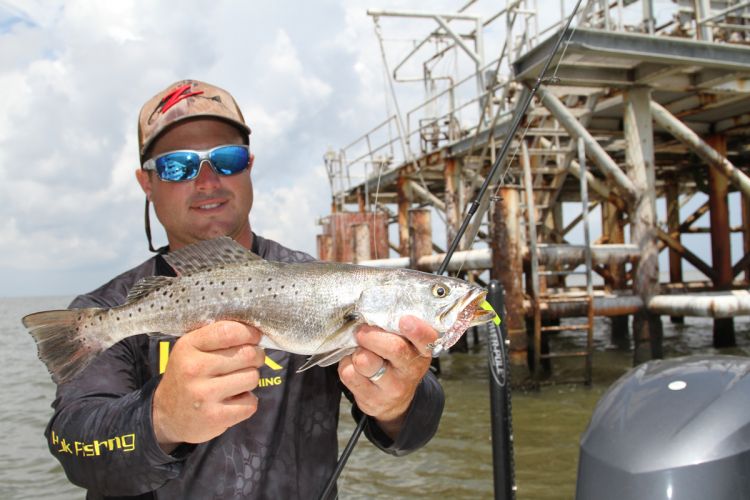
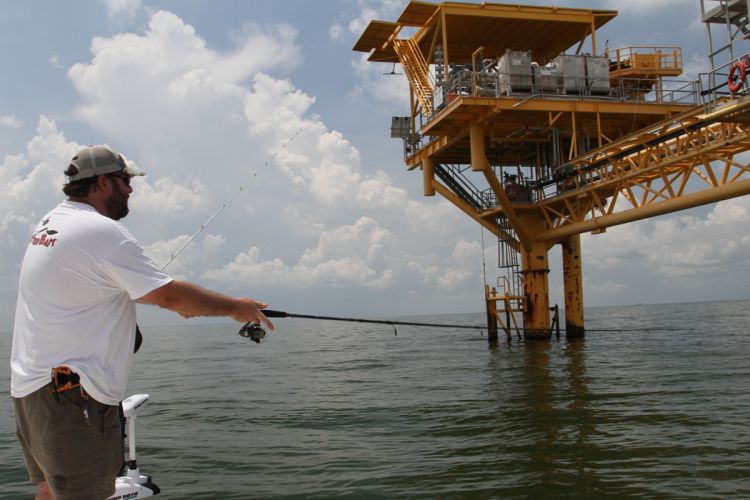
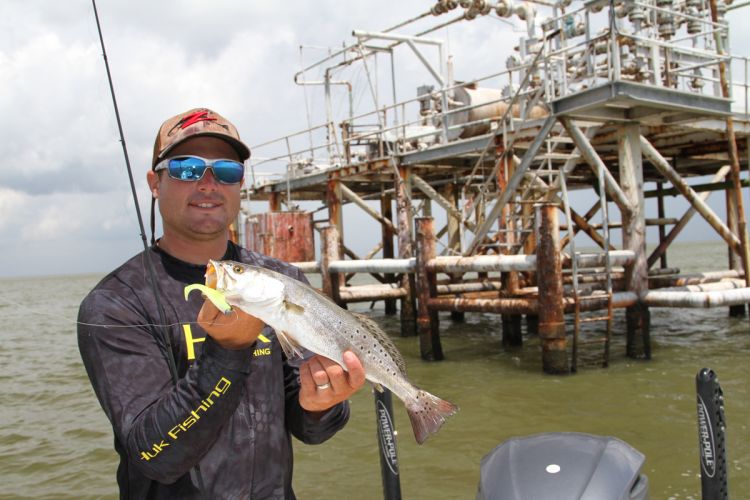
The mouth of the Mississippi River is ringed with nearshore structures that are trout magnets. And these guides share their knowledge about how to score every time you head out.
Everyone loves a hot Delta bite, but you can expect the action to cool off when the weather heats up.
OK, if you don’t mind wading through the pun puddles, this is actually a straightforward premise: When summer’s swelter has the inshore fish languishing in lethargy, you’ll find your brightest opportunities where the warm-season discomfort has minimal impact.
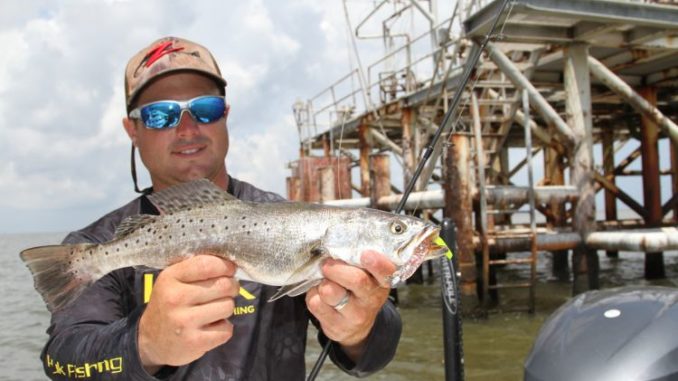
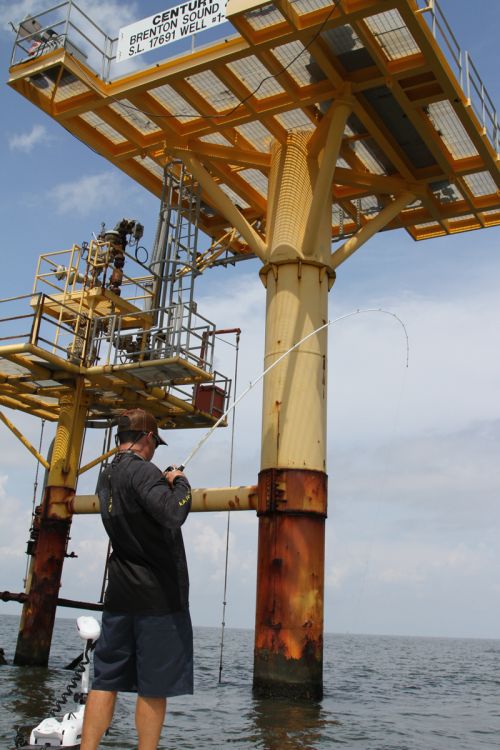
Indeed, when inshore waters feel like a bathtub, turn your attention to the rigs, and the various pumping stations and support structures scattered along the Delta’s perimeter.
There, some of your top coastal species find cozy digs with plenty of features to keep them happy.
“During the summertime, water temperatures in the shallows are very warm, which makes oxygen levels go down, so fish move to the deeper water, which tends to be cooler,” said Capt. Ross Montet of Buras-based Cajun Fishing Adventures.
So what do nearshore rigs have going for them?
• Shade: Montet said the shadows help keep the water temperature a little cooler, and this time of year every little bit helps.
• Fortress: Anglers aren’t the only predator looking for trout, redfish and their buds. Sharks and dolphins present constant threats, and rig structure offers lots of hiding spots.
• The gang’s all here: Just like their offshore counterparts, nearshore rigs host entire ecosystems of progressively larger forage that ensures a constant supply of food for trout, redfish and the like.
• Current breaks: Water breaking around solid objects create current dynamics, which facilitate feeding.
Expect the fish to loosely roam a rig’s structure and perimeter during slower tidal periods, but they’ll pull tight to the legs when the current increases.
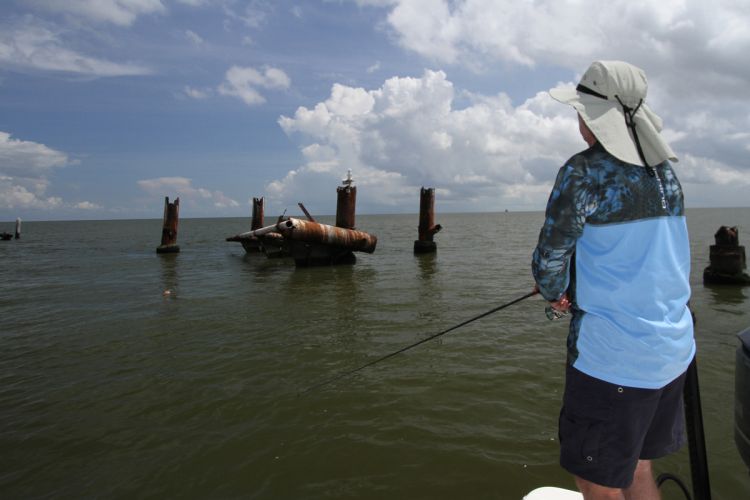
• Additional structure: Montet likes rigs with additional piers, especially crumbled structures with lots of junk in the water.
The shell pads upon which rigs are erected solidify the footing but also preovide more fish-attracting structure.
Hard stuff always interests coastal fish, but the shells also harbor a lot of the wriggly, crawly crustaceans and invertebrates that reds, drum, sheepshead and even trout like to munch.
Following are some thoughts on how to effectively fish these shallow structures.
Find the right rig
Given the vast number of structures dotting coastal waters around the mouth of the Mississippi River, selective targeting is the first order of business.
It’s great when you limit out on the first one you visit, but a typical day finds anglers hitting a handful of structures, with two or three producing most of their fish.
Here are some of the considerations:
• Which side: Of the west/east Delta decision, Walbaum said there’s a pretty clear-cut way to figure out which should be best.
“Wind is the biggest factor,” he said. “You try to get the least amount of wind possible.”
This, he said, affects a few key considerations.
First the run out and the run back are directly impacted by wind speed and direction.
And, from an angling proficiency standpoint, battling a blow not only challenges casting and boat position but it leads to unnecessary noise.
• Depth preference: While some of the structures right outside the Mississippi River’s passes might be as shallow as 5 feet, Walbaum rarely goes less than 10 feet in depth.
He finds plenty of fish between that range and about 25 feet.
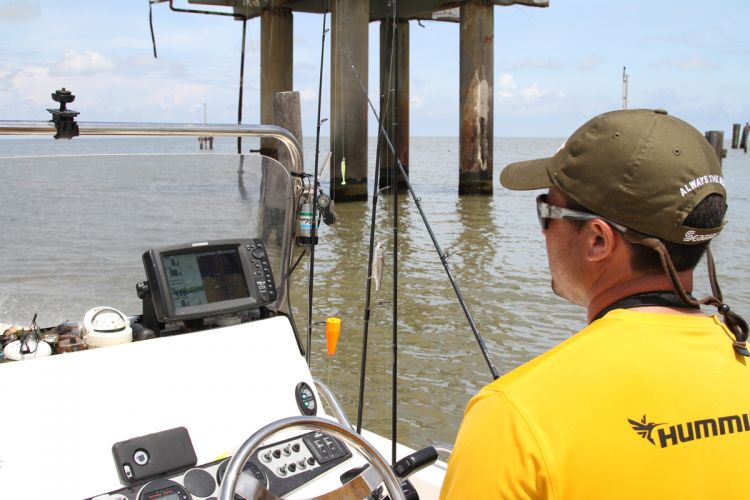
• Take a peak: Few technological advancements have aided anglers like side-scanning and forward-looking sonar.
From Humminbird 360, to Lowrance Side Scan, to Garmin Panoptix, the ability to look beneath a rig gives anglers a tremendous advantage over the cast-and-hope route.
Montet calls this a serious time saver that helps him identify fish, the bait they seek and key pieces of structure that could be worth a couple more passes.
Productivity often comes down to time-management, so eliminating unimpressive rigs allows more time to find one that’s loaded.
• Watch the weather: Every time I visit my pals at Cajun Fishing Adventures in Buras, I can count on two thing: enjoying a generous portion of Redfish Ryan (a crab/shrimp-stuffed delicacy created by lodge owner Ryan Lambert) and getting chased off the water by a pop-up storm.
These sudden, intense Delta weather systems are no joke, so take Montet’s advice and don’t overstay your visit when skies are darkening.
Summer storms, he said, might appear far way, but you’ll get busy fishing, and when you turn around the monster’s bearing down on you.
Frequently glancing around your position is the fail-safe method for avoiding potentially hazardous surprises, but also pay attention to drastic lighting changes: When that surface glimmer shifts to an ominous darkness, you can bet there’s a thunderhead stacking skyward.
And when you feel that spine-tingling rush of cool air, it’s time to go.
I’ll never forget a productive day of fishing rigs in Breton Sound with Montet and Z-Man’s Joey Prochazka when a particularly nasty storm snuck up on us.
OK, Joey, it didn’t sneak up on us; I took too long with my photos.
Anyway, you know you’re out of time when you hear the crack and it feels like your eyebrows got a perm.
“Yeah, let’s not do that again,” Prochazka said when we finally reached Baptiste Collette Pass.
Yep.
How to fish them
You’ll always fare best by working with the tide. That’s why Montet likes to start where the tide is breaking around a corner of the rig.
Presentations that come downcurrent look more realistic than a bait retrieved against the flow.
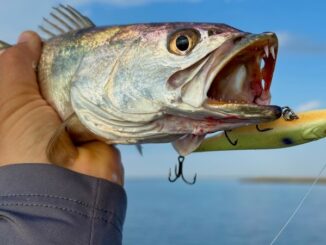
Day in and day out, you can’t go wrong with jigs, and Walbaum finds ¼- to ½-ounce heads plenty for the nearshore rigs.
Bait tail styles are pretty much a matter of preference, but Walbaum suggests matching colors to water clarity.
“The darker or muddier the water, the brighter the bait,” he said. “If you have really clean water, you want more-subdued colors.”
As Walbaum pointed out, jigs are perfectly suited for reaching fish holding closer to the bottom. Such is often the case on deeper rigs, but when muddy river water reaches nearshore rigs, the jig is just what you need for quickly overcoming what might initially appear as a bite-killer.
“Saltwater’s heavier than freshwater, so sometimes there’s a split,” he said. “You’ll have really clean, green saltwater 4 to 5 feet down. Trout in particular will hang right there below that dirty water.
“You can throw your jig and let it drop 5 to 6 feet to where it hits the saltwater, and they’re waiting right there. They bang it.”
Venice guide Capt. David Iverson loves the West Delta rigs, and he believes a lot of the area’s bull reds live on these structures year-round.
The fish might move from one rig to the next, but one thing’s consistent —the size.
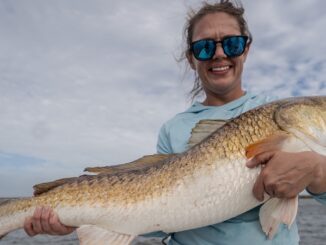
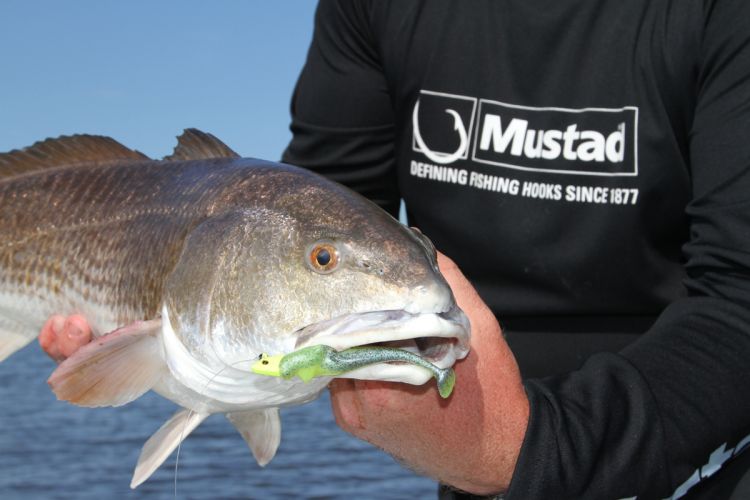
“When you catch a redfish out on the rigs, it’s going to be at least 10 to 12 pounds, and those are the babies,” Iverson said.
He targets rig bulls by casting upcurrent and bouncing a ¾- to 1-ounce jig along the structure.
In deeper spots, he favors glow tails, as the fish can spot them better in the dark water.
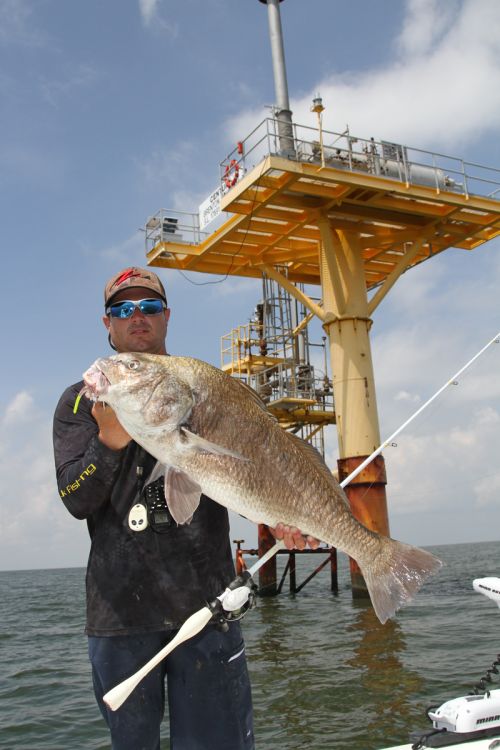
In addition to trout and reds, those light jigs will also tempt some pretty hefty rig denizens. If I wasn’t already convinced of Montet’s mettle, I certainly tipped my hat to the young man when he did battle with a pair of 15-pounders — one black drum and then a big, nasty jack crevalle — that took a liking to his Z-Man Trout Trick.
For just about anything that feeds on baitfish or crustaceans, a jig is tough to beat in terms of castability, presentation variance (hopping, swimming, dead sticking) and the ability to quickly change tail size, shape and color.
Experimenting with different looks will help dial in what the fish want on a given day.
Float rigs: Walbaum said he’s not much of a live-baiter, but when he does turn to the real thing, slip-float rigs set for the specified depth and long fluorocarbon leaders are his bet for presenting live baits like shrimp and croakers to trout or whomever’s hungry under the rig.
Popping corks: These are particularly effective around shallower rigs and anywhere you want to make a controlled drift past a target zone. Cast upcurrent and let the water bring the rig back your way, as you pop and take up slack in steady measure.
In a perpendicular scenario, where the current runs along the side of the rig you’re facing, you can make long sweeps across the side of the rig by casting upcurrent.
The difference here is that, instead of working the cork back to you, it’s working parallel to your position. Pop the cork on a semi-slack line so you don’t pull it too far off course with each tug.
Hard baits: Trolling lipless crankbaits or diving plugs appropriate for the depth you’re fishing offers a low-effort way to test a rig for productivity before committing to a full-on casting effort.
Topwaters occasionally yield exciting early morning bites on shallower rigs, but once the sun gets up that deal’s done.
Mackerel and bluefish make occasional appearances on nearshore rigs, so cast spoons or Gotcha plugs with wire leaders around the perimeters.
And if you spot what looks like a piece of trash floating by the rig, toss a live shrimp under a cork and you might score a tasty tripletail bonus.
Iverson said it’s this diversity that keeps him coming back to the nearshore rigs.
“In the winter months, when you fish with artificials in the marsh, you might catch a trout or a flounder, but 90 percent of the time, when you catch a fish on an artificial it’s going to be a redfish,” he said. “But on the rigs, you never know what you’re going to catch.
“One time, I dropped a ¾-ounce jig down there and a king mackerel bit it on the way down. We chased that thing all over the place until we finally caught up to him.”