What would bass fishermen say if a commercial operation was allowed to take 22,000 adult, breeding-sized largemouth and/or Florida-strain bass from their favorite lake?
Or, for that matter, the reaction from any freshwater angler if that activity was allowed to take 10 times that many sac-a-lait and hundreds of times more forage fish from that same lake?
OK, so let’s not confine it to one lake. Let’s spread that misery around and divide that kind of operation to three highly productive lakes like Toledo Bend, Bussey Brake and Caney Lake.
Riots? Maybe, but certainly the reaction would reach far beyond the banks of those vaunted fishing holes, certainly to our State Legislature and assuredly to the governor’s office.
Fishermen would demand accountability, change and drastic action.
What if that happened in our vast saltwater fishery?
Well, it does, and how long will it take for the hundreds of thousands of Louisiana saltwater fishing license holders to demand more than the current restrictions imposed on the commercial menhaden industry operating off Louisiana’s coast.
Oh, it took decades for our elected officials to decide to impose at least a modicum of regulations on the two foreign-owned commercial menhaden fishing businesses operating here.
And, it wasn’t until 2024 when a push for a one-mile “no-fishing” zone off our coast was pushed back to a half-mile ban by order of Gov. Jeff Landry.
Make no mistake, these businesses love fishing Louisiana. The bulk of the annual menhaden catch comes from our waters — our state waters.
Results of the study
So, July 8, during the Wildlife and Fisheries Commission meeting, the long-awaited bycatch study — conducted by LGL Ecological Research Associates — showed commercial menhaden operations conducted their business with 3.62 percent bycatch, a figure below the 5 percent bycatch rate our state allows West Bank and Omega Protein (names of the foreign-owned companies) to take when they collect the catch of menhaden from their purse-seine nets.
This is from LGL’s study: “In total, 62 different bycatch species were encountered. Average: 59.8 individuals per sampling cage. Mostly smaller bycatch species mixed with menhaden. Atlantic croaker, sand seatrout, spot, and white shrimp comprise 84 percent of the estimated total retained bycatch by number and 51 percent by weight.”
Immediately after this study, some folks went to their calculators and figured out from all the charts and graphs in the presentation that the breakdown meant the bycatch totals included:
240,000 speckled trout
80.592 million croaker
24.75 million white trout
11.7 million spot
5.7 million white shrimp
were RETAINED in the catch.
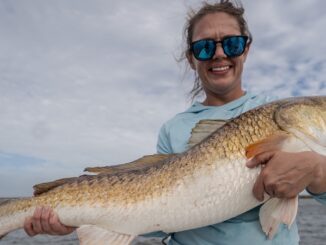
And the total number of redfish killed goes up past the 22,000 redfish when 8,354 reds are added to the retained catch.
What’s more, add Spanish mackerel, gafftopsail and hardhead catfish, hognosed rays, flounder and sharks to this list.
Need more?
When the push came for the one-mile barrier, it meant menhaden boats would have to do their work in deeper water, and the LGL study clearly showed bycatch rates in the aforementioned species dropped, clearly pointing to the need to push these operations farther offshore.
The numbers were derived from 418 onboard observations by LGL teams. The menhaden industry reported 13,144 sets made in 2024. The 3.6 percent (by weight) bycatch mortality rate was determined by the 418 then pushed out into the total number of sets to get a total.
One more oddity gleaned from the presentation was the lack of study in sets made off Louisiana’s far western coastal waters, where dead redfish floated up on Cameron Parish beaches after a menhaden boat was forced to ditch its catch.
The health of our waters
Let’s not quibble here: the menhaden folks like to tout they’re staying under the 5 percent bycatch regulation. LGL’s study shows that.
Yet, let’s go farther: the industry’s reported 13,144 sets in 2024 is, by reports, some 4,000 fewer than previous seasons’ averages.
Next step: the National Oceanographic and Atmospheric Administration reports the total menhaden catch averages 600,000 metric tons and LGL’s report indicated the average take from Gulf waters is “…500,000 metric tons over the last decade. Majority of landings occur in Louisiana: 93.5 percent in 2024.”
So, 93.5 percent of 500,000 metric tons equals 467,500 metric tons from Louisiana.
A metric ton is the equivalent of 2,204.62 pounds.
Which means the total catch weight from Louisiana waters is a staggering 1,030,659,850.
And, at 3.6 percent, the weight of the bycatch from menhaden operations in Louisiana totals 37,103,754.6 pounds — that’s millions.
While our state allows 5 percent and the 3.6 percent seems reasonable to some — and wouldn’t we all be satisfied if our rate was 3.6 percent for sales and income taxes — that 3.6 percent translates into much, much more when it comes to the overall health of our coastal waters.
It’s with an apology it took so long to get to this point in the story, but multiply that 37 million by 10 years, by 20 years, by 30 years and even longer when eyes were not so trained on how this commercial operation worked along Louisiana’s coast.
Maybe it’s time to reconsider just how much this industry touts its $419 million economic impact on our state compared to the $3.7 billion of recreational fishing, or how it touts $25 million in state taxes it contributes when recreational fishing adds at least 10 times that amount to Louisiana.
It’s just time!