See where European powers clashed over Louisiana
When European powers fought for control of North America, both Spain and France claimed what became western Louisiana. France established Fort St. Jean Baptiste at Natchitoches in 1714, the first European settlement in modern Louisiana.
Spain considered the territory part of its Tejas (Texas) province. In 1716, Spain established six missions just west of Natchitoches. After a French attack from Fort St. Jean Baptiste in 1719, the Spanish established the Presidio Nuestra Señora del Pilar de Los Adaes (Fort of Our Lady of Pilar at the Adaes). They named it after the Adai native people who lived in the area. Los Adaes served as the Tejas capital from 1721 to 1773.
“Los Adaes was the symbol of New Spain in Louisiana,” said Raymond Berthelot, the Parks Administrator for the Louisiana Office of State Parks. “It was the scene of a unique cooperation among the French, the Spanish and the indigenous Native Americans. An area rich in archaeological finds, it thrives today as one of Louisiana’s most intriguing state historic sites.”
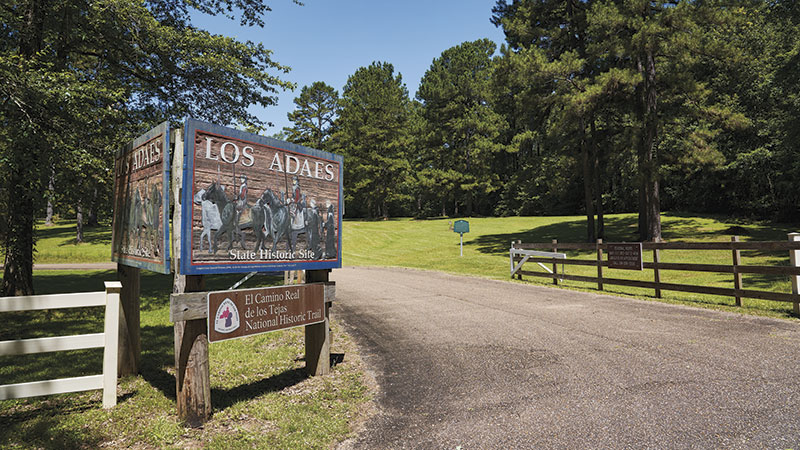
Now preserved as the Los Adaes State Historic Site, the property sits at 6354 Highway 485 in Robeline in Natchitoches Parish. The site became a National Historic Landmark in 1986.
The site covers approximately 60 acres. People can visit a small museum, operated by the Cane River National Heritage Area, walk trails and view a series of signs indicating significant aspects of the site.
Culture and traditions
Although colonial rivals, the Spanish and French soldiers and settlers in the area traded with each other. Some Spanish soldiers even married French women from Natchitoches. French and Spanish both married local Native Americans.
“Los Adaes played a significant role on the 18th century Spanish colonial frontier, but also contributed towards the development of the culture and traditions still found in Louisiana today,” Berthelot said. “The intermingling of French, Spanish and Native American cultures developed into the ‘Creole’ culture. Remnants of the Creole culture can still be found today in Northwest Louisiana in the foods, family names and folk traditions of the communities around the archaeological site of Los Adaes.”
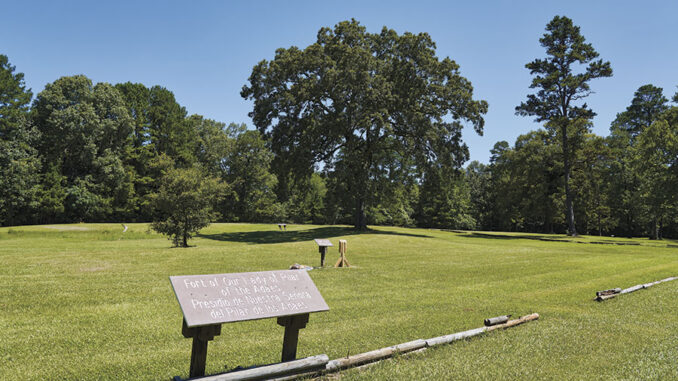
Today, the Los Adaes site remains primarily a rich archaeological site, but visitors can still see the outline of the old fort. Within the boundaries of the fort, people can still see where the soldiers’ barracks, the governor’s house, the chapel and other features once existed.
Visiting the area
Visitors can walk along clearly defined trails and even see where individual houses once stood. They can see the remains of the old El Camino Real de los Tejas, (The Royal Road of Texas) which exists today as a National Historic Trail.
“Los Adaes was linked to the rest of the colonial Spanish Empire via the El Camino Real,” Berthelot said. “Wagon trail ruts along the El Camino are some of the best preserved in the country. One can also see the site of the colonial mission, which served the local population and Native Americans from the local Adai tribe.”
The site does not offer food service, but people can find whatever they need in nearby Natchitoches. Try the Natchitoches meat pies. People can also visit a full-scale replica of Fort St. Jean Baptiste, the only 18th century French colonial palisade fort in the United States, at 155 Rue Jefferson in Natchitoches.
“As the site is not operated on a set schedule, I recommend that visitors contact either Fort St. Jean Baptiste State Historic Site (318-357-3101 or 888-677-7853) or the Cane River National Heritage Area (www.canerivernha.org) before arriving,” Berthelot said.
For more information, call 318-356-5555. Online, see www.lastateparks.com/historic-sites/los-adaes-state-historic-site.