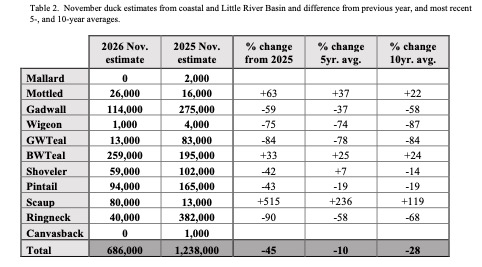
The 2026 November survey estimated 686,000 ducks in Louisiana’s coastal region and Little River basin (Table 1), 45% below November 2025 (1,238,000) and 10% and 28% below the 5- and 10-year November averages (764,000 and 951,000, respectively). The estimate was 68% below the long-term November average of 2.12 million (Figure 1). Blue-winged teal were the most abundant species at 259,000, up 33% from 2025. Scaup increased from 13,000 to 80,000, while ring-necked ducks declined 90% to 40,000 (Table 2). The southwest accounted for 72% of the coastal duck estimate. Down from the 252,000 estimated in November 2025, 108,000 black-bellied whistling ducks were estimated across the coastal region utilizing the same extrapolation factors as other species, with observers noting black-bellies distributed in more locations, yet in lower abundances in those locations. This estimate is similar to November 2024 and is not included in the Table totals. The mottled duck estimate remains 57% below its long-term average, but is 22% and 37% above its most recent 10- and 5-year averages.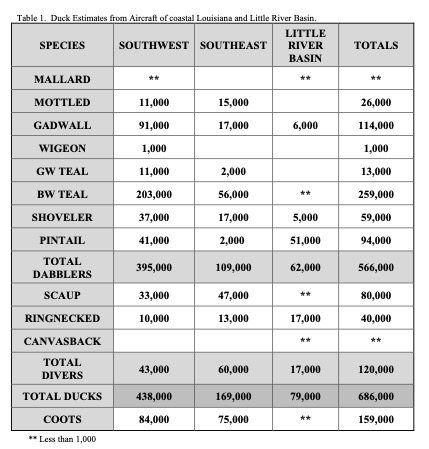
 Southwest Louisiana – 438,000
The duck estimate for SW Louisiana is 38% lower than 2025 (704,000), and 10% and 22% lower than the most recent 5-year (487,000) and 10-year (561,000) averages respectively. Marsh conditions in the Southwest remain very good to excellent. The agricultural region held substantially more surface water than September, however a large majority of the fields that could potentially hold water were dry. No duck flocks greater than 700 were observed during the flight, however the largest observed groups were near Rockefeller Refuge, Lacassine NWR, and the Pecan Island area. Few white-fronted geese, and no light geese, were observed in southwest rice fields.
Southeast Louisiana – 169,000
The duck estimate for SE Louisiana is 59% lower than the 2025 estimate of 414,000. It is 11% and 40% below the most recent 5-year (191,000) and 10-year (283,000) averages, respectively. Large rafts of ring-necked ducks typically encountered in freshwater marshes south of Houma were largely absent and relatively few ducks were observed in the Delacroix marshes and Mississippi River delta. These regions usually contribute significantly to the duck estimate in southeast Louisiana.
Little River Basin – 79,000
Water level, measured at the center of Lake, was 27.65 M.S.L. at the time of the survey. Whereas the margins of the basin were dry, ducks were observed near the center where ideal water depths for foraging were observed. Pintail made up 65% of the species composition while ring-necks made up another 22%. An additional 5,000 ducks were counted on Catahoula Lake NWR’s Little Lake. Species were evenly split and included gadwall and pintail. A few hundred blue-winged teal, northern shovelers, and ring-necks accompanied them.
Northwest Louisiana – 7,000
Like much of the state north of the coastal marsh, northwest Louisiana is very dry aside from fields that could pump water. The 2026 count was 30% below the November 2025 count (10,000). The most abundant species were gadwall (2,000), green-winged teal (1,500), shovelers (1,000) and blue-winged teal (1,000). Only a few hundred each of other species were observed. The largest concentrations were observed at Red River NWR and various other privately managed impoundments, as is often the case. Grand Bayou, Black Lake, and Bistineau are all low with variable salvinia coverage. Lakes Wallace, Black Bayou – Hosston, and Caddo were notably infested with salvinia, hyacinth, and water lotus.
The season
The first segment of the West Zone duck season began Saturday, Nov. 14 and runs until Sunday, Dec. 6. Following a single (12-day) split, it will re-open on Saturday, Dec. 19 and conclude on Sunday, Jan. 24.
The duck season in the East Zone opens Saturday, Nov. 21 and runs until Sunday, Dec. 6. Following a single (12-day) split, it will re-open on Saturday, Dec. 19 and conclude on Sunday, Jan. 31.
Reminders:
The daily bag limit for mottled ducks is 0 for the first 15 days of the season, regardless of the zone being hunted, and will be 1 per day for the remaining 45 days. The 2026-27 daily bag limit for pintails is 3 per day, only one of which may be a hen.