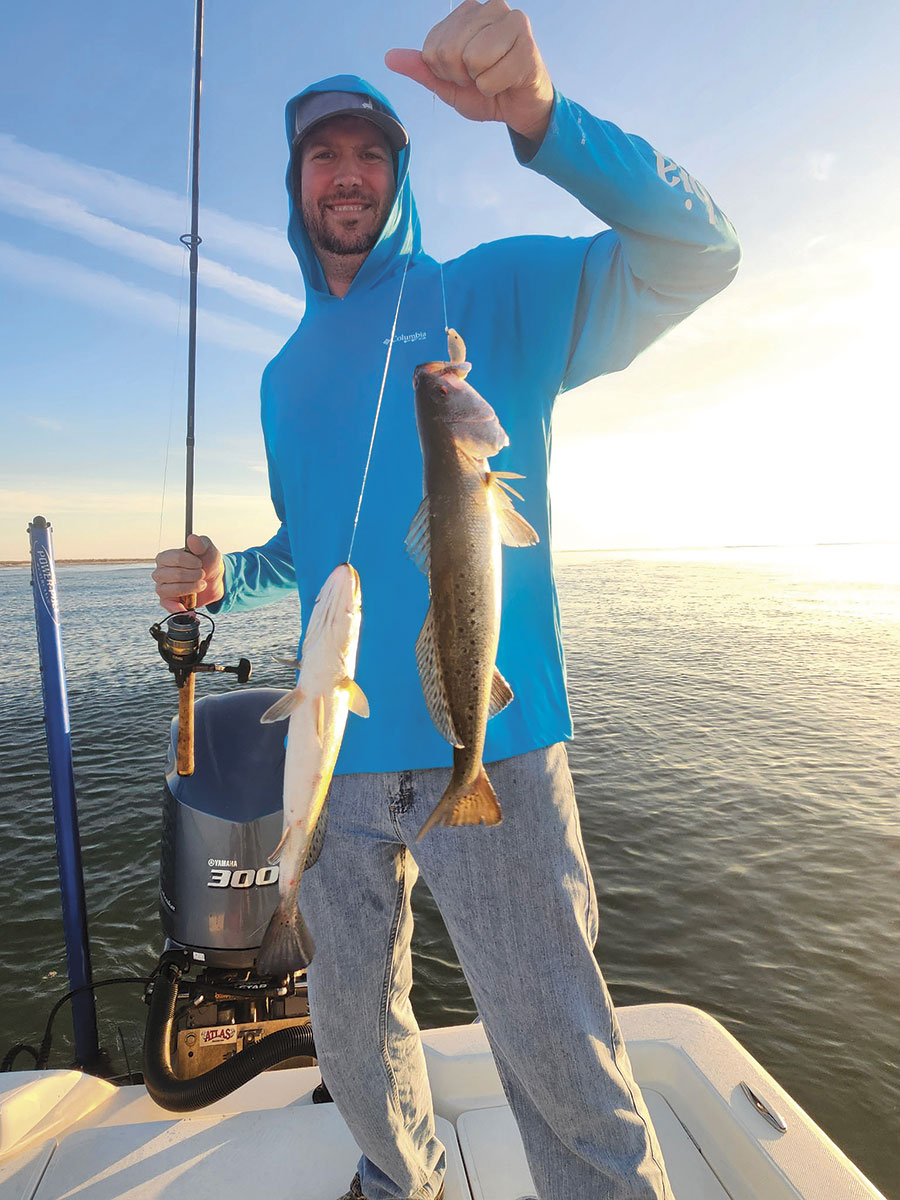
Of all the water bodies that typically give up beaucoup speckled trout in November, Lake Decade continues to be the most popular for fish and fishermen in south central Louisiana.
No one knows that perennial hotspot better than Tommy Pellegrin, a veteran charter boat captain who owns Custom Charters LLC and has been pulling fish out of the area for as long as he can remember.
Pellegrin, who was born and raised in downtown Houma and still lives nearby, can’t wait to put Berkley’s newest soft plastic shrimp imitation to work this month in and around Lake Decade. He came up with the coloration for the Shrimperor, which hit the market in October.
His favorite Shrimperor colors are shrimp boil, scooby, blurple and marsh dew, and he fishes it under a Boat Monkey Popping Cork.
Other proven soft plastics that trigger speckled trout and redfish bites include the bunker- or fire tiger-colored Berkley PowerBait Pre-rigged Swim Shad, which was intended to be a bass bait but became a coveted crossover bait because so many saltwater anglers use it.
The Pre-rigged Swim Shad can be bounced off the bottom or jerked back on the retrieve, Pellegrin said, adding, “Some days they want a twitch, some days they don’t.”
Big fish are there
One prime access point to get to Lake Decade is nearby Falgout Canal Marina, which is just east of the lake with a rich history of giving up speckled trout and redfish every November.
According to Pellegrin, those fish leave the areas around The Pickets and Coon Point, following the shrimp as the crustaceans head north into the marshy areas. Speckled trout use the Houma Navigation Canal and eventually end up in Lake Decade as well as Lake Mechant, which are both very productive saltwater fishing lakes during the winter.
“It’s just one of those ‘spots,’” Pellegrin said about Lake Decade.
The lake gives up some undersized fish, sure, but generally the average speckled trout catch is 13 to 15 inches long, with plenty of nice 16- to 19-inch long fish in there, Pellegrin said from experience.
The 68-year-old charter boat captain, who started guiding full time in 1995, has fished the area his whole life, starting when he was a young boy going to each grandfather’s camp.
Drift and cast
Pellegrin said drifting and casting your way across the lake remains the most effective method of putting speckled trout in the boat.
“It’s kind of an open lake,” he said. “Just drift and cast. When you catch, stop right there and fish. It’s mostly drifting. When you finish the drift, say, you’ve caught 15-20 fish, start again and drift the area.”
Mostly, speckled trout suspend approximately 2 feet deep or are closer to the surface. They also often can be found under the working birds.
“They’ll have birds diving because there are a lot of minnows in the lake,” Pellegrin said. “And there will still be shrimp in the lake then.”
Generally, some of the more productive waters are on the east-southeast side and the west-southwest side, but that isn’t cast in stone.
“I hate spottin’ a side because the whole lake is good,” Pellegrin said.
There is a trough on the outer edges around the lake that’s deeper and speckled trout use it when the water gets cold, he said. They’ll come out on the nearby flats to feed. There is granite rip-rap protecting the shoreline on the southeast side.
Take note: If there’s a strong wind, the lake chops up and gets dirty quick. Your best bet is to fish the leeward side and look for cleaner water.
As for Lake Mechant, it’s pretty much the same pattern for targeting speckled trout except there are more oyster reefs, Pellegrin said, so it’s important to know where the oyster reefs are that harbor so many fish. Fish the reefs, under diving birds and current lines coming around points, he said.