Brandon Crossley came to northeast Louisiana from Oklahoma specifically to kill an alligator for a full-body mount. He more than got his wish.
David Hanson of Swartz runs a lake vegetation control business. On the side, he works as a nuisance alligator trapper for the Louisiana Department Wildlife and Fisheries and guides alligator hunters. He agreed to take the Oklahoma sportsmen on an alligator hunt none of them will ever forget.
“I take out 20 to 25 hunters a year,” Hanson said. “I typically hunt some oxbows off the Tensas and Little Tensas Rivers in Tensas Parish.”
For the past three years, Terry Mayberry hunted alligators with Hanson. This year, he brought Crossley, Dylan Weinrich and Ben Bullock with him from Oklahoma. On Sept. 21, 2026, Hanson set about a dozen lines for the Oklahoma crew.
“The hunts had been tough lately, so I beefed up my bait a little, literally,” Hanson recalled. “I added beef liver to my regular chicken baits. With a full moon approaching, that’s a better time to catch alligators. I’ve caught some good gators on a full moon.”
Gators galore
The crew started running lines on the morning of Sept. 22. Hanson’s wife, Kristi, said she would pray for the team to do well catching alligators that day. Apparently, it worked.
“We started the day with the double rainbow in the sky,” Hanson said. “That was a good sign. We caught alligators right off the bat. Everyone was excited.”
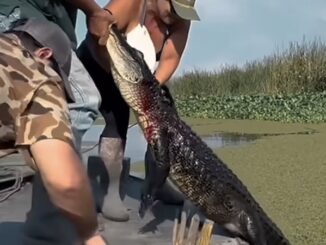
The team caught some alligators in the 7- to 8-foot range. They also caught three 9-footers. That would make any gator hunter ecstatic, but the story doesn’t end there. Soon, they found a “tree shaker” thrashing the water.
“I’ve seen a bunch of big alligators in that area before,” Hanson said. “I’ve caught some 12-footers, some close to 13 feet. Earlier that day, we already caught a 9-footer very close to that tree limb line. When we got close to the limb line, we saw all this activity under the tree. We knew we had a monster gator on the line. The tree limb bent like a fishing rod when the alligator pulled it down. That probably kept him from breaking off.”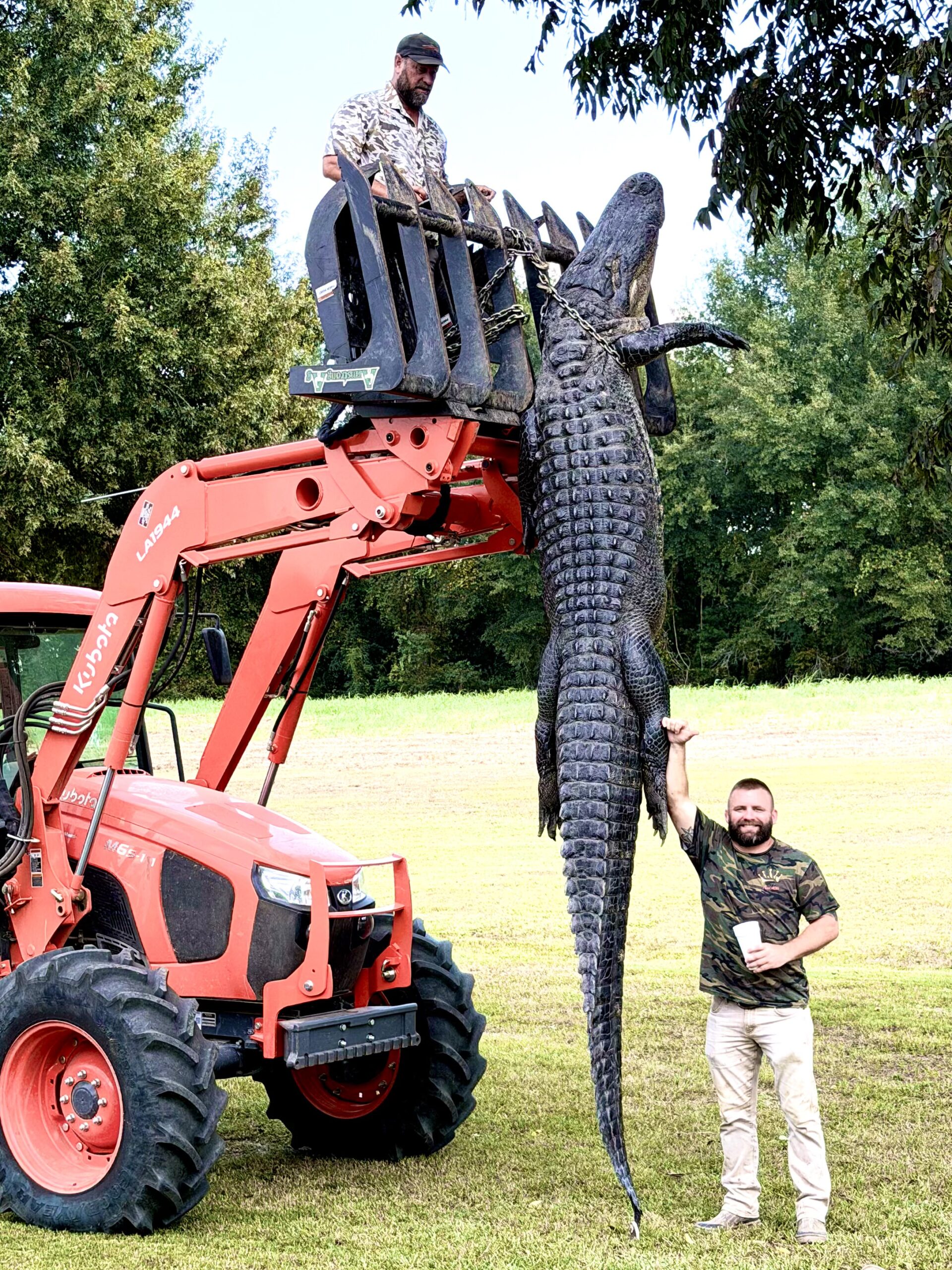
For his lines, Hanson uses 1,800-pound-test “mule tape line.” Workers use the flat, heavy woven polyester rope to pull wires or cables through conduit systems. Unlike traditional rounded ropes or lines, this flat line doesn’t cut into people’s hands when fighting a massive alligator.
“The Oklahoma guys were arguing who would take the shot for the big gator,” Hanson said. “When we pulled it up and first saw the diameter of its tail, we knew it exceeded 13 feet. We finally pulled its head up and got the reptile in position for a shot.”
A beast
The team agreed that Crossley would shoot. Hanson normally uses a .22 magnum to dispatch alligators, but for this behemoth, they switched to a .357 magnum. Crossley made a perfect shot.
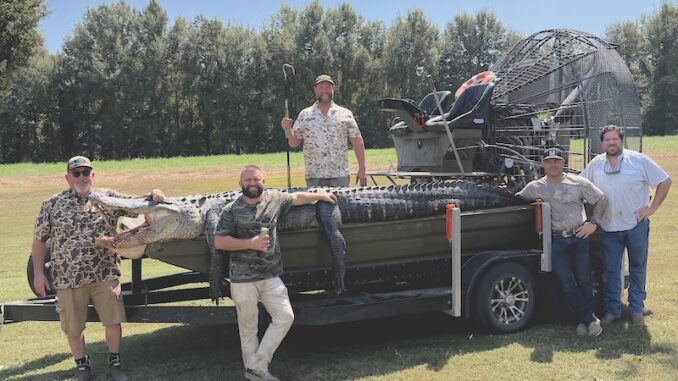
Now, the real work began. The team had to manhandle a reptile weighing close to 800 pounds into the Swamp Donkey, a 17-foot Phoenix airboat. They also used a gaff from Zook Fishing Company (zookfishing.com) of Baton Rouge, owned by Brock Miller and Mason Maurer, to help hoist the dinosaur into the boat. The Swamp Donkey already carried five men plus several large alligators.
“The Oklahoma guys were high-fiving each other,” Hanson said. “Brandon wanted to get a big alligator mounted. It doesn’t get much better than this one. It was so long, I had to go underwater to grab its front leg. Once we got him in the boat, we had no room. One guy had to sit on him. Water came over the bow as we moved.”
The team put the other alligators on shore to come back for them later because of the weight in the boat. Hanson headed to Cypress Point Hunt Club, owned by his father-in-law Richard Zimmerman. At the camp, they contacted Jason Martin, a LDWF game warden, to come and officially weigh the beast.
They weighed it twice, once hanging vertically and once on the ground to ensure accurate measurements. The toothy monster measured 14 feet, 5.25 inches long with a 33-inch head. Just his tail measured 7.5 feet long.
“We had to use a tractor to lift the big alligator to measure him,” Hanson said. “He was a very healthy male. We wanted to take special care with this alligator because it’s a record and Brandon wanted to preserve it whole.”
No official record system
The current largest alligator on record measured 15 feet, 9 inches long and weighed 1,011 pounds. In 2014, Amanda Stokes and her party landed the brute while hunting the Alabama River system near Millers Ferry, Ala.
“Louisiana doesn’t have an official record system for alligators, but our alligator was the biggest ever certified in the state,” Hanson said. “We videoed it and had a LDWF representative there to verify it. According to the Safari Club International, this alligator ranks about the fourth or fifth biggest ever in the world. Maybe this alligator will prompt the state to create an alligator record keeping system.”
Hanson estimated this big reptile lived about 75 years. In the wild, alligators can usually live about 70 to 80 years. The oldest documented alligator died in the Belgrade Zoo in Serbia at the age of 84. If Hanson’s alligator lived 75 years, it hatched in about 1951 and survived all those years of alligator hunting.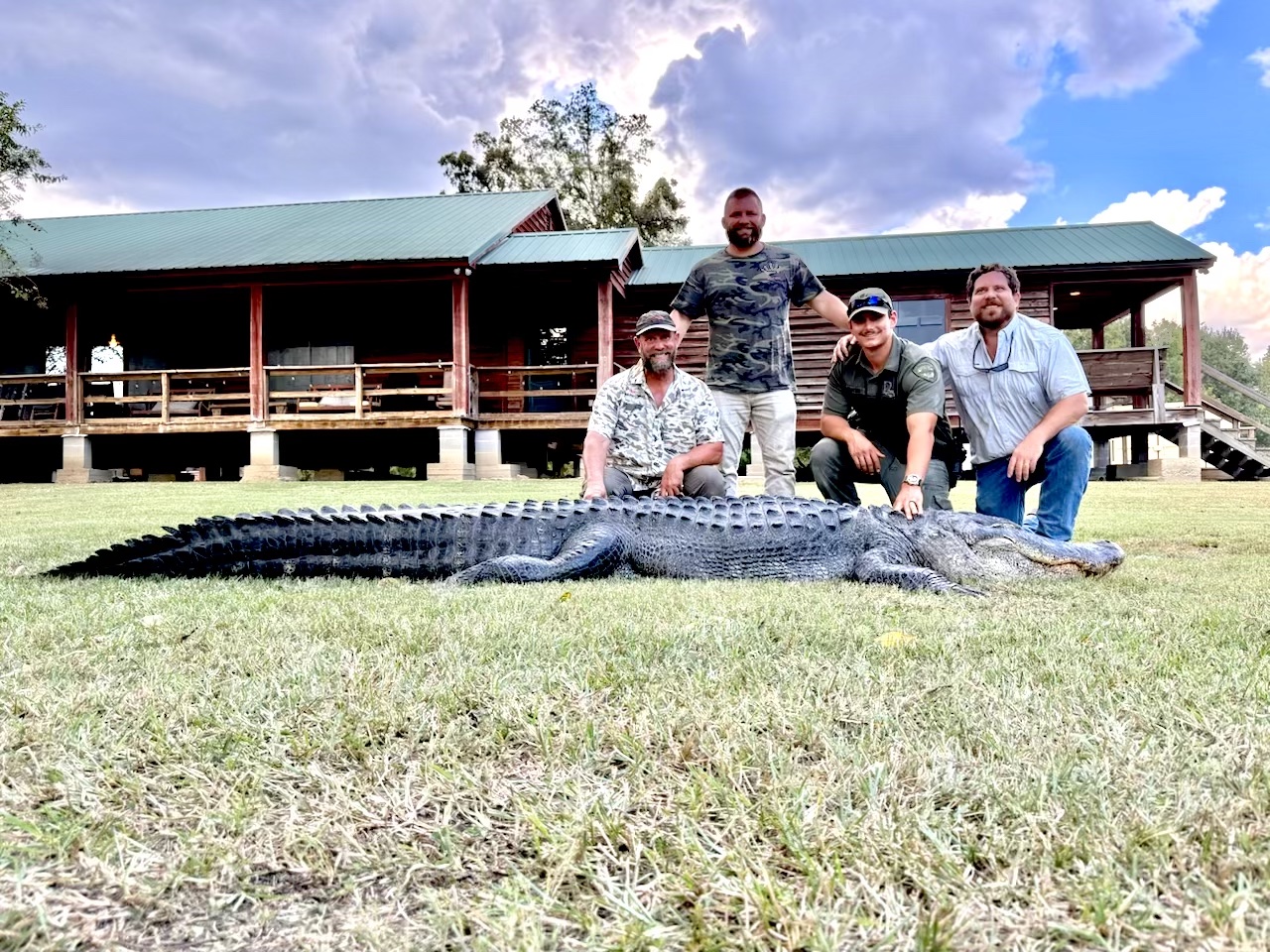
According to the LDWF, about 100,000 alligators populated Louisiana during the 1970s. Now, wild alligators surpass 3 million, the most of any state, with another million living on alligator farms.
Apex predators
This year, Louisiana opened a recreational alligator hunting season for the first time. It runs from October 1-31. The state will issue a maximum of 5,000 recreational permits. Each permitted hunter selected by lottery may harvest two alligators.
“Big alligators are apex predators,” Hanson said. “A couple weeks before we caught the big one, we caught an alligator that had been bitten by a larger alligator. With the teeth marks, I think it might have been our big one that bit it. When we cleaned our big one, it had a 4-foot alligator in its stomach, plus some turtles and other creatures. He was the king of his area and had ruled his domain for a long time. It was a special alligator. I enjoyed sharing that experience with those guys from Oklahoma.”