Summer offers a fantastic time to catch big speckled trout when females swell with roe.
“The Louisiana trout spawning season runs from about April through September,” said Jason Adriance, the Louisiana Department of Wildlife and Fisheries Finfish Program Manager. “Some trout reach sexual maturity at about 10 inches long or roughly a year old but some won’t spawn until they reach about 14 inches long, or about 18 months old. Trout can spawn about once every seven days, but that doesn’t necessarily mean they will. A 20-inch trout will lay more than 20 million eggs a year.”
In early summer, trout feed heavily upon shrimp. In May or June, young brown shrimp start migrating from the estuaries toward the Gulf. When the shrimp move, everything follows and periodically attacks to fill their bellies with crustaceans.
“June is a good time to catch trout,” said Billy Jordan with Cajun Comfort Charters (225-806-3719) in Montegut. “In the summer, trout are eating smaller shrimp. I fish a 2.5-inch Four Horsemen (www.4horsementackle.com) Boom Boom Shrimp under a popping cork. If we put on a big live shrimp, they won’t touch it. If we put on a small live shrimp, they will grab it right away.”
Schooling trout
With trout feeding mostly on smaller shrimp, watch for bird activity. Trout herd shrimp to the surface. Sharp-eyed birds quickly spot the activity and swoop down to get their share of protein.
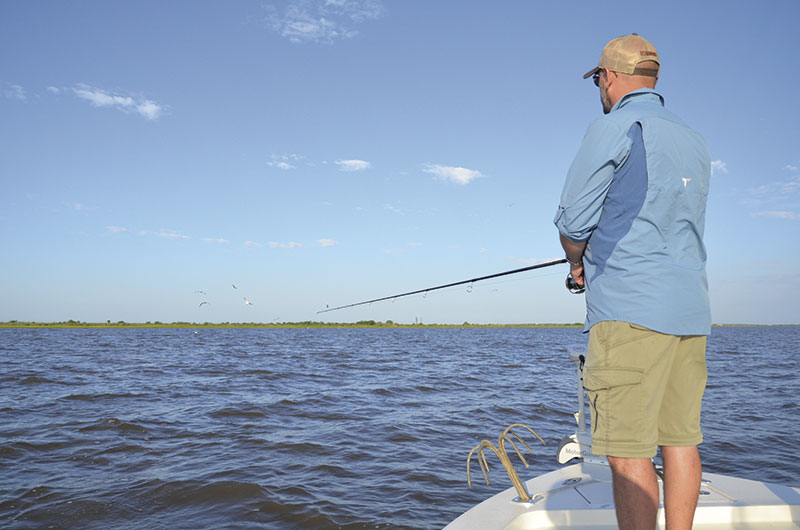
“If only one bird dives over here and another over there, don’t even worry about it,” said Tommy Pellegrin, long-time owner of Custom Charters (985-851-3304) who fishes the Cocodrie area. “I want to see a bunch of birds all diving at the same spot on the water. That’s where shrimp are jumping.”
After spotting diving birds, try to determine where the fish school wants to go. Then, get upwind of them. Let the breeze or tide push the boat quietly toward the activity. Use the trolling motor sparingly for directional control. Make longer casts with the wind. With the bait and fish high in the water column, throw popping corks sweetened with soft-plastic shrimp imitations like Gulp!, D.O.A., Vudu Shrimp or similar baits.
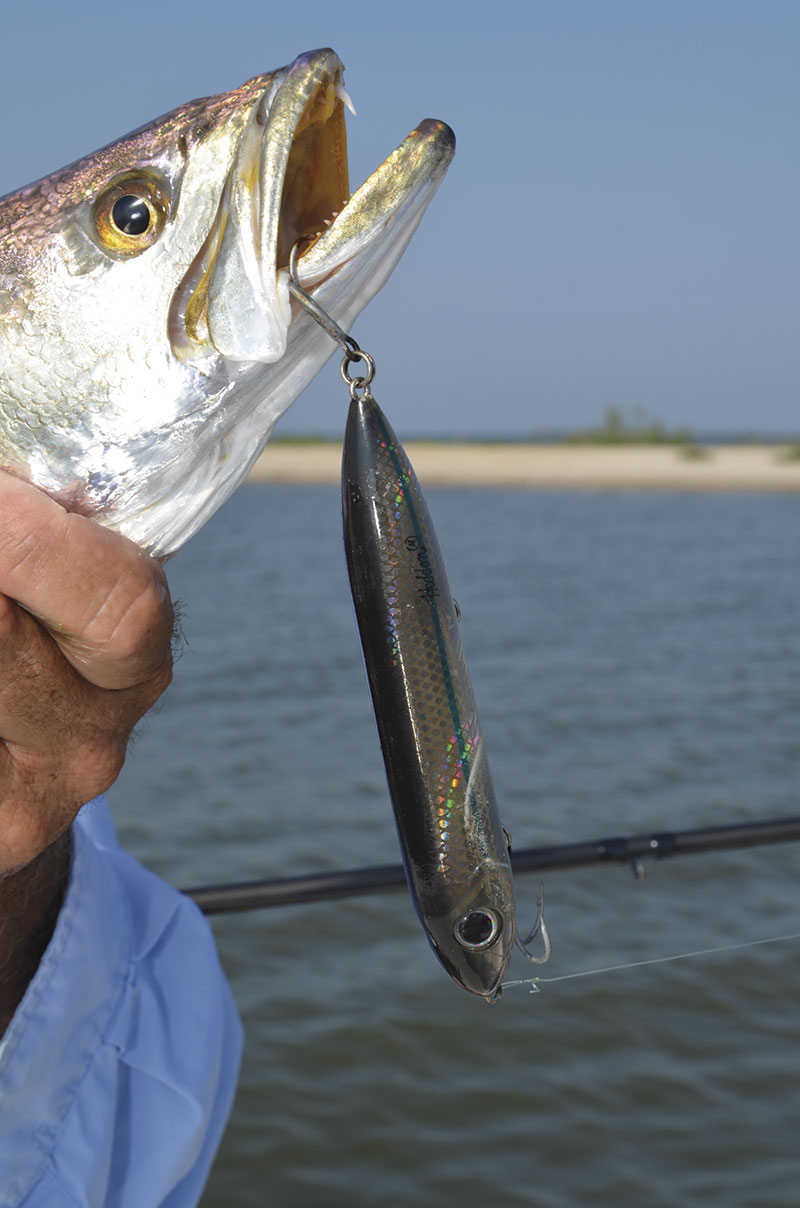
“When we’re on a bird frenzy, we don’t need live bait,” Pellegrin said. “I throw a Berkley Rattle Shrimp (www.berkley-fishing.com) in coastal candy or a natural color. Rig it 2 feet under a Boat Monkey cork (boatmonkeyfloat.com).”
Schooling trout tend to run smaller, but giant trout sometimes follow under the school. Larger specks don’t want small shrimp. Bigger trout prefer bigger baits. They want to snatch young trout. A 5-pound speck can easily inhale a 12-inch fish.
Larger specks
For monster specks, fish live mullet or pogies on a free line. Large lipless crankbaits or suspending baits in baitfish colors entice bigger fish. People could also throw topwaters. Topwater baits often attract bigger fish but fewer bites. Most saltwater anglers prefer walking baits that mimic wounded mullets struggling on the surface.
“In June, we throw topwaters early in the morning on calm days,” said Brian Hanchey with Louisiana Backwater Charters (337-660-6594, louisianabackwatercharters.com) on the Calcasieu Ship Channel in Hackberry.
Known locally as Big Lake, Calcasieu Lake gained a reputation over the years for producing massive speckled trout. The system still delivers large trout, but no 10-pounders in recent years.
“Those big trout are still out there, but they are not as prevalent as they once were,” Hanchey said. “We’re getting some 3- to 6-pounders and seeing 7- and 8-pounders more consistently. We might be on an upcycle now, but it’s going to take a little bit longer before we see 10-pounders.”
Larger specks feed more on fish than shrimp. When trout eat oily baitfish like pogies or mullet, “slicks” resembling a petroleum sheen might appear on the surface. A tight, well-defined emerging slick means fish just beginning to feed. Wind and tide can move and spread out slicks, so head upwind to find the fish.
“When we find a slick about the size of a basketball and growing, that means fish are feeding right there,” Hanchey said. “We can smell slicks. They smell almost like watermelon. Around slicks, I throw 1/8-ounce jigs tipped with Down South Lures (www.downsouthlures.com), MirrOlure Lil John (www.shopmirrolure.com) or Matrix Shad (matrixshad.com) soft plastics in anything purplish, bluish or a transparent color when the water is green and clear.”
Fish-holding structure
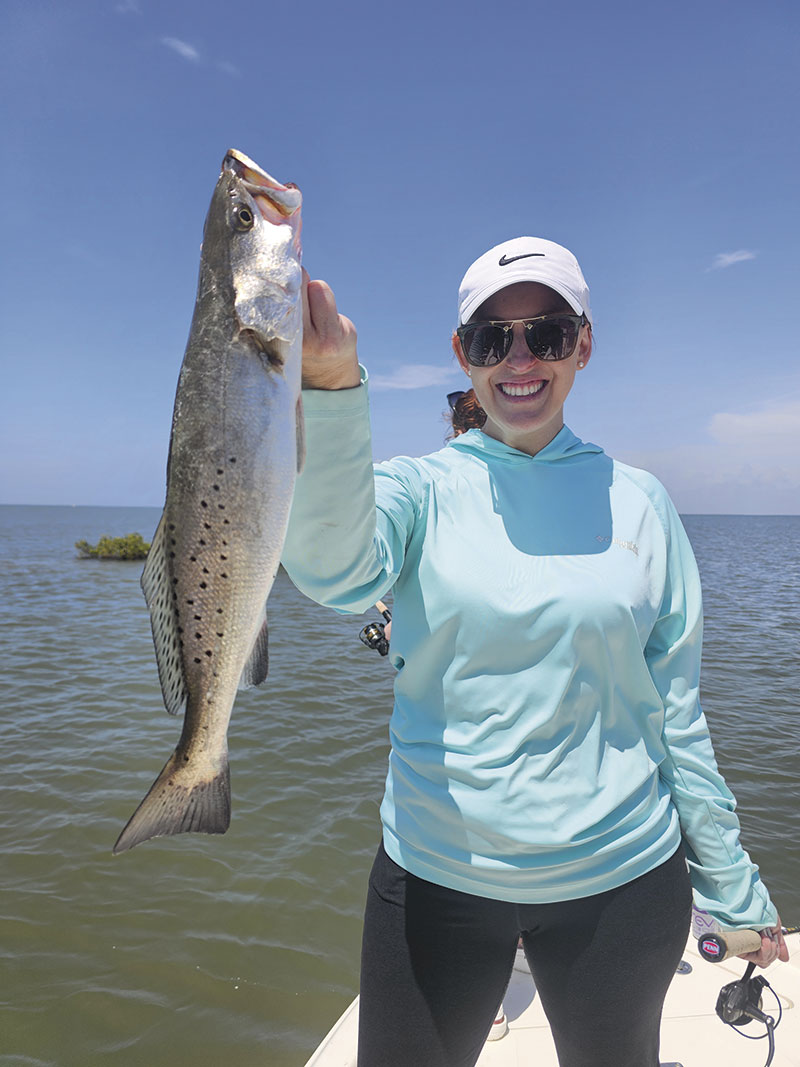
Reefs don’t move. Without spotting birds or slicks, hit the hard structures. Oyster reefs provide excellent cover in many lakes and bays across South Louisiana.
“In the summer, I especially like to fish oyster beds near openings coming out of the marsh with good tidal flow,” Jordan said. “I also like to fish grassy duck ponds. Later in the day, fish go deeper.”
Petroleum platforms dot much of South Louisiana. These structures create fish-holding structure. People can spot platforms and wellheads miles away. They get heavily pressured, especially in the summer. With electronics, anglers could discover hidden reefs that fewer people fish.
“All the wellheads have either a shell or rock pad from when they drilled it,” Pellegrin said. “Even if they removed the wellhead and pipes, that shell and rock remain on the bottom. With a side-scan sonar unit, we can find those pads. Sometimes, a small, random spot can produce great action because few people know about it.”
Try fishing popping corks with live or plastic shrimp around reefs and pads. In deeper water, fish plastics on jigheads. During summer heat, toss the lure toward the structure. Let it sink to the bottom and work the bait slowly just off the bottom.
“I like to throw a Berkley PowerBait Paddlin’ PowerStinger around structure,” Pellegrin said. “The cold beer color looks just like the foam head on a beer. It’s an awesome color. Another good color is fireball.”
Beaches
As the summer progresses and water temperatures rise, many trout, especially bigger ones, leave the estuaries to seek cooling comfort in the Gulf waters. In June, big trout regularly hunt right in the surf of barrier islands or along other beaches.
Beaches might appear sterile, but look for anything different, such as small sandy or rocky points and other objects. Pounding surf action reconfigures sand into bars and troughs and scours deeper passages between the bars. Flat water between rolling waves could indicate a break between sandbars. Bait drops into those troughs and trout follow their prey. Use natural-colored lures or free-line live shrimp, pogies or mullets.
“In June, the beaches usually get jammed up with speckled trout,” Hanchey said. “On an incoming tide, trout get closer to the beach. We throw the bait right where the waves are cresting. If they are right up in the surf and not eating a topwater or a jig, we throw a live shrimp on a cork. On an outgoing tide, they stay a bit farther out.”
Jetties thrusting into the Gulf also make great places for summer action. Jetties normally lead to deeper water. Try different sections at various depths to find the fish. Redfish, sheepshead and drum typically hold tight to structures, but trout prefer to hunt slightly off the jetties in open water.
Nearshore rigs
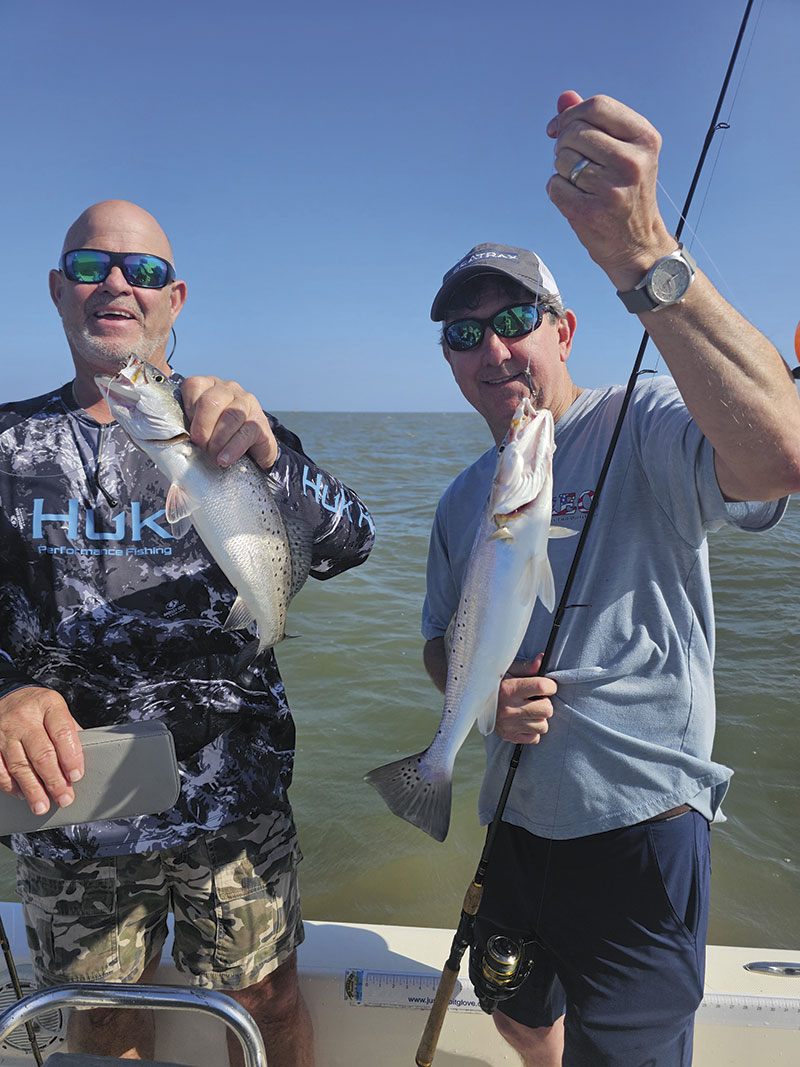
Water warms as summer progresses. Trout frequently congregate around nearshore petroleum platforms, reefs and other structures. Fish with live bait, jigheads tipped by soft plastics, suspending or sinking lures.
“Later in June, depending on the weather, we go fish the nearshore rigs,” Hanchey said. “We go seven to eight miles out and fish in water 25 to 30 feet deep. The trout usually suspend about 10 to 15 feet down. We look for fish on the sonar and drop the bait so it drifts with the current to them. We drop jigs or split-shot live shrimp, croaker or mullet to the trout.”
With a slip-cork rig, anglers can fish live or artificial baits at varied depths. A weight pulls line down until it reaches bottom or a pre-determined depth that the angler sets with a stopper. Anglers can fish vertically away from the boat at any depth they wish and keep baits suspended in the strike zone longer. Stores sell commercial slip-cork rigs that come with rubber “bobber stoppers” that attach to the line or simply clip a small split-shot to the line to stop the float. Slide these stoppers up and down the line to change the depth setting.
“In deeper water, I use a sliding cork rig,” Pellegrin said. “With that, I can fish the surf in 2 feet of water or go to a wellhead and fish 10 feet deep without rerigging. One day, boats all around me were fishing corks and not catching anything because we were in 12 feet of water. The fish were down about 8 feet. I rigged a sliding cork to suspend a bait at 8 feet and started hammering them.”
Even on the hottest summer days, anglers might find fast action. They just need to look for the trout and try different baits, methods and depths to see what fish want that day. Bring plenty of water and stay hydrated.