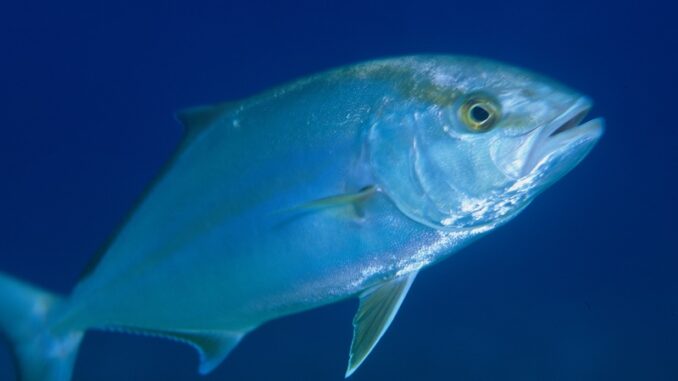
Louisiana’s push for state management of greater amberjack has reached the point where Wildlife and Fisheries marine biologists are ready to lay out their plan.
Deputy Assistant Secretary Chris Schieble, who heads up the agency’s Fisheries Section, outlined the state’s plan during the Louisiana Wildlife and Fisheries Commission’s July meeting.
It was just one of many agenda items along with a plan to modify turkey hunting regulations on wildlife management areas and on Kisatchie National Forest lands.
But, it was amberjack that raised the most eyebrows.
Schieble said the offering to the Gulf Council and federal fisheries managers calls for an exempted fishing permit (EFP), which will give the agency’s marine fisheries staff a chance to determine catch rates and fishing effort for a species which, twice, has been determined to be overfished and undergoing what federal managers classify as “overfishing.”
“We need something outside the normal fishing regulations,” Schieble said, adding the EFP will give Louisiana’s LA Creel data collection system access for what he said is “scientific research.”
East and west sectors
The background here is that the Gulf Council changed the fishing year for greater amberjack, a move means an August-through-July period, not a calendar-year plan.
About a decade ago, an EFP for red snapper was obtained, then used by Louisiana to develop LA Creel, a real-time data collection system which was the first such program to get federal approval and a system copied by other states to determine reef-fish-species catches.
Schieble said the plan also calls for dividing the Gulf into east and west sectors with Louisiana, Mississippi and Texas in the west and Florida and Alabama in the east.
Furthermore, the EFP would allow for a 61-day season with anglers continuing with the current 34-inch minimum size and one-per-day limit regulations. Fishermen will have to have a no-fee Recreational Offshore Landing Permit, a rule in place for the taking and keeping of all reef fish and some pelagic species. And, the agency’s secretary will have the power to close the season.
“We don’t know how LA Creel will work, but we will test it out on a species that has no sector separation for amberjack like there is for red snapper,” he said, explaining that recreational and commercial take of amberjack is lumped together. Red snapper has separate rules and seasons for recreational and commercial catches.
“State management is the ultimate goal,” Schnieble said.
Public land turkey hunting
Next up, the commission voted down (by a 4-2 vote) a regulation to ban what state wildlife biologist Cody Cedotal described as “fanning and reaping.”
Cedotal, the agency’s Wild Turkey Program manager, said the practice involves hunters using the “fans,” the tail feathers of a male turkey, a gobbler, to lure an aggressive gobbler within hunting range.
Cedotal said hunters hide behind the fans with shotguns, bows and crossbows and sneak up on a turkey hoping the aggressive gobbler will come near to defend his territory.
He said the ban on this practice “…is much needed,” on public land and because it is “…most dangerous, and safety is the primary reason for the change. Most times first thing a hunter sees is the fan and, while we always preach (to hunters) about clearly identifying their target, this could be a problem.”
Responding to a question about conflicts, Cedotal said there were no reports about this practice resulting in accidental shootings in Louisiana, and that several other states, mostly in the eastern U.S., have banned the practice due to safety concerns.
The commission did not pass the notice.
Other actions
-The presentation of the annual Theophile Bourgeois Memorial Award to Enforcement Division Sgt. Shea Schexnaydre for his work in “…ensuring compliance with state charter guide regulations in 2025…for making 11 cases for violations, the majority of these cases involve illegal out-of-state charter guides.”
The Louisiana Charter Boat Association made a $1,000 contribution to the charity of Schexnaydre’s choice, the Tunnels To Towers Foundation;
-Enforcement agents had a busy June issuing 1,599 citations, investigating five boating incidents (two injuries, two fatalities) and rescued 86 people in Avoyelles Parish from flooding in the wake of Tropical Storm Arthur;
-We were updated on the new world screw worm recently discovered making a return in Texas. State Wildlife Veterinarian Dr. Jonathan Roberts outlined state plans to combat the possible larvae invasion from the fly laying the eggs that hatch out and burrow into live animals;
-We learned from reports by Delta Waterfowl and Ducks Unlimited about how each conservation group used Louisiana hunters’ dedicated funds on waterfowl breeding grounds. Delta works in the Canadian province of Manitoba and has secured 1,541 acres in either perpetual protected or easement agreements – the goal is 2,056 acres in the three-year agreement with the state – while DU works in Saskatchewan and turned the state’s funding into 1,956 acres with 811 protected acres in that number.
Both reports cited increased rainfall in these two provinces in June.
-Lastly, we learned the new recreational bowfishing permit program has 811 active permits and came through the first year with 793 recreational, 196 non-resident and 18 charter permit applications. The report indicated the all-nighttime effort is “…directed at redfish,” and that indications are that bowfishing accounts for about 6% of the overall-effort total take from an estimated 85,000 bowfishing effort/trips.