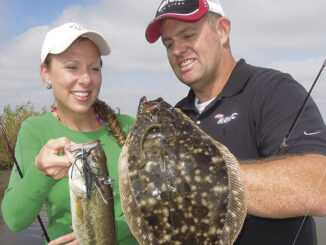
You can find success fishing the main river channel for bass
The pattern had now held for almost 30 minutes. Cast to the narrow cut, make three or four turns of the reel handle, and hold on. My fishing partner and I had hit the jackpot on this hot August day, as I hauled in yet another fat spotted bass from the Ouachita River.
At first glance, the small gap where water was escaping a small slough barely 20 feet wide certainly didn’t appear to be much. In fact, I had almost passed it as we headed to the ramp, the temperature now in the mid 90’s with little to no breeze. But at the core of what it takes to be a good fisherman is the same mindset needed to be a good hunter. You must be an eternal optimist, believing that the next cast or call will yield a 5 pounder or a flock of mallards, and so I backed off the throttle and steered the boat towards the western bank.
Dog days and stacked bass
Summer months on the Ouachita can often be hit or miss, depending on a wide variety of conditions that include water level, clarity and current. Locations that one day fail to yield a single bite, the next will hold a school of voracious feeders ready to knock the paint off your favorite crankbait. However, to find these locations you’ll need to do some running, searching for the productive locations where fish are holding.
River conditions for success
While the vast majority of successful river fishermen will talk about the importance of current, I find that river levels play more of a role in my success or failure.
 Once summer comes, backwater areas, small lakes, bayous and even ditches become shallow, losing oxygen, which forces baitfish towards the main channel. It’s at this time I experience the most success.
In a morning of fishing, I may stop at 15 to 20 different locations in search of one holding fish. And even though I may locate fish using my forward facing sonar, not all schools of river fish are created the same.
Again, I won’t spend much time casting to fish that won’t bite when there are literally hundreds of other places to try.
Timing is everything
As is the case with river fishing in most instances, timing the fall of the river can be crucial to your chances.

As the river begins falling in the summer months, I keep a close eye on the daily river stages, searching for the magic number that will allow the backwaters to begin flowing into the main channel. That number can change depending on which section of the river you’re fishing, work being done on locks and dams, rainfall or other circumstances.
The river stages are simply a click away on the internet and not only provide up-to-date stages, but they also predict them for the coming days.
Go-to baits
I find that any type of crankbait will catch fish on the Ouachita, as long as it’s a Bandit.
On a serious note, the 200 Series Bandit in chrome and black is probably my favorite, but any bait that mimics the shad and baitfish stacked in these cuts will work. If things are tough, I’ll slow down with a Carolina rig and get bites that I can’t seem to get on the crankbait. Early mornings I’ll throw both buzz baits and spinnerbaits into the shallow sides of these cuts, but once the sun is up I go directly to the Bandit.
There’s a reason crankbaits have been referred to as “idiot proof,” they’re easy to operate, and on the Ouachita I’ve found that retrieve speeds or styles aren’t nearly as important as they may be on area lakes. I would also recommend you have several extra baits with you based on the fact that most days I lose at least one to the occasional garfish feeding alongside the bass.
Go fast and slow down
When I pull up to a cut, I normally only make a half dozen casts before moving to the next spot if I fail to get a bite. Again, much of what you’ll be doing on the river is eliminating where the fish aren’t on that particular day.
Once I catch one though, my approach changes radically. At that point I slow down, maneuvering my boat, making several casts until I’ve pinpointed where and how the fish are situated. Often times the angle the bait moves past the fish will dictate whether I get bit or not. That’s fish sitting in current seams, places where the river current isn’t as fast or strong, allowing the bass to sit tight to cover and feed on baitfish being swept past them.
Expert advice

My longtime friend and Outdoor News creator Rex Moncrief has spent lots of time fishing both the Ouachita River and Red River. Here are a few tips he recently shared.
- Learn to fish a Carolina rig
Moncrief, who was an angling student of the late Allan Butler, witnessed firsthand the effectiveness of the Carolina rig on summertime river bass.
“If things got slow, Butler always seemed to be able to make fish bite, casting to the inlets and sandbars,” he said.
- Don’t be afraid to fish shallow
“Regardless of water temperature, if you see bait fish, try it,” Moncrief said. “When it gets hot a lot of anglers give up on shallow areas. If the structure is there and I see activity, I’m going to fish it.”
- Understand that crankbait selection is about more than just color and size, it’s also about the wobble or action of the bait
“There’s a reason that Bandit crankbaits are super effective on the Ouachita,” Moncrief said. “They simply have a different action than most of the other crankbaits available to anglers. They have smaller, lighter hooks that I feel contribute to that action.”
- Be ready to do a lot of starting and stopping
“Some days I’ll spend more time running than I will actually casting, but when I find that spot where the fish are stacked, it can heat up quickly,” Moncrief said.