Historic post offers a glimpse of early frontier life
When the United States bought the Louisiana Territory from France in 1803, neither nation really knew the exact boundary of the massive land purchase, which bordered Spanish territory to the west.
Spain and the United States both claimed ownership of what became known as the Neutral Ground in modern western Louisiana and eastern Texas. Both nations agreed to keep their soldiers out of that territory to avoid going to war. With neither nation policing this disputed “Neutral Ground” the area became a lawless “No Man’s Land” of outlaws, rogues and others who wanted to stay hidden from civilization.
“This area was demilitarized for 49 years between three different countries, Spain, France and the United States,” said Carrie McCormic, the Fort Jesup State Historic Site park manager. “That meant outside of joint military maneuvers there was no real police force in the area. This is how a large chunk of it gained the name No Man’s Land.”
Finally, Spain and the United States signed a treaty in 1819 that established the border at the Sabine River, the current boundary between Louisiana and Texas. In 1822, the United States built Fort Jesup in the former Neutral Ground with Lieutenant Colonel Zachary Taylor in command of the post to bring law and order to his unruly region.
“Fort Jesup is historically significant because at its construction it was the western most point on the United States frontier at that time,” McCormic said. “The soldiers of the fort policed the area.”
In 1845, soldiers passed through the fort on their way to fight in Mexico under now Major General Taylor. One year later, the Army abandoned the post as no longer needed. In 1961, the U.S. Department of the Interior designated Fort Jesup a National Historic Landmark.
Things to see

The Louisiana Office of State Parks acquired the property in 1956. Today, the Fort Jesup State Historic Site sits at 32 Geoghagan Road off Louisiana Highway 6 in Sabine Parish seven miles northeast of Many and 22 miles west of Natchitoches.
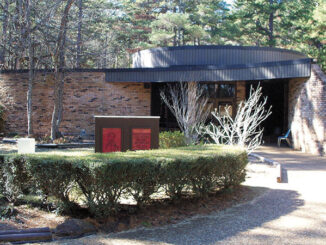
“The site houses a 203-year-old original military kitchen constructed in 1822, which is still fully functional.” McCormic said. “Since then, the kitchen has been restored and decorated with historically accurate furniture. An officers’ quarters has been reconstructed and now serves as a museum. It’s a reproduction of what would have been found on site during the time that Fort Jesup was an active military post.”
Visitors can walk the grounds where soldiers once drilled. The kitchen and the rest of the site give people a glimpse of early 19th century life on the American frontier. People can see various historic artifacts in the museum.
“We do living history programs throughout the year on many different topics and crafts that offer interesting perspectives on the past,” McCormic said. “Guests are welcome to take the tour, walk the grounds, and during program days, participate in the activities. We have 22 acres of grounds including a spring fed pond and picnic area.”
Plan a trip
The state does not offer any food or lodging on the grounds, but people can find what they need in Many or Natchitoches. The museum stays open Friday through Sunday. The grounds remain open Wednesday through Sunday from 9 a.m. to 5 p.m., except on Thanksgiving, Christmas and New Year’s Day.
“Fort Jesup gives a unique perspective on a period of American history that is often lost between the American Revolution and the Civil War,” McCormic said. “It is a historic piece in the puzzle of the shaping of the state of Louisiana.”
For more information on the park, call 318-256-4117 or 888-677-5378. Online, see www.lastateparks.com/historic-sites/fort-jesup-state-historic-site.