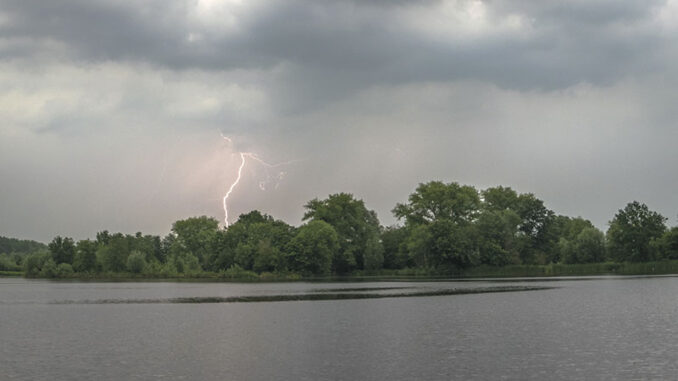
While fishing a shallow lagoon, a massive lightning bolt struck about 100 yards away. Moments later, another bolt flashed 50 yards away.
I took the hint and headed for shore. The sky opened as if someone turned on a million firehoses. About 30 minutes later, the storm subsided and typical summer swelter resumed.
Lightning can strike anyone anytime. Along the Gulf Coast, lightning strikes on humans occur most frequently during July, followed by June and August. According to the Centers for Disease Control, lightning kills about 20 Americans each year and injures many others. Under a clear sky, a literal “bolt out of the blue” from miles away could suddenly hit a person.
“Lightning injuries are very serious and can result in death,” said Logan Poole, a National Weather Service meteorologist in Jackson, Miss. “The Gulf Coast is one of the most active areas for lightning activity.”
On the open water
Essentially a giant spark, or technically a “channeled stream of plasma,” lightning forms from static electricity. When walking across a carpet in socks, a person could build up a static electric charge. If that person touches a metal doorknob, it might spark and shock the person. Multiply that by billions and that’s lightning.
“In a thunderstorm, particles of ice, water and air rub against each other,” Poole said. “That builds up a static electricity charge. When the charge gets strong enough, that massive spark jumps from the thunderstorm to something else not as highly charged. It could be a cloud-to-cloud strike or it could hit a building, a tree, the ground or someone.”
Air does not conduct electricity very efficiently so lightning “struggles” to jump through air. Eventually, it builds up a charge powerful enough to jump. Therefore, a bolt coming from miles away carries significantly more energy than one just overhead.
Lightning doesn’t always hit the tallest objects, but since they come closer to the sky, tall objects receive hits more often. Someone standing in a boat in open water creates the tallest object around. Holding a fishing rod makes that person an even taller target.
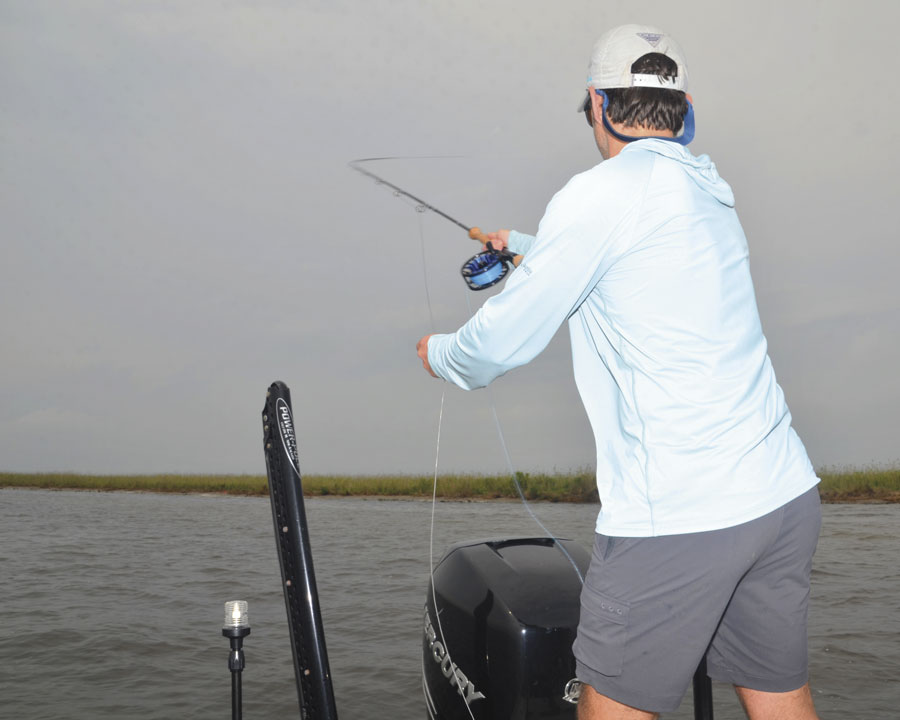
Lightning doesn’t need to make a direct hit. If lightning strikes water close to a metal boat, the electrical charge will affect the person in the boat more than a person in a wooden or fiberglass craft.
“A person’s height above the water makes a tremendous difference,” Poole said. “The odds of getting hit while in a metal boat is not much higher than anyone else, but since metal is a great conductor of electricity, people in metal boats are more at risk if struck.”
As low as possible
Weather can change rapidly on the Gulf Coast. A calm summer morning could suddenly develop into an afternoon thunderstorm. If a thunderstorm begins building, head for shelter or in a safe direction away from the storm.
During the summer, many anglers head offshore to fish with no shelter in any direction. If caught in a storm many miles from shore, get as low as possible. Lower all antennas and remove rods from holders. Avoid touching anything metal.
On land, don’t hide under trees. Energy travels down the trunk into the ground. That could affect people around the tree. If possible, get inside a building or vehicle. If caught in the open, crouch low with the least amount of body touching the ground.
Vehicles can provide good protection. If driving, pull over at a safe place, like under an overpass. When parked, don’t touch the steering wheel or anything metal. If lightning strikes, it should flow around the outside of the vehicle.
When lightning threatens, take precautions. Avoid becoming the next statistic.