
Ironically, it’s the fox squirrels — and not their smaller cousins — that draw hunters to Cat Island.
Well, actually this tasty little fish is not really a mullet, but you would never believe it if you listened to South Louisianans. Usually, they call it a channel mullet, ground mullet or black mullet. Every once in a while, a fisherman with an air of sophistication will call it a whiting.
“It,” in this case, is actually two species of fish. The common and scientific names for the two accepted by the American Fisheries Society are southern kingfish (Menticirrhus americanus) and gulf kingfish (Menticirrhus littoralis). Other local and regional names for the southern kingfish include sea mullet, southern whiting, king whiting and southern kingcroaker. Similar monikers for the gulf kingfish are gulf whiting, beach whiting and gulf kingcroaker.
Confused? Well, they’re not whitings. Whitings are members of the cod family. And, of course, you have already gathered they are not members of the mullet family either. The family to which they belong is the drum family, the big family so important to coastal fishermen, which includes speckled trout, redfish, croaker and black drum.
Southern kingfish can be differentiated from gulf kingfish both by color and where they are caught. Gulf kingfish, overall the less common of the two in Louisiana, has a relatively uniform silver body color with no blotching pigment pattern. It is also uncommon outside of the thin strip of water along beaches where Gulf of Mexico waves break on sandy shorelines.
There, it pounces on creatures like sand fleas, worms, crabs and shrimp that are uncovered by wave action. When the surf is calm, it roots its food items out of the bottom with its pointed nose.
Southern kingfish are easily recognizable by their silvery-gray background color that is overlaid by diagonal broad brown bars, giving it a blotchy appearance. The southern kingfish is common over a broader area than is the gulf kingfish, being found from high-salinity inshore bays out to near-shore waters. It is much more common in waters less than 15 to 20 feet deep than it is in deeper waters.
Wherever the species occurs, it feeds heavily on shrimp, but will take a variety of other foods, including worms, small fishes, crabs and other small crustaceans.
More is known about the biology of the southern kingfish than the gulf kingfish, but neither is a well-researched fish. Southern kingfish spawn annually in two periods, from February to April and then again from August to November. They reach spawning maturity at 6 to 9 inches long and at 12 to 14 months old. Males mature at a smaller size than do females. Southern kingfish have a short life span, with most adult fish in the population being only 2 or 3 years old. Few live to 4.
In a family known for the diversity of its members (compare a speckled trout to a black drum), kingfish stand out for being different than the rest of them. Viewed head-on, its body has a very pronounced triangular shape, with one flat side of the triangle on the bottom.
The first thing that strikes an angler who tries to hold one to unhook it is how firm the body of the fish is. It is almost stiff, certainly so when compared to the soft flesh of its speckled and white trout cousins.
This, plus its odd triangular cross-sectional shape, makes it an extremely difficult fish to hold. In fact, you can expect that almost every one will flip out of an angler’s hand immediately after the hook is removed from its mouth.
And inevitably, if it flips overboard, the angler says “oops,” grins and mumbles something about it being no great loss and goes back to fishing. Little does he know that what flipped overboard was much better table fare than the vaunted speckled trout.
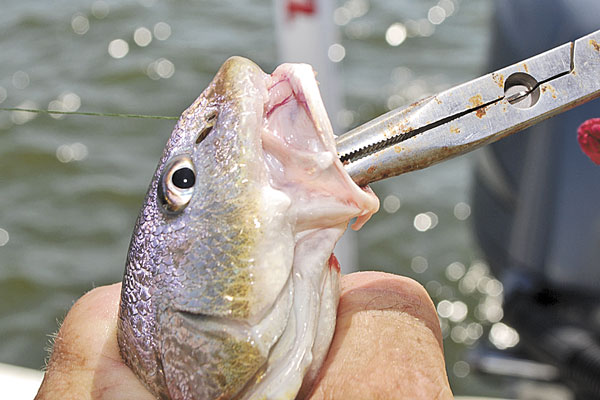
Another thing that sets the two species off from the rest of the members of the drum family is their incredibly underslung mouth. The word that biologists use to describe its location is “subterminal,” and it is even more subterminal than that of the redfish. In fact, it would do a sturgeon or a freshwater sucker proud.
The location of the mouth makes it a supreme vacuum cleaner for nabbing food items from the bottom, but its location, coupled with its extremely small size, makes it a very difficult fish to hook.
Kingfish are very common in coastal waters, and are aggressive predators. They will hit large plastic baits fished near the bottom with abandon, but because they are so difficult to hook, all the angler feels are the pecks and thumps, which most people attribute to croakers.
Because they are common and not shy about biting, they are an ideal fish for breaking kids into fishing. Bits of shrimp on small hooks fished near the bottom in and near passes will usually produce plenty of action. Because they are not choosy, after the first one is caught, it can be cut up for cut bait and just as many if not more kingfish can be caught on it as on as shrimp. Be sure to leave the skin on the cut bait, because it is tough and many fish can be caught on one strip.
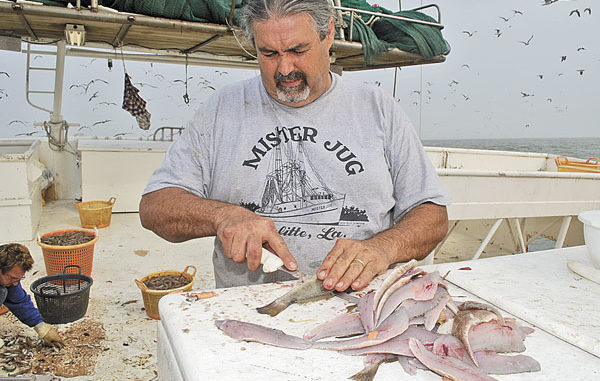
Kingfish are small, but large enough to fillet. They have a lean, pinkish-white flesh that is much firmer and tastes better than any other fish in their family, including trout. Kingfish also freeze extremely well. Their delectability makes them the fish of choice on commercial shrimp boats, a long-held secret.